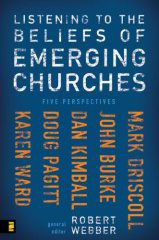
Part 1: Mark Driscoll
Part 2: John Burke
Part 3: Dan Kimball
Part 4: Doug Pagitt
Part 5: Karen Ward
Karen Ward: Communal Theology
Karen’s chapter was fun to read because one can clearly see how important the role of community is to COTA (Church of the Apostles). In her chapter, and in the life of her church, she draws heavily on the work of Clemens Sedmak. He writes on the idea of local theology-making, specifically in his book, Doing Local Theology: A Guide for Artisans of a New Humanity. Sedmak talks about “little theologies” – theologies that arise out of people in community seeking God out in their daily lives. It’s clear that COTA is about the work of seeking after God, and amidst the many local, “little theologies” they may be creating, they are doing some great work.
When speaking of evangelism, Karen writes:
“So, ‘evangelism’ is not something we do to attract seekers; instead we simply invite others to join us and be part of what God is doing in the world around us, and to help us put God’s eschatology into practice in doing justice, loving kindness, and walking humbly with God” (171).
One thing about Karen’s church that has always interested me is their affiliation to not one, but two mainline denominations, both Lutheran and Anglican. Karen is swimming thoroughly in both mainline streams as well as the Emergent stream and she is a great example of how one can be both faithful to a historic tradition, while looking forward and not just being interested in maintaining the status quo or trying to “renew” old faith. She writes:
“‘The wisdom of past ages without a vision for the future is irrelevant, but a vision of the future ignorant of the lessons of the past is irresponsible’ (from the COTA website). The practices of those who have come before us in the faith are deep roots that support us as we grow together toward God’s future.
We value the traditions handed down to us that are of the gospel. We hold them as treasure entrusted to us for future generations. We will use them creatively to illumine the path we are walking within the emerging culture and toward the kingdom of God” (179).
I was very appreciative of her chapter, and so was very frustrated by a few of Driscoll’s comments in response to her chapter. First, he goes off on the issue of women in ministry. C’mon. After reading the chapter of the only woman contributor to this book, Mark goes off on how Karen is an “unmarried woman who is the senior and only ordained leader in her church” (184) – as if it is any of his business. Then he condemns her for not using enough scripture in her chapter:
“Karen’s chapter raises the important question of what exactly is the level of authority that Scripture holds in the church. Karen’s chapter uses only three Scripture references, an old worship song, an indie rock band, a postmodern philosopher, a church blog, a movie, an obscure theologian, and Hindu Ghandi as her authorities…she quotes the poet Rilke, saying, ‘God speaks to us…out of our own lives, no less so than God speaks to us in the canon of Holy Scripture…’ at the risk of stating the obvious, before we drop the authority of Scripture, we need a better reason than a poem from a non-Christian whose mother wanted a girl so badly that she called him Sophia and made him wear girls’ clothes until the age of five” (184).
I put this quote in just so that you all could see ridiculous some of his statements are. First and foremost, for anyone who is engaged in reaching out to today’s postmoderns, I think a chapter that uses scripture, culture, poetry, philosophy, online media and music as ways to reach out to people will be much more accepted than someone who insists on using over 174 footnotes of Bible verses.
Furthermore, Driscoll’s inane anecdote about Rilke just goes to show his homophobic tendencies and his fear of any type of masculinity that looks different from his own, uber-macho masculinity.
But, before this becomes yet another Driscoll tangent, I should end.
Related posts:
- Theology Pub in Livermore
- Jesus, the Bible & Homosexuality, by Jack Rogers: Chapter 1
- Jesus, the Bible & Homosexuality, by Jack Rogers: Final Thoughts
- Jesus, the Bible & Homosexuality, by Jack Rogers: Chapter 3


{ 2 trackbacks }
{ 31 comments… read them below or add one }
whoa now…easy on the driscoll…he’s human too, you know
So…Interesting analysis of Karen’s chapter. I need to get this book myself and read it through…if nothing else it sounds like a good and challenging read for the church today.
/Adam, you really don’t get Mark. Period. You don’t get him. You don’t get why he is so theologically orthodox, you don’t get why he sees the world in blacks and whites, you don’t get why he is passionate about scripture as the sole authority of the church. Until you open you mind to why people think like Mark, you will sound ignorant in your condemnation. Granted, your ilk will appreciate your attacks, but it wont make you respected, even in the so-called “postmodern” culture which you like to talk about.
Adam,
Why is it you get so angry at Driscoll and call his opinions “ridiculous?” Seems so narrow minded. Just because he does not agree with you does that give you the right to be unfriendly and dismissive toward his position? I mean you write post after post about being progressive, conversational, friendly, open minded, and inclusive, but it does not seem you really mean that. Do this words and concepts only apply to the to the boundaries of your own theological convictions. The book is set up so that the authors analyze and make comments on the other person’s writing, that is the whole point of a “counterpoints” book and for that matter a conversation.
You are also off base to say that Driscoll’s comment about Karen’s lack of scripture usage is out of place when it comes to reaching young postmodern people. Last time I checked Driscoll is in the SAME city as Karen and seems to be a fantastic job at reaching young, postmodern people. I am not saying that size is the only measurement but to say that Karen obviously knows how to reach postmodern and Driscoll doesn’t just does not hold up to the facts. Once again it could be that Karen’s methodology fits better with yours so you judge Driscoll’s through that lens. Books like “Listening to the Beliefs of the Emerging Church” are supposed to be frustrating. But if this is truly a conversation we can not just dismiss those we disagree with and call their views ridiculous.
What exactly about Mark is homophobic? Mark has members who are dealing with same sex attractions at his church,their treated with respect and love,i would say that pretty positive..
As a young man i was part of the bi/gay lifestyle and to find a church where they were willing to except people struggling with these issues was unheard of..
Is it that Mark says homosexuality is a sin that you find homophobic ?if so why, it is…whats ur opinion of Charlene E. Cothran a well known gay activist who recently got saved
“I have recently experienced the power of change that came over me once I completely surrendered to the teachings of Jesus Christ. As a believer of the word of God, I fully accept and have always known that same-sex relationships are not what God intended for us.”
this is the testimony of many of us
What he states about Rainer is a fact,true its slighly flippant..As far as i know Rainer wasn’t gay he was madly in love with Lou Andreas-Salome if memory serves me well..
Mark style is a bit flippent,and its a shame his points are sometimes clouded by a throw away remark..
But the point about the Holy Scripture are valid IF Karen was using the poem to confirm God speaks to us out of our own lives, NO LESS so than God speaks to us in the canon of Holy Scripture , the problem with that thinking what becomes the plumbline for truth?my experiances or urs ..
u see some what precious about Mark lol
So, how does becoming a bigoted myopic “liberal” make you one of the most talked about bloggers in pomo christian blogging? I don’t get it. You share a good word about Karen, make us all think and cause us to open our minds; then you proceed to portray your ignorance in your comments about pastor Driscoll. I honestly don’t get it. This man, like him or not, is doing something new, reaching out to a city hopelessly confused, and sharing jesus with people. When will we, as a community, learn that the gospel is not about our open-minded ambitions, nor our “cyberpunk” talk…but is about Jesus? I honestly don’t get how you can call yourself “progressive”….in the classical sense of the word.
/Anyway, I am glad you have opened your website to talk about these things…but I get the impression that you should save the big-boy talk for people who are educated on such things.
My, Adam, you’re really bringing the Driscoll Kool-aiders out in force…
Apparently it’s OK for Driscoll to bash Karen in the comments, calling into question her right to even hold the position she does, but it’s not OK to call him on it…
Samsonite – As for “big-boy talk” – could you possibly be more condescending? I would make some pot/kettle observation…
driscoll kool-aider?? what exactly did i say to deserve that wonderful title?
I’m not sure what kool aid is, but thanks anyway
Even if we grant that Driscoll is homophobic (which is fine by me) and his supporters are “Kool-aiders” (Christian charity at work here), we still haven’t dealt with the issue of authority, which it seems was the point of Driscoll’s response to Karen (I didn’t get the impression that he was bashing her). What is the authority by which we evaluate different positions and adjudicate between them? As everyone has noted, Driscoll is unrelenting in his scriptural footnotes. Ward has a variety of authorities to which she appeals. Would it be accurate to say that we are therefore dealing with “paradigms” which are incommensurable? If so, on what basis can we really be critical of Driscoll for criticizing Ward but not be subject to the same criticism ourselves? If not, what is the common ground between the different positions by which we can evaluate them?
IMO Mark is correct when he says “at the risk of stating the obvious, before we drop the authority of Scripture, we need a better reason than a poem from a non-Christian”..
But to be fair to Karen i’m not sure she was lifting Rilke’s poem to that degree..The rest of his comments were somewhat flippant..
But the kool aider post because someone disagrees with u or adam, seems as petty as Mark sarcastic comments,its all BS
Ringo & Samsonite: I know not all people here use their actual names, and I haven’t been really pushing any comment policy, but I think that it would be more helpful to the conversation if you used your actual names. Especially since you are both PTS students, and next year when I’m actually on campus, it might help with the conversation to know who is actually leaving comments, instead of having to guess who Ringo is or who Samsonite is.
Just a thought.
And, I’m with Dave. If Mark feels like he can bash Karen (that’s my perception, I don’t know how Karen took it), I feel like I am allowed to make a few pointed comments re:Mark here on my blog.
And Samsonite…your comment makes any conversation with you here on this blog, or in person, sound like a real “joy.”
For those of you not getting the Kool-Aid reference, I suggest you peruse the following:
http://en.wikipedia.org/wiki/Jonestown
And before you all get carried away debating the finer points of authority, I remind you that Driscoll doesn’t even think Karen Ward is entitled to be a priest (pastor, minister, whatever). His views on the matter of female religious leadership are public in his own words in a wide variety of forums (SPU debates, his own blog, books.)
His comments on his blog about the Episcopal Church electing a female Presiding Bishop (a post he has since removed – how “authentic” is that?) were totally unacceptable in any supposed “leader” and disqualify him from any kind of protection from criticism.
In fact, that’s what I find so amusing about his disciples – he has rampaged about like a mad bull for several years now, criticizing all comers on a regular basis, but somehow you guys (and I guess only guys qualify) just can’t see it.
Dave, you seem awfully certain that supporters of Driscoll have taken Kool-Aid, but have you considered that perhaps you’ve taken some as well? Are you even aware of how references to Kool-Aid make you look like one who is less interested in having a reasoned discussion and more like one who is interested in throwing stones at those with whom you disagree? As I attempt to ask questions (which nobody even tries to answer), and take part in the “conversation” everyone claims to be having, the only responses are labels, which suggests that the emerging church is more new kind of Pharisees than new kind of Christians (though there are definite exceptions to this).
Timbo, you want answers? We got answers…
Quite possible. I wonder why Driscoll even wanted to participate in the book, except that it appears to have given him yet another chance to take potshots at the other authors (let’s not forget, for instance, that he has frequently referred to Doug Pagitt disparagingly as Tonto, i.e. “Lone Ranger” Brian McLaren’s sidekick).
I think we can safely say that if Driscoll wants to throw toys out of the crib it’s fair for anyone else to take him to task for it. Let’s face it, he doesn’t play nice in any forum. Why should he, or his apologists, expect to be treated any fairer?
In this case Driscoll has a 100% faith in the Bible and 0% in anything else. Most people can find some merit in just about anything, from 0.1% to 99.9%. And most people are intelligent enough to distill the good and interesting from the bad and stupid. Mark is a one trick pony. If the pony is Jesus, that;s one thing, but usually the pony is just Mark’s ego.
You’ve got me there, but Driscoll is the one who sets the parameters. If you’re not 100% for him, you’re deemed to be 100% against him. Really, have you ever listened to the SPU debates on the role of women in the church? (guess what Mark had to say…)
Also telling is the fact that Driscoll’s blog has been gutted of 90% of the obnoxious posts he’s made over the past few months (including the Episcopal Church ones).
Honest? Open? Or a sudden realization that he wasn’t doing himself or his church any favors, PR-wise, and a hasty retreat was deemed wise?
Plus, he was abruptly relieved last fall of his co-authoring of the Seattle Times religion column in the wake of a slew of publicity on his Neanderthal views on the role of women in society. It was a mercy killing really, though. His columns were absolute crap – not even controversial, just crap.
“I wonder why Driscoll even wanted to participate in the book, except that it appears to have given him yet another chance to take potshots at the other authors….”
Perhaps Driscoll was asked to contribute his beliefs and he wanted to explain them. Or is it better to assume that because he struggles with tact that taking “potshots” was his only reason? Again, it all comes back to charity, and I don’t get the sense that you have any.
“I think we can safely say that if Driscoll wants to throw toys out of the crib it’s fair for anyone else to take him to task for it. Let’s face it, he doesn’t play nice in any forum. Why should he, or his apologists, expect to be treated any fairer?”
So if Driscoll has a difficult time playing nice everyone who agrees with his theology is a Kool-Aid drinker? Are we exempt if we dislike that Driscoll has gone over the top, even though we hold (many of) the same views that he does? Again, you’re just as bad as he is.
“In this case Driscoll has a 100% faith in the Bible and 0% in anything else.”
Are you certain of this? Are you 100% certain of this, or only 99.9% certain?
“You’ve got me there, but Driscoll is the one who sets the parameters.”
And I thought it was Christ who set the parameters. You think it’s Mark.
Look, Dave, you may not agree with anything that Driscoll stands for, but when you so cavalierly refer to those who do agree with him as Kool-Aid drinkers and fail to attempt to understand them, you come across as just as much of a $#@! as you say Driscoll has been.
So Mark’s rude about Karen, ur rude about Mark, people defend SOME of Mark’s comments and ur rude about them,they then get annoyed and come back and are rude about u
awwwwww Christianity what a family
I guess some people would argue that Mark started this by making comments about Karen in the first place..Stating Biblical facts may be upsetting,even offensive to some,but does that mean we shouldn’t risk offending people by speaking the truth?
If Karen is the head of her church,Mark was right to say what he did,if she agrees that other sources are as important to a Christian as the Bible then she is wrong..If thats why Mark’s considered rude,then he shares that honor with some pretty awesome Christians through history along side Biblical Characters
I think the bottom line to all of this, is that many of us are tired of hearing about how diverse, friendly, conversational, and open the emergent church is, but the practices seem so much different. It all comes down to how you define conversation. Do you see it as just talking to other people who agree with you, and calling names to those who don’t (like Adam did in this post)? Or do you believe conversation is willing to be exposed and open to views that differ from your own? I know that many in the church may not like Driscoll’s view on women in ministry but it is not like his view is a fringe one. And even if you do not like his view does it give you the right to really just attack him? I hope emergent has more to offer than that.
to Adam and Dave i think i should apologize if i was rude i’m sorry..u have ur take on things and i have mine..
i was just reading ur blog and my eyes fell on the recent comment “He is Risen” which really is the bottom line..hope the rest of ur Easter is great GB
Just to wrap up my participation in this, you all seem to think that I’m an Emergent apologist, which I’m not. I’m a mainstream Episcopalian – a denomination that’s been around about 500 years.
I find the Emergent movement participants to be mostly post-Evangelical, post-fundamentalist, which is a struggle I don’t share. In fact, many of the practices Emergent has latched onto have been in pretty constant use by the historical church (i.e. the church that existed prior to the rise of 19th century North American fundamentalism), so I’m intrigued to see how that plays out.
It helps that Emergent has some articulate spokespeople who are willing to put their ideas on the line. One problem with that has been the emergence of the cult of personality – inevitable in any human enterprise – where the few spokespeople get put up on a pedestal, etc.
My main beef with Driscoll is actually his numerous comments about the Episcopal Church last year (comments which, along with many other controversial ones, have recently been deleted from his blog.) Given that the Episcopal Church elected a female Presiding Bishop last year (the incident he derided) that has, and will continue to be, something I will respond to. Given that Karen Ward is a) half-Episcopalian (she’s sponsored by the Lutheran and Episcopal churches), b) an ordained female, c) has a church within a rock throw of Driscoll’s and d) is a friend of mine, that causes me to speak out more than I might.
Andy’s comment “Stating Biblical facts… (about the ordination of women)” it’s obvious you guys are pretty closed-minded about the issue. Pretty much like Driscoll. That seems to be the crux of the matter here. As usual, it all comes down to how we interpret the Bible.
Fundamentalist/creationist/literalists are never going to give it up, and won’t even acknowledge there’s a huge body of scholarship through church history that says there are other ways to interpret the Bible. You won’t even acknowledge that your own little corner of the ecclesiastical world is a construct mostly of 19th century North America.
Given that it’s not even debatable for you, how do you have an intelligent conversation about it?
I didn’t say i disagreed that a woman could preach,teach Theresa Conlon springs to mind at Time Square,the only thing i disagreed with was as the head of a church..Thats what i believe,if that upsets you i apologize..But all i’m saying is what i believe,and except you have the right to believe differently..
As far as “it’s obvious you guys are pretty closed-minded about the issue.” implies your open minded and could be persuaded to change ur mind hmmmmm
Are all Emerging Church people like you guys and this website simply pro gay because you are biblically illiertate or do you simply refuse to listen to scripture and allow it to dictate your convictions, actions, and theology on the subject.
You guys seem pretty smug and close minded about such subjects when you are confronted. Just giving my 2 cents for those who will email me their rants, raves, and simple minded ploys to lure me into a discussion of baseless theology and limitless cultural interjection about the things scripture clearly dictates.
Heh.
Dave, I think you nailed it. How exactly does one have an intelligent conversation with somebody who is so close-minded that he fails to even consider that those of us who have a strong view of the authority of Scripture may not necessarily be fundies from the 19th century? Ever hear of Sola Scriptura? The Westminster Standards? The reason that I “won’t even acknowledge that [my] own little corner of the ecclesiastical world is a construct mostly of 19th century North America” is because it isn’t! Exactly how could I have an intelligent conversation with you, Dave, “[g]iven that it’s not even debatable for you” that I am a “Fundamentalist/creationist/literalist”? Open your mind!
The difference, my dear Timbo, is that while I may disagree with your reliance on Luther and Calvin (and the 19th century american fundies who elevated their work to an art form), I don’t deny that you are, in large part, Christian.
I disagree with you about many things, but not that. You and your fundie friends however, do not reciprocate, preferring to label anyone not within your domain (and quite a limited part of the Christian spectrum it is) as heretics.
And here’s a conundrum for you – how come there are five Solas? Surely if you need something “alone” there can’t be four other things you need. Which of these five things you”only” need are the most important? I think grace is up there, but feel free to explain (174 biblical footnotes would be nice. I’ll send your grade by return of post.)
And Sola Scriptura in and of itself is the ultimate piece of circular logic, isn’t it?. If God designed logic, she surely wouldn’t have left such a gaping hole in it, would she?
I have spent a fair amount of time in ecumenical ministries, so I’ve been exposed to pretty much the entire gamut of belief, from fundie fanatic to liberal wacko and everything in between. Most people are well into the “in-between” category and I’d say that I can work well with most people.
However, by far the most obnoxious are the argumentative fundies who are so certain they are right they believe it gives them the right to act like asses, purely because they are “right”.
“The difference, my dear Timbo, is that while I may disagree with your reliance on Luther and Calvin (and the 19th century american fundies who elevated their work to an art form), I don’t deny that you are, in large part, Christian.”
Dave, where have I denied that you are a Christian? Perhaps Driscoll has, but I haven’t. Moreover, if he has, then I think that he is wrong for doing so! I think there is room to disagree, even strongly, about things within the context of what C.S. Lewis referred to as “Mere Christianity.” Augustine (or was it St. Francis?) put it well: “In essentials unity, in non-essentials liberty, in all things, charity.” I’m still waiting for some charity from you, Dave.
“You and your fundie friends however, do not reciprocate, preferring to label anyone not within your domain (and quite a limited part of the Christian spectrum it is) as heretics.”
Me and my fundy friends? A lot of my friends worked at Calvin Crest, a camp where Adam also worked. It’s Presbyterian, and hardly fundamentalist. Moreover, I cannot help but note the irony of you complaining about me and my “fundy” friends (which friends are those?) labelling those not within our domain, yet you are the one who’s labelled me (us?) as fundies! I’m still waiting for some charity from you, Dave.
“And here’s a conundrum for you – how come there are five Solas? Surely if you need something “alone” there can’t be four other things you need. Which of these five things you”only” need are the most important? I think grace is up there, but feel free to explain (174 biblical footnotes would be nice. I’ll send your grade by return of post.)”
If that’s your criticism of the five Solas, then it’s clear that you don’t understand them. I really don’t want to debate these (so I’ll bypass your charge of circularity), but here is a short summary:
Sola Scriptura: Scripture is the sole authority for Christian doctrine.
Sola Gratia: Grace is the sole cause of salvation (i.e., not our works).
Sola Fide: Faith is the sole means through which justification comes.
Solus Christus: Christ is the sole medaitor between God and humankind.
Soli Deo Gloria: God is the sole agent to which we are to ascribe “glory.”
Given that each has a different referent, they are clearly not contradictory.
“I have spent a fair amount of time in ecumenical ministries, so I’ve been exposed to pretty much the entire gamut of belief, from fundie fanatic to liberal wacko and everything in between. Most people are well into the “in-between” category and I’d say that I can work well with most people.”
That’s weird because I am constantly exposed to pretty much the entire gamut of belief myself, and I work well for them (or most of them), even as I nevertheless disagree with their theology.
“However, by far the most obnoxious are the argumentative fundies who are so certain they are right they believe it gives them the right to act like asses, purely because they are “right”.”
I’ve encountered the same kind of people, and they do at times make me embarassed to be Reformed theologically. At the same time, though, I am convinced by the arguments for Reformed theology, and thus accept it on that basis. The irony of your statement is that you seem convinced that everyone who accepts Reformed theology is a fundie, and you believe (“are so certain”) that it gives you the right to label them as such. I am still waiting for some charity from you, Dave.
I read a great of Mark D.’s web-published materials, on his church website, blog, listened/watched sermons. I respect the fact that he is consistent. He doesn’t take issue with things that have no biblical warrant (drinking in moderation, etc.). I will grant that what he goes on about are things that can actually be found in the Bible.
Two things: my issue w/ Mark is that he seems to leave little room for the idea that one can disagree with his interpretations and remain within the boundaries of orthodoxy. On his website, his statement about what he considers the basics of the faith implies that if this isn’t what you believe, you aren’t a Christian. He may not think that, but there is the implication. For instance, I suspect that Mark believes that belief in the Penal Substitutionary View of Atonement (as taught by Hodge, etc., and modern evangelicals) is necessary for one to be orthodox. This is something that the church through history has never made a litmus test for orthodoxy. I also think that the statement that Mark’s ideas stem from 19th century American concerns is true. His theology (except on baptism, interestingly enough) is straight Princeton School.
While Mark is more moderate and pastoral in his preaching (that I have seen/heard), the fact is, he does come across in much of what he writes as a jerk. he strikes so many people the wrong way that I think he should take a look at how he communicates. Sometimes it’s funny, but mostly it’s just rude.
I have noticed a tendency amongst some to emulate the style of the Reformers, who were frequently very quick with the barbed remark or mocking insult. That kind of communication is not respected within the bulk of our culture the way it was in cultures of the past.
I would also note that on the Mars hill website, it is stated that anyone that disagrees with the leadership should find another church. This suggests that Mark does believe that if you don’t agree with him, you can’t fellowship with him or his church, which would suggest that he also doubts your Christianity.
Brian I have to disagree with you. If you listen to Driscoll he says all the time that the church has and “open hand” and a “closed hand” when it comes to theology. In the closed goes things like, trinity, exclusivity of Jesus for salvation, authority of the Bible ect. He goes on to say that the atonement is not just one sided by multi-faceted and have many different aspects to it, ala Demerest/Lewis. There are plenty of people at his church who do not dot all their theological issues in the same manner he does, but the church does place a high value on theology and their congregation is actually more nuanced in these debates than most. Besides most churches, and people who join churches want to have agreement in theology, and mission at least at a basic level, for membership. Why do you think their are so many denominations?
Again, these are impressions. i know from my own experience that there is often a difference between how nuanced public statements are and how things are talked about “amongst family.” My point was simply to suggest that all the people who have encountered the public face of mark Driscoll and Mars Hill, via books and the web, are not reacting unreasonably when those things, taken together, form a negative impression of Mark.
My impression (as someone who is about Mark’s age and also in ministry) is that some of Mark’s bravado will be tempered as he grows older. It is easy to forget that he has a large church and a lot of national attention for someone who is relatively young. You can stand uncompromisingly for all the things Mark stands for, just as forcefully, and not alienate people the way he does. He alienates a lot of Christians.
a VERY late contribution to this discussion – but what struck me (having just read this book) is how wide the contributions are – not dissimilar to the struggles in the early church perhaps :)