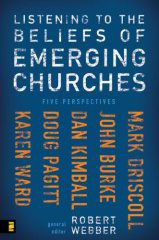
Listening to the Beliefs of Emerging Churches: Mark Driscoll

April 2, 2007 · 45 comments

in Books, Emergent, Theology

Listening to the Beliefs of Emerging ChurchesPart 1: Mark Driscoll

Mark Driscoll: Biblicist Theology
I just don’t get this guy. I really wonder why Zondervan asked Driscoll to be a part of this book, and I have to wonder why Driscoll said yes. Mark apparently thinks that the number of Biblical citations is directly proportional to how faithful his chapter actually is to scripture? Seriously, he has 176 footnotes, 174 of which are practically lists of Bible verses for a 14-pg chapter. It also seems as though Driscoll has an unhealthy need for power; Driscoll mentions numerous times about how a major point in his essay is to show how “The Christian revelation of God is distinct from and superior to all other views of God” (26) and “But the fact remains that Jesus Christ is distinct from and superior to all other religious leaders and their religions…” (27). Later on, in response to John Burke’s chapter, he writes again, “It is imperative that we remain steadfastly committed to articulating the reasons why Jesus is distinct from and superior to all other religions and religious leaders” (71). What is his deal with this power trip?

We all know that Mark is a big penal substitutionary atonement guy, and he definitely shows his colors in this chapter:

“Many people warmly recollect the kind deeds of Jesus, such as healing the sick, caring for the poor, and feeding the hungry. Many people also appreciate Jesus’ teachings related to doing good deeds and being loving. But it is the death of Jesus and what it accomplished that is the most controversial aspect of Jesus’ life and ministry, because it is the most important” (29).

There it is – Jesus’ life, ministry, care for the poor…nope. Let’s focus on the most important thing: Jesus’ death. I am all for the theological diversity that exists within Emergent and the emerging church discussion, but I just don’t get what Driscoll’s deal was with this chapter? Was this so he could show the chapter off to his buddies like John Piper and Douglas Wilson – to show that even an uber-conservative, Reformed, fundamentalist self-described biblicist can shed the light on the emerging errors? I really just don’t get it, and I had to nod in agreement with Doug Pagitt, when he wrote in response to Mark, “At times I found it difficult to read Mark’s chapter” (43).

Related posts:

{ 6 trackbacks }

Listening to the Beliefs of Emerging Churches: Dan Kimball | pomomusings | progressive theology & design
April 4, 2007 at 7:01 am
Listening to the Beliefs of Emerging Churches: Doug Pagitt | pomomusings | progressive theology & design
April 5, 2007 at 7:00 am
Listening to the Beliefs of Emerging Churches: Karen Ward | pomomusings | progressive theology & design
April 6, 2007 at 7:00 am
Listening to the Beliefs of Emerging Churches: Summary | pomomusings | progressive theology & design
April 7, 2007 at 7:00 am
Power of Suggestion » Listening to…Emerging Churches, Part Deux
August 2, 2007 at 1:13 am
Mark Driscoll, this Wink’s for you. | pomomusings | progressive theology & design
September 24, 2007 at 4:35 pm

{ 39 comments… read them below or add one }

1 Wess Daniels April 2, 2007 at 10:02 am

Adam,
lovely review! A friend read aloud some of this chapter the other day while we were at school and we were both scratching our heads at what Mark wrote. For one, I was astounded at his ability to proof-text. I also didn’t really see the connection between what he wrote about the emerging church? If anything I am under the impression that he showed what the emerging church isn’t.

Reply

2 Truth Seeker April 2, 2007 at 10:07 am

But isn’t that what being an emergent is all about? Dealing with the hard and difficult stuff that rocks your worldview boat? At least that is what the emergents want the fundementalist conservatives to do…right? So why is it not okay for someone to rock the emergent boat?

I happen to agree with Driscoll and less with Pagitt on the Substitutionary Atonement aspect of Jesus’ life. Without this, and the resurrection, Jesus’ life is nothing but a life akin to Ghandi, Mohammed, and every other joe-schmoe walking around. Sure Jesus preached being kind to the poor and all that other good stuff, but so did Ghandi, Mother Teresa, and >. But what made Jesus distinct is the goal and reason he was even here. Yes, he did come to usher in the kingdom of God and to teach us how to be good people. But his ultimate goal was to make atonement for mankind’s sin to appease an angry God, His own Father. It was promised in Genesis that a way would be made for man to come back to God. It is in Jesus that this is fulfilled.

Driscoll, while I don’t agree with everything he says, is spot-on right with this one. I just hope emergents will follow their advice and wrestle with the hard issues. It’s one thing to feed the poor but its another to wrestle with sin and the death of holiness.

Blessings,

Reply

3 Boo Hoo Hoo April 2, 2007 at 10:39 am

Substitutionary Atonement. Sounds like a party! What a complete ball of fun this Emergent crowd is.

Can’t wait to get my hands on this.

You think they’ll make an action film out of this one or wait for the sequel?

You know, I went to my work party the other day and this is exactly what they were talking about. You know, Superbowl, Final 4, Crisis in Iraq, Substitutionary atonemen.

Reply

4 Timbo April 2, 2007 at 10:54 am

So, the first complaint is that by repeatedly pointing out the uniqueness of Jesus Christ, Driscoll is on a “power trip,” and the second complaint is that by focusing on the penal substitionary nature of Christ’s atonement, Driscoll has forgotten about ministry, care for the poor, etc. Talk about missing the point! Perhaps the reason for pointing out Christ’s (and Christianity’s) superiority to all other religious leaders (and religions) is precisely because Jesus does more than simply care for the poor and offer high (and good, to be sure) platitudes. Truth seeker is right. If Jesus was simply a good moral leader, Jesus is not that far off from Gandhi, et. al. But Gandhi doesn’t save anybody from anything anymore. That Christ has indeed saved His people from their sins is a very strong indicator that He truly is “distinct from and superior to all other religious leaders and their religions,” as Driscoll has said. Saying this is not exercising some “power trip” but is the core of Christianity: salvation comes through Jesus Christ and Christ alone. What is the point of being a Christian as opposed to a Gandhi follower?

Reply

5 Mykel April 2, 2007 at 10:59 am

While I have not read the book, I do find it facinating that you only had so critical review of Mark. We all know you do not like his theology so why harp on it?
I thought emergant was about letting people speak their mind? That there are many views on Christ and it’s ok if we all just accept everyone?
Sounds hypocritial of you to blast a guy for just saying what he believes. What makes Emergant right and Driscoll wrong?

Reply

6 gus April 2, 2007 at 11:11 am

Adam, for someone who embraces Driscoll as a fellow Christian, you sure have a lot of venom for whenever you can single him out.

Reply

7 Amanda April 2, 2007 at 11:11 am

I use your theme and I love it and then discovering you and I have similiar interest for many years I was going to goto school for theology to become a biblical anthropologist so I am definitely coming back and reading your opinons!

Reply

8 Dan Morehead April 2, 2007 at 12:02 pm

Even if (and I see no need for this) we were to focus solely on Christ’s passion and ressurection [...while Adam mentions "Jesus’ life, ministry, care for the poor," it is worth noting that our early witnesses to the person of Jesus of Nazareth do tell their stories with the passion as the climax, even though the Kingdom of God does not dawn with the death of Jesus but with the Incarnation, which is to say, not his death, but his coming...] wouldn’t Easter trump Good Friday as an, if not the, important locus in the life of Christ as far as significance for the church is concerned, even if Good Friday is the necessary precondition for Easter?

All that is to say that I share Adam’s uneasiness with the focus on the death of Jesus.

Reply

9 melissa April 2, 2007 at 12:17 pm

I don’t think that I’m being particularly conservative about my Christian faith when I believe that the uniqueness and then the ultimate power of Christ’s life and ministry necessarily reside in a theology of his death. Christ’s death is a reality of Christ’s life and ministry, and while it may embody different associations for different people, is it not yet important – and definitive/unique! – that Christ, in full humanity AND full divinity, died? And even that he rose? (I commented on a different post here earlier this spring that I struggle with constructing a theology of the resurrection, and yet I can’t deny its importance!) I feel that I can, as a Christian, assert the ultimate significance of Christ’s death, whether or not it is within the context of one particular atonement theology or another.

If we ONLY focus on Christ’s death, then we have an incomplete (and perhaps overly-spiritualized or over-sentimentalized) picture of the importance of the incarnation. But if we ONLY focus on Christ’s life and ministry, then we are also incomplete in our understanding of the meaning of Christ. Our understanding of Christ needs to include all parts of his life, ministry, death, and resurrection. And yet can we in faith emphasize one part over another? I admit that I haven’t yet solved this question for myself.

I suspect that your problem with Driscoll’s problem is that he uses the words “most important” when referring to Christ’s death. Does this wording, however, necessarily imply that Dricsoll finds the ministry of Jesus UN-important? I understand how one might disagree that we could claim either Christ’s life or death as more important than the other, but I don’t think that choosing one emphasis over another necessarily means we have rendered the other parts of Christ’s life unimportant or disposable.

Reply

10 Marissa April 2, 2007 at 12:27 pm

Putting aside his shock jock antics and hypermasculine personal style, doesn’t Mark “The death of Jesus is the most important” Driscoll stand on the shoulders of Paul “I decided to know nothing among you but Christ crucified” Tarsus?

Reply

11 Truth Seeker April 2, 2007 at 12:46 pm

Marissa,

Yes, Mark and others are standing on the shoulders of Paul of Tarsus, just as Martin – Christ is an example…in his death, he is a sacrifice, satisfying for our sins – Luther .

Oh and we cannot forget the emergent favorite Thomas “Bear the Cross and it will Bear You” a Kempis!

Man, how we stand on shoulders of giants and yet we doubt that they truly stood firm.

Blessings

Reply

12 jazzact13 April 2, 2007 at 2:56 pm

Where in the quotes does Driscoll show a ‘power trip’? Are not Jesus and Christianity really “distinct from and superior to all other religious leaders and their religions”? If such is reality, then why is the writer of such a statement subjected to abuse on what I assume to be a Christian website?

Also, among Christian, I cannot see the controversy over the statement that Christ’s death is the most important aspect of his life (though I would also put in His resurrection as a part of it, too). Such a statement does not equate into an minimizing of His life and teachings and deeds.

Reply

13 RJ Steve April 2, 2007 at 3:39 pm

Mykel said, “I thought emergant was about letting people speak their mind?”

Actually, emergent is about letting people speak your mind.

Reply

14 Chris TerryNelson April 2, 2007 at 4:37 pm

While I’m not about penal substitution, I think substitution itself cannot be ruled out given the biblical witness. Protestants need to recognize that to throw out substitution altogether gets rid of Christ as Our High Priest (read that much neglected book called Hebrews), and thus cuts away our Jewish roots. Furthermore, ecumenically speaking, Catholics and Eastern Orthodox will have nothing to do with us. If violence is what we’re worried about, perhaps it would helps us to remember that it is God who is both the priest and the sacrifice. Nothing could be more non-violent in my opinion.

Reply

15 Madison April 2, 2007 at 5:10 pm

I don’t understand. The emerging church seems to be covering up truth with thing we find appealing.. people are pleased that they don’t have to do certain traditions.. but don’t you think that at somepoint; God wants us to sacrifice as his Son sacrificed for us? Shouldnt Christianity be more about exact truth rather than gifts & things that might please us???

Does this make sense?

Reply

16 Steven Good April 2, 2007 at 5:18 pm

The health of a pluralistic society depends on robust statements of belief. The problem with most of us Westerners is that we arrive at pluralism via relativism (i.e. because we can’t really know anything, religious beliefs are relative – so it is best to have as little doctrine as possible, or to be indifferent toward the doctrine we do have). That, however, is an intellectual bridge which need not be crossed. As Christians we are claiming to see something not only different, but also true about the nature of God in the person of Jesus Christ. That does not mean we cannot affirm the truth that we see in other realms (all truth is God’s truth). So arguing for the superiority of Christianity (and Christ) is not necessarily an anti-pluralistic sentiment (although Driscoll may intend it to be such), but it is surely an anti-relativistic one.

The Second Vatican Council gives this point clarity in the document Dignitatis Humanae. Essentially it argues that because religious faith is so important and not relative, it cannot be constrained. However, it is precisely because religious faith cannot be constrained (and should never be) that it needs clear creedal formulations in order to provide continuity from generation to generation. While I find great swathes of Driscoll’s hyper-Calvinism problematic, and his personal machismo entirely unbearable – as a Christian (and a Presbyterian one at that) I certainly don’t have a problem with his Christocentrism. Using words like “superiority” might jam a spoke in the etiquette of polite interfaith dialogue, but nothing will be gained in a pluralistic environment if Christians surrender the conviction that God was in Christ reconciling the world to himself in an utterly unique and profound way.

Reply

17 Adam Walker Cleaveland April 2, 2007 at 5:29 pm

Truth Seeker (and others). Yes, I suppose that some of what I’m saying goes against the openness and willingness of Emergent to converse with those whom they disagree with. I do commend Doug Pagitt, Dan Kimball, Karen Ward, John Burke and Mark Driscoll (all of whom have very different theologies) who have written this book together and are going on a speaking tour together to discuss this book. I think that’s some good stuff, and I’m glad they’re able to do it.

I just get frustrated with Driscoll (and Mars Hill Church) for a variety of reasons, not all of which I will go into on this site. However, it’s mainly over theological issues, particularly when it comes to Driscoll’s view of women in the church, of homosexuality and just his general demeanor.

Driscoll is entitled to his opinions…no doubt. And I don’t know that I was necessarily having a problem with calling Christ unique. I believe that interfaith dialogue is extremely important and the church should be doing much more of it. But I’m not talking about the kind of ‘weak’ dialogue in which everyone kind of comes together and says, “Well…this is what I believe…I guess…but, I don’t really believe it *that* much, I mean — you have a good thing going there too…” I do believe that when that happens, no one’s beliefs are respected and/or honored. But I don’t believe we need to be always playing the “superiority” card – which is where I think Driscoll was going when I mentioned the power trip.

Chris, and thanks for your thoughts. I don’t think I’m entirely against substitution as a metaphor for the atonement. I think there is definitely scripture that points to that, for sure. But unlike Mark – who will say “It’s penal substitution, or…nothing!” – I’m not going to go down that route.

Alright, I’d like to respond to more, but my computer is being shipped off to Apple for some tender-loving-care – so until next week, I’m out. Carry on with the conversation though.

Reply

18 LandonSandy April 2, 2007 at 8:24 pm

I find Mark Driscoll to be annoying in an unforgivable way cause he does it on purpose. For my blood pressure and for the same reason you look the other way when a child throws a tantrum I try to avoid him altogether.

However I think that he deserved a spot at the table of Christian mover and shakers… that is until he doesn’t bring any potluck, calls the rest of the family names, and storms out year after year. We should take the fact that he thinks our family is superior to be a rare complement.

Reply

19 dave paisley April 2, 2007 at 9:37 pm

Um, surely it isn’t Jesus death that is “the most important thing”, but his resurrection that sets him apart?

History is littered with millions who died for whatever they believed in. Not so many came back from such a blow.

But then, I’m no theologian. I mean, it’s not like I have a communications degree from WSU or anything.

Reply

20 Big Mike Lewis April 2, 2007 at 10:47 pm

Anytime a group of “inclusive” Christians start talking about who is and is not a “real” one of what they claim is not a movement, it’s time to say like Elijah, “I am no better than my fathers.”

Reply

21 Sellis April 2, 2007 at 11:38 pm

I’ll save comments about Mark’s responses till Adam’s posts on those respective chapters. Like Adam and Mr. Paggitt said, it was tough reading Mark’s chapter. At no real point did I feel Mark engaged me as a reader. With several of the authors, reading their chapter felt like sitting down over coffee (or for Adam, a hookah) and having a conversation. Reading Mark’s felt like having to sit through a lecture from someone who knows you’re thinking is wrong and is bound and determined to set you straight. On a different note, I really aprreciated that Mark restrained himself in this chapter from using his sense of humor. I’ve been fairly offended in the past by his mocking of the arts (especially male artists), women (especially those in ministry), and the working class (thank God he’s not in that any more).

Now theologically, I’m not smart enough to disagree with Mark’s chapter. I mean, he proved it’s accuracy to me on 174 separate occasions with Scripture (p220-224). I’m sure if I took the time to read the couple of hundred references while I was reading through his chapter, my view of the Trinity and of Christ’s death would have expanded a lot. However, just because you go over the top to prove your points to me does not mean I’ll care. For whatever regretful reason, I did not find myself weeping while I read this chapter in the same way Mark did while writing it (21) or the thousands of people who did at Mars Hill when he did his series on Atonement (35).

Adam, I liked, in your response, your comment that you’re not against substitution as a metaphor for atonement, but as the only metaphor. In the story we find ourselves in, McLaren suggests on p102 that subscribing to a single atonement theory is like “trying to see the whole beautiful, majestic sky from one of your…windows.” Trying to see Christ’s death from various theories can give you a little better idea of what the sky looks like, though you’re still bound by the horizon and can never see it all. I think Mark would say it’s more like an eye perscription. The right perscription will allow you to see correctly, and anything else may have general similarities but is going to be blurry and just won’t work.

Mark’s view of the metanarrative intrigued me. He states that the Bible is “the story about the Trinitarian God who created us, mercifully endures our sin, and sent Jesus Christ to live and die in our place, thereby saving us from eternal wrath if we repent of sin and trust in him alone. This is the true Gospel revealed to us by God through Scripture.”(35) For me, there has to be at least of mention of exile, redemption, and a kingdom that is here and still coming more fully.

Good post Adam, I’m excited for the rest.

Reply

22 Peter April 2, 2007 at 11:59 pm

It’s easy to use loaded labels such as “fundamentalist” and “conservative” to advance your point of view. I don’t agree with many aspects of Driscoll’s argument but to casually dismiss his chapter or any other for that matter with such illuminating observations as him having a “power trip” is rather superficial and contrarian to much of the spirit of the emergent movement or more simply, even toward a thoughtful discourse. Having been an interested reader of your blog for the past year, I would expect better.

Reply

23 Chris TerryNelson April 3, 2007 at 12:03 am

A few things of helpful signficance (and I owe all of this to a class on the Eucharist given by George Hunsinger at Princeton Seminary this semester):

Thomas Torrance emphasizes that It’s not death in general, but the person who died that is of significance for the cross. Death is a work of God. Remember, Christ is not just the lamb, but the priest as well.

The Driscoll quote above about the story of the Trinitarian God ends with “if we repent of sin and trust in him alone.” I’m sorry, but the work of God to save has no “if” attached to it, as if we could somehow cooperate with our salvation (faith is dead when it becomes OUR work). “One has died for all; therefore all have died.” 2 Corinthians 5:14 It’s complete, finished. Repentence? Where do I sign?

On the fact that substitution is not the only metaphor, it caught my attention that Romans looks at the cross both in terms of substitution (1-4) and participation (5-8). You can’t have one without the other.

Reply

24 Matt Mc April 3, 2007 at 7:06 am

I can’t say much that hasn’t been said already, but I’d like to stress a couple of points.

First, I do not see how you can deny that Christ’s death and resurrection (together) are the most important parts of his coming. His death is what Isaiah prophesied (Ch. 53), his death is the method by which God sets up the new covenant with his people (Jeremiah 31), his death was foreordained by God from eternity (Acts 2:22-23). His death and resurrection are the point of our faith. They are the events which our salvation depends upon, and without it we simply have good “life lessons” taught by a man who claimed he was the Son of God. It is important to see how his life, ministry and teaching all pointed towards his coming sacrifice that would glorify God by reconciling his people to him (Hebrews 2:14-18).

Second, as has been pointed out, this post is yet another example of why the “emergent conversation” is little more than a figure of speech. Much like the very thing that emergent claims to be against, they show over and over again that they have no time or patience to hear out those who disagree with them. Further, they can only respond with vitriol and condescension.

Third, why are you offended at Driscoll’s citation of scripture? You should be relieved. Reference to scripture in modern-day spiritual “conversation” hardly seems to exist. It is useless for us to discuss our ideas and philosophies of the Christian faith outside of scripture. Without it we have no leg to stand on, and our message inevitably ends up being something antithetical to the Bible because we base it off of ourselves.

It is disturbing to me that more and more people want their truths delivered in such a way that makes them feel good about themselves and in such a way that allows them to validate their own opinions. Christianity is an offense to humanity because of its exclusivity, and because of what it requires of us–to deny ourselves, our nature, and to admit that we are wrong and helpless without the grace of God. That is not and will never be a popular message, but it is one that we must hold to.

Reply

25 jazzact13 April 3, 2007 at 8:40 am

I’m not sure I can agree with the claim that there are no ‘ifs’ in the work of God. I think it is in I John we are told that “If we confess our sin, He if faithful and just to forgive us…”, and in Romans “If you confess with your mouth that Jesus is Lord, and believe in your heart that God raised Him from the dead, you will be saved”. Considering these scriptures, I have no problem with Driscoll’s statement about repentence and faith in God alone.

Reply

26 Kellen April 3, 2007 at 10:32 am

The main problem with books like this is a nasty combination of rhetoric and thoughtlessness. In Driscoll’s case, if Adam is right at all to react so negatively toward it, it sounds like Driscoll has penned a hasty presentation of christology without taking good measure to consider the implications of his thinking and subsequent articulation of that thought.

However, I agree with Timbo above. Claiming Jesus’ uniqueness viz a viz other religions on the earth’s face is the traditional Christian good news. That Jesus came to save the poor, etc., is little reason to worship him as God, which historically, at least, Christians have always and everywhere done. (Anyway, I’m not sure what business one has going to a church and praying to a man named “Jesus” if he isn’t in some way “God.”) Many others have come and gone in this world to do service among marginalized people — e.g., Martin Luther King, Jr., or the Buddha, or Mother Teresa, etc. That I should ever believe that some such person who has come to save the poor is indeed God, and therefore God’s lived language about who God, in fact, is, could emerge only if something were to mark that person as God and therefore not merely a human creature. If I were to believe that such a person were, say, raised from the dead, then I would have good grounds to adore that person as God, for such a thing does not simply happen to human creatures. (I suppose that one could argue that we should worship Jesus apart from his resurrection, but I, for one, am not into the worship of dead people or people who will die, being that they have no power over matters of life and death and are hardly worth supplicating, praising, or petitioning.)

That the “atonement,” or divine reconciliation, was a part of Jesus’ death and resurrection is, of course, debatable. So Dan’s question, Why focus on the death of Jesus? is an important one. I suppose it depends on what we mean by “focus,” and on what we claim Jesus’ death accomplishes. Steven does well to point out Mark’s “hyper-Calvinism,” which probably does tend to throw things into high relief at crucial points. But if Jesus’ death is the death of the Son of God, then it is an extremely important event. That’s not just any person dying on the cross (as Christ has tried to show, I think), but it is God’s Son and therefore God. Jesus’ death is important because it means God takes death into himself and destroys it. As they say, that’ll preach! The good news of Jesus’ resurrection is no good if Jesus didn’t actually die.

But why must he have died such a gruesome, excruciatingly painful death as crucifixion? The tendency of the church to understand that something moral happened on the cross, I think, stems from the fact that in the same way that the resurrection is no mere afterthought appended to the crucifixion, neither is Jesus’ death on the cross little more than a “precondition,” as Dan put it, for Easter. (The Gospel writers, for example, attach prophetic significance to various events surrounding the crucifixion, which make good sense especially when viewed in light of the hopes of someone like Isaiah.) The two events — death and resurrection — stand together in narrative unity, each with its own theological burden to bear.

I would suggest that the atonement is necessary if we are to have any workable concept of forgivness functioning in churches. With a moral influence theory of atonement, in which one encourages humans to do as Jesus did (say, to give one’s life for one’s friends), but which does not establish an above-all, unconditional act of reconciliation that begins in God’s very nature, Christians’ forgiving one another is not likely to catch on.

Barth’s version of reconciliation, however, establishes the grounds for the need of reconciliation in the being of God, beyond the bounds of human control or influence, and gives grammar to the logic of John’s first letter: “We love because God first loved us.” Without God’s eternally prior love in the form of reconciliatory sacrifice (crucifixion), why should I love and therefore forgive my neighbor? Because some dude did that a long time ago? That isn’t likely to be altogether compelling. Knowing that God has forgiven me even before the foundations of the world, however, does have a way of softening the hard, human heart….

I know that Adam would not want to imagine a Christianity without “forgiveness of sins.” I suppose such a religion would look something like the arrogant exclusivism he rightly deplores so often. But in my opinion and in my experience, a substitutionary atonement establishes — rather than prevents or hinders — forgiveness as the wellspring of Christian life.

[I would like to add that I probably spent way too much time working this out, but for those of you who made it this far, please read kindly: any exaggerations or errors are my part are probably really exaggerations or errors, and they should be dealt with as such.]

Reply

27 Big Mike Lewis April 3, 2007 at 11:24 am

It’s funny that the Emerging Church was established out of a distaste for arrogance and not believing that someone could know absolute truth…yet all I see coming from the Emergent conversation is arrogance and reactionary attitudes. Mark may not have it all together, but 174 scriptures…is he really a false teacher? That sure is a lot of scripture to back up what he’s saying. All I hear is people saying, “I can’t go read all of that scripture to see if he’s right.” Maybe they aught to be reading MORE scripture instead of the teachings of men.

I am no better than my fathers…

Reply

28 Sellis April 3, 2007 at 2:11 pm

Big Mike: I’m guessing your comment about reading more was directed at my words about not having the time to read them all. Thank you for that, and I agree that I do need to be in the Scriptures more. However, the way Mark used the Scriptures in his chapter seemed like a concordance to me. Any time there was a word that was found in the Bible, there’d be foot note (174 of them). And many footnotes had multiple references attached, some as many as 30. Also, I may be underestimating Mark here, but it felt to me more like he hired his interns to go through Strongs concordance and find any verses that applied to topics or phrases he included.

Doug, in his response to Mark’s chapter, points out “that declaring oneself a “devout biblicist” does not mean that one uses the Bible in an appropriate manner.” He also is “troubled by Mark’s use of the Bible in what seems to be a reference approach.”(43)

I have attended Mars Hill several times and have enjoyed it. I agreed with a lot of what Mark said, and my disagreements usually were with his method of using Scripture. On one occasion, he championed the fact that everyone on their elder board averaged a six figure income (which he justifed with I Corinthians), and that this was proving the church’s devotion to Scripture that mandates to give, be generous, and to support the pastors and take care of them (which was backed up with 7-8 verses). I didn’t disagree with the verses he used, but I did feel uncomfortable with the way he used them and the conclusion he drew.

As far as the arrongance and exclusivity that all these Emergent folk seem to have, I think Mark does get it worse than most. But I also think he pulls a bait and switch a lot of the time. I feel like he pushes the emerging church and encourages dialogue to the point that it gets him a platform to speak from; then he uses that platform to condemn and distance himself from Emergent as well as from much of what’s going on in Non-Emergent emerging churches. He had the priviledge of being asked to contribute to this book as a voice from within the emerging church, but in his chapter. . .

“I have been greatly concerned by some the aberrent theological concepts gaining popularity with some fellow emerging-type younger pastors” (21)
“This chapter is my attempt to. . .correct emerging error. . .” (21)
“. . .we literally have hell to pay for emerging into false teachers. . .”(35)
“…a new theology does not need to emerge…”(35)

So it’s simply in the context of this book it doesn’t make sense to me and left me scratching my head.

Reply

29 Big Mike Lewis April 3, 2007 at 3:28 pm

I don’t agree with everything Mark says…nor do I agree with everything everyone says. I guess the review here was expected as Adam always bashes pretty much anything Mark says, especially when he gets publicity from it, like a book.

Reply

30 Big Mike Lewis April 3, 2007 at 3:30 pm

Oh, and I’m not trying to pick on any one person. I just think we should take the wheat and throw out the chaff. We should be like the Bereans and search the scriptures to see if what someone is saying is true.

Reply

31 Chris TerryNelson April 3, 2007 at 3:55 pm

Jazzact13-
Thanks for bringing these quotations up. The fact is that there are biblical statements that state objective truths about God’s activity, especially when they use the Greek aorist tense. This means its completed, which rules out any cooperation on our part. Christ’s death on our behalf is just such an example. Where it gets trickier, I’ll admit, is when we start talking about salvation.
It seems to me that if Christ is our High Priest, we live vicariously through Him. Thus, faith is not our work alone but the work of Christ in which we participate. The verses you cite do not necessarily say that “if you don’t confess Christ, then you won’t receive salvation.” Salvation has three tenses, and Paul often moves between talking about our past, present, and future. The point stands that God’s work is done and completed regardless of our response to it, and we have the freedom to participate and response. Whatever we do, we cannot complete our salvation in anyway.

Reply

32 Ringo April 3, 2007 at 4:54 pm

Adam…I don’t know what to say. I think you might benefit from listening to Driscoll’s last sermon, on Nehemiah chapter 1-2. He talks a lot about the Tobiah’s of the world…and I think he is placing many of the blogger nay-sayers in that category- after reading this post of yours, I might agree with him.

By the way, to all the others here. What is so wrong with claiming the uniqeness of Jesus’ death and resurrection for all humanity? If you don’t believe it is unique, why the hell are you claiming to be a Christian? And if you do believe it is unique, why the hell are you criticizing a pastor for making that claim?

Reply

33 Rick April 3, 2007 at 6:25 pm

The emergent church is a false belief system that is trying to corrupt Christianity today. John MacArthur gives a great synopsis of this branch of theology in his new book. It sadens me that a Scriptural author would actually add scripture to his work in this book for the emergent church and back up what he says with Scripture and people would complain about it. Guess what folks Christianity is about the BIBLE not what one WANTS TO BELIEVE. A true Christian will BELIEVE THE BIBLE from cover to cover and try to dilute or distort its message.

Reply

34 Rick April 3, 2007 at 6:28 pm

if you want my email address to discuss this issue it is ssgkrueger81@hotmail.com

Reply

35 Chris TerryNelson April 3, 2007 at 10:26 pm

I have yet to find any Christian or sect of Christians (conservative or liberal) who has a true belief system. Rarely do I find anyone who has a false belief system who is actually TRYING to corrupt Christianity. Having read most of the Emergent poster boys, I can guarantee you that they are not trying to corrupt it.

This brings me to the point about uniqueness: what’s our measuring stick for this?
Hint: It’s not the number of believers, it’s not the money, it’s not the quality of life even.

Is Christianity a religion among many religions? Yes. Is it unique? Only insofar as it testifies to Jesus Christ. Can the accuracy of its testimony be measured in any way that is obvious to the world? No. Why? Because our belief system is one of faith, which is foolishness. Furthermore, as sinners we can never say our religion is superior to others because we don’t practice it.

The only thing that is unique is Jesus Christ. Period.

Reply

36 jazzact13 April 4, 2007 at 8:55 am

Chris TerryNelson–
Thanks for your response. As you said, things do get trickier when we start talking about salvation, and from what I understood of the Driscoll quote in your earlier entry, that was what he was talking about, and was also what the verses I mentioned seemed to be about.

Also, there may have been some confusion on my part about what was meant by a ‘Work of God’. Perhaps I should have considered what may be called our responses to God’s work, or what constitutes participation. I agree that salvation is not a thing we can earn, it is ‘not of works’, but ‘by grace…through faith’. But the Bible also seems clear that we do have some responsibility to respond to God’s offer of salvation, which seems to entail belief and repentence.

Reply

37 Chris TerryNelson April 4, 2007 at 9:20 am

Responsibility is fine with me. Grace is not cheap by any stretch of the imagination (cf. Bonhoeffer, Cost of Discipleship). As long as our response is seen in the wider frame of God’s grace, activated by the Holy Spirit dwelling in us, I have no problem. Salvation goes much deeper than simply being a benefit of our belief that Jesus Christ is the only Son of God whom we need to follow.
“By grace through faith” needs to be understood in light of the new exegesis of Galatians 2:16, which is about the. We are saved by Christ, not by belief. This is a hard concept for evangelicals like myself to swallow, after being brought up on so much “justified by faith” language. However, I think it’s liberating to know that even in my unbelief God is powerful to save. Our faith/belief has typically been considered a work, and this must cease.

Reply

38 Chris TerryNelson April 4, 2007 at 9:21 am

Sorry, I tried to give a link there.
“By grace through faith” needs to be understood in light of the new exegesis by Richard Hays of Galatians 2:16, which is about “the faith OF Jesus Christ” rather than “faith in Jesus Christ.”
http://www.amazon.com/Faith-Jesus-Christ-Narrative-Substructure/dp/0802849571

Reply

39 Patrick April 5, 2007 at 2:27 pm

I read this and can’t help but get a funny picture in my head of Mark Driscoll, John Piper, and Douglas Wilson (to use your grouping) high-fiving each other, saying, “Dude, that was AWESOME! You were SO orthodox!” “No, dude, YOU were SO orthodox!” “Dude, we’re SO orthodox!”

It’s like a bunch of Pharisees sitting around tickling each other.

Reply

Leave a Comment

Previous post: Listening to the Beliefs of Emerging Churches: A Review

Next post: Listening to the Beliefs of Emerging Churches: John Burke