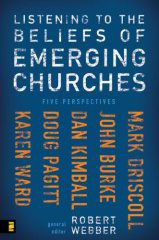
Listening to the Beliefs of Emerging Churches: John Burke

Date April 3, 2007

Listening to the Beliefs of Emerging ChurchesPart 1: Mark Driscoll
Part 2: John Burke

John Burke: Incarnational Theology
John Burke is pastor of Gateway Church, and I appreciate the ministry that seems to be happening at Gateway. I’ve never met John, and he is theologically closer to Driscoll than myself, but he doesn’t have the same negative vibe that Driscoll had in his chapter.

Burke’s community must be a very welcoming place because he relates some stories about people who have been very skeptical about Christianity, have come with plenty of questions, and yet, somewhere along the line, have made a commitment to faith at Gateway Church. Burke talked about a theology of religions and what place Christianity has amidst all other world religions. While Burke is certainly no universalist, he does offer a more progressive evangelical perspective than Driscoll was comfortable with:

“The emerging church can affirm the mysterious ways God has always been at work, drawing people to himself out of the various religious backgrounds, like God did with Nebuchadnezzar the Babylonian king…the Queen of Sheba from Africa, the Iranian astrologer, and the magi…Can the emerging church build the kinds of bridges to those pursuing other faiths or coming from other religious backgrounds like Paul did? Does our theology have room for a God who works behind the scenes, even in other religious pursuits, drawing people to Christ” (58-59)?

Tags: , , , , , ,

7 Responses to “Listening to the Beliefs of Emerging Churches: John Burke”

  1. jim said:

    There was a lot of good stuff in this chapter, especially the points about seeing that God just might be at work in other faith traditions and that we should connect with others with this type of respect.

    What I didn’t like was Burke’s argument for the authority of scripture and the superiority of Christianity over and against other religions based completely on “how God confirmed his revelation in history by foretelling the life and death of his Messiah through the Old Testament, confirming it in both the New Testament and extra-biblical history (pg. 60).” His argument for authority rests on this alone.

    To me this seems like overstating the point, by reading back into the text from our post Jesus view point and then drawing the conclusion that “aha the scriptures revealed this would happen.”

    The OT scriptures may allude to a general hope of a coming messiah but I’m not so sure the scriptures revealed exactly when and how it would happen. That is a meaning we’ve (starting with the gospel writers) interpreted back into the OT scriptures.

  2. Chris TerryNelson said:

    Sounds like Burke actually read Calvin and understands the work of the Spirit apart from the church. Thank goodness.

    I’m curious why it’s called “incarnational theology.” This is a buzzword that I keep hearing but I have no idea what it means.

  3. Paul Martin said:

    Well, to try and answer that question, yes and no. I think if we insist on the “Christ” part it will go over about as well with other traditions as Muslims trying to tell us Muhammed was Seal of the Prophets. Christ is a Messianic title. To me, existing in a pluralistic world, which we do, like it or not, means genuinely respecting other traditions and being willing to listen and learn as well as offer what we have to say.

    As long as we regard non Christians as our spiritual inferiors - and large groups of Muslims, Jews etc, also do the same with those outside of their traditions - I don’t think it bodes well for genuine dialog.

  4. Chris TerryNelson said:

    I disagree. When religions tamp down their uniqueness (i.e., the fact that they believe ____ is the true God), genuine dialogue ceases to happen. Just because I believe Christ is the Son of God doesn’t mean:
    A. I don’t respect other religions or people who adhere to them.
    B. I can’t have genuine dialogue.
    There’s a false dichotomy here.

  5. Sean said:

    Incarnational Evangelism and Incarnational Theology are phrases that YoungLife has been using since, or shortly after its beginings in 1938.

    The idea of Incarnational Theology, at least from my perspective from being led to Christ through YoungLife, serving as a volunteer for almost a decade, and then leaving my career for a few years to serve on staff, is that it is simply about being Christ where you are at, to whom you are with. You may be the only ‘Jesus’ that person meets, you are a emissary/viceroy/little Christ to those in your reach (sphere of influence if you will).

    How does Incarnational Evangelism or Theology differ? Well it shouldn’t differ; as long as we as Christians, the church, are truly being Christians (little Christs). The issue (in general, I am casting a wide net) has been, especially since the 50’s, to have a “come and see” attitude in church. “We will hold an event, create some cool conference, design some new seeker-sensitive service for non-Believers to come to. We will give our mission money to our denomination so they can send missionaries out. The push to reach lost friends is generally to actively witness, give tracts out, and invite to church. Some churches are so ingrained into this, they hold all sorts of events to reach the lost. Most of those churches also have the budgets to have so many events weekly and even tools (gyms, sports teams, group meetings) aimed at ministering to their congregation. The problem is that too many of the church goers of those churches are too busy “getting ministered to” through the church softball league or singles dance, that they are not reaching beyond the walls.

    Instead, Incarnational view seeks to have each and every Believer be Christ where they are at. Witnessing is living your life out. YL talks about “winning the right to be heard” meaning you build friendships and genuinely care for/like/love the person. In this the friend see someone who is different, someone who has something they don’t. The Christian does not hide his/her views or Christianity, but they do not sell, push, or peddle their faith either. The friend gets to see a Christian, who boasts no pride - who messes up and repents - who is simply trying to live a godly life as best they can. The non-Believer can see a real, struggling Christian (isn’t that what we are, really?) work out his/her faith. When the time is right, the Holy Spirit leads, the conversation will come up, the seed that has been planted and watered, will more than likely flourish and begin to bloom.

    Incarnational - so meet on Sundays and even a few group meetings through the week, that is fine. But rather than spend budget dollars on all sorts of other stuff, consider: having members join city sports leagues and minister to those other teams; adopt projects in the community/state/country/world (Jerusalem, Judea, outermost parts) to build/rebuild other communities/serve the sick or needy, hold events in community locations rather than the church - be where the people are, go to the people.

    So I don’t think John coined the term, just brought an old term to new light. I know he used to do campus ministry and not sure if he crossed many a YoungLife’er there or not. I also remember Bill Hybels, his former boss talks a lot about incarnational ministry in one of his books, Contagious Christianity (I think). Hybels taking the same idea as above and pushing his members to be winsome to others.

    Granted I have not read his book - send me a copy - but I have visited the church and plan to do so today Easter 2008. My first reaction was - okay, lot of different types of people; a lot of “cool folks” (and I may not be a cool folk). The sermon was good and theologically sound (I hold to a very conservative orthodox theology) but also a bit shallow (but it is seeker-driven, so okay). Then I went to the Garage, the bookstore/cafĂ©/offices. In the book store I found some of John’s books, many Emergent authors, some standard mainstream Christian authors, an odd book of charts and maps revealing the “Truth of the Dispensation of God”, as well as a book by TD Jakes (who is a modalist) and some from Joyce Meyer (or maybe Marilyn Hickey) - either way, no I have no clue of the theology of the church. So off I go to the Easter 2008 service “See What Love has Done: God’s Heart, Through the Music of U2″

  6. james said:

    well according to the bible there is no foundation for incarnational theology or freindship evangalism. the main problem with this approach is that we dont know what the future holds. the person we may want to share our faith with may die that evening. also what if the person doesnt see anything in you that they want. maybe they are enjoying the pleasures of sin and are perfectly happy with their life style. then what do we do? i will tell you we beg, plead, and earnestly exhort them to repent of their sin or it will lead to eternal death (hell) and flee to Jesus Christ and escape the wrath that is to come.” then pray that God will grant them repentance to the acknowledging of the truth” (2 Tim 2:25)

  7. Kyle said:

    No foundation for incarnational theology?

    As far as I can tell, the Great Commission is foundation enough:

    “Therefore, go and make disciples”

    disciples=followers–followers who are becoming/trying to become like their Master.

    it makes sense (to me, anyways) that we have to be disciples in order to make disciples.

    If we’re disciples, or if we’re becoming disciples, then we’re trying to be like “Christ where (we) are at, to whom (we) are with.”

    But that doesn’t at all mean that we shouldn’t tell them about Jesus. That doesn’t mean that we shouldn’t “pray that God will grant them repentance to acknowledging the truth.” It means precisely that.

    It also means, however, that we must look at them as a person–as a dearly loved child of God–which means that we must not look at them as another point on our ‘converts won’ scoreboard (as many do). And it means that we need to be humble, love them as ourselves, and recognize that we may have as much to learn from them as they do from us (the last part isn’t really incarnational, since Jesus has/had nothing to learn from us that he didn’t already know, but it’s important all the same).

    If they (whoever they may be) don’t respond to us telling them about Jesus, we shouldn’t stop loving them and being in relationship with them, and we need to accept that God’s means of reaching them might be through relationship rather than our begging, pleading, and earnest exhortations.

    Grace and Peace

Trackbacks...

Leave a Reply

XHTML: You can use these tags: <a href="" title=""> <abbr title=""> <acronym title=""> <b> <blockquote cite=""> <cite> <code> <del datetime=""> <em> <i> <q cite=""> <strike> <strong>