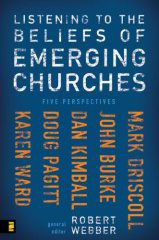
Part 1: Mark Driscoll
Part 2: John Burke
Part 3: Dan Kimball
Part 4: Doug Pagitt
Doug Pagitt: Embodied Theology
Doug’s chapter was probably one of the strongest in the book I thought. I loved reading Driscoll’s critique of Doug’s chapter: “I find Doug’s chapter the most difficult to respond to…we were assigned to articulate our views on the Trinity, the atonement, and Scripture, and having read Doug’s chapter, I remain uncertain of his position on these issues” (144). Perhaps that’s because Doug is not out to create answers, or to give a cohesive, biblicist response to these theological issues…
Doug has some great quotes in this chapter. Here are some of my favorites:
“Because theology is connected to real life, answering particular questions, concerns and opportunities of the day, it will be ever-changing. If it is not so, then it may well not be theology – it may be dogma, history, or a collection of random facts, but not theology. Theology is the living understanding of the story of God in play with the story of our lives” (121).
“I think it is worth saying again that theology is not the same as the story of God. Far too often, in my opinion, this becomes an issue, and when one disagrees with our theology, we can too easily assume they have abandoned Scripture or the story of God. Theology is explanatory – answering certain questions or addressing certain issues. But it must never be confused with the life of God or the story of God” (123).
These two quotes play into his definitions of theology later in the chapter as being temporary, evolving, participatory, calling for an integrated holism and one that pursues the rhythm of God. Pagitt is also in agreement with Kimball as to the role of the community to be actively involved with theology. If you’ve heard Doug speak recently, you’ve certainly heard him use the phrase, “cauldrons of theological imagination.” That’s his new shtick. And it’s a good one. Here is a paragraph from his chapter:
“We are called to be communities that are cauldrons of theological imagination, not ‘authorized re-staters’ of past ideas. What we have in our communities are not simply people who need to have the gospel applied to their lives, but people who need to know their situation and what the Good News of God means for them. So our job as leaders of communities is not simply to apply the well-founded answers of previous generations’ questions or assumptions to the lives of our people, but rather to guide, extract, and join with the hopes and aspirations deeply embedded by God in the lives of our people” (127).
This is important especially for those of us who are involved in mainline denominations. We are called to be imaginative, theologically, I think. Is it enough to simply tell people what Calvin, Luther or Wesley came up with, theologically? Sure there may have been some similar issues in their day as we currently experience, but we live in vastly different worlds, and we may have questions that they never even would have thought of. I’m with Doug – it’s not enough to simply re-state what we learn in our Systematic Theology courses in seminary, nor is it enough to simply teach people what we find in our Book of Confessions – but we need to be encouraging and calling people to their own theological imaginings. Does that mean that it’s a theological free-for-all? Perhaps. Or maybe not. But does it matter? Does it matter if our congregations are theological-free-for-alls if they are seeking out the rhythm of God and ways in which the story of God and their individual and communal stories interact?
Related posts:
- Doug Pagitt on Plurality 2.0
- Emerging Worship Environments
- Churches: Change Your Web Hosting Companies!
- Sexual Integrity and Leadership in the Emerging Church


{ 10 comments… read them below or add one }
“We are called to be communities that are cauldrons of theological imagination, not ‘authorized re-staters’ of past ideas.”
Perhaps we are called to be communities that are cauldrons of theological preservation, not “authorized re-framers” of past ideas? As such, we now have two options. To what do we appeal to adjudicate between them? To what does Pagitt appeal?
Sorry, that should be “unauthorized re-framers” in my, er, re-framing of Pagitt’s statement.
But he didn’t quote enough scriptures and to make matters worse he quoted a ‘liberal theologian.’ ;)
Timbo, what is the fear of imagination? Why do we simply have to be “preserving” something that was put together for a certain time in a certain place?
Dang, looks like I was pre-ordained to see this argument all over again.
I’m struck in your last paragraph, Adam, by how all of this applies to Scripture, too – how it isn’t enough to just restate/restudy again and again only what a certain set of people (biblical writers) imagined theologically. Paul over at http://www.originalfaith.com/blog/index.html has some interesting thoughts on all of this, particularly in his earlier archives.
Anyway, I haven’t read this book, but do you think Pagitt…or you…would take the argument that far?
I don’t think its fair to say that a concern about Pagitt’s views on theology are a “fear of imagination.” I think there is a legitimate amount of concern to be had when someone doesn’t just seem for imaginative retellings or reappropriations in continuity with the past, but rather is open to the apparent abandonment of yesterday’s parts of the story. The story metaphor isn’t a bad way of looking at theology so long as today’s imagination is held in tension with yesterday’s.
Plus, there is a problem with community-free-for-alls; we are not just called to be local, discrete groups. Yes, that is where most of our being the body of Christ will occur, but we still have to find a path to connection with the wider Christian community/body. A community that has decided its rhythmic interaction (whatever that is) with God’s story is entirely different than what other communities believe to be their experience will inevitably lead to discord, schism and separation. So I think you have to pair imagination with a certain sense of responsibility towards other Christians, which is precisely what seems to be lacking in Emergent.
A couple of questions for clarification: what is the “rhythm of God”? How do we know what that is? And what is its content?
Why do we simply have to be “preserving” something that was put together for a certain time in a certain place?
Well, what if we were primarily concerned with the truth, rather than in our perception of theology? I think that is what made guys like Calvin and Luther more astute than guys like us…they cared about something beyond themselves.
Timbo, what is the fear of imagination? Why do we simply have to be “preserving” something that was put together for a certain time in a certain place?
What has fear to do with imagination? As Nathan points out, there is concern over the “apparent abandonment of yesterday’s parts of the story,” although what I was getting at was more fundamental. If Pagitt seeks theological imagination and Driscoll looks to preserve theology that has preceded him, what common ground has authority for both Driscoll and Pagitt (or anyone else for that matter) that could help us adjudicate and/or evaluate their positions? As you noted, Driscoll has a plethora of Scripture references, which presumably means that he is appealing to Scripture to justify his preservation of substitutionary atonement, etc. To what is Pagitt appealing? Who is calling Pagitt and his communities to be “cauldrons of theological imagination” as opposed to cauldrons of theological preservation (which I think is more neutral terminology for “‘authorized re-staters’ of past ideas”)? As for your question to me, where did I say that we should be simply “preserving” theology? Perhaps I think we should be preservationist while still being (cautiously) open to imagination as it is developed by leaders who stay connected to tradition (which is democracy of the dead according to Chesterton). What about the opposite? Isn’t the whole notion of progress(ive) a modern one? Are Pagitt’s “cauldrons of theological imagination” better than Driscoll’s cauldrons, or just different? If better, on what basis? If just different, then what makes them “Christian” as opposed to a “spiritual but not religious” form of humanism, given their apparent rejection (or diminishment) of past theological traditions? Connection to the Creeds? But those are past ideas that were “put together for a certain time in a certain place.”
So, the biggest example of this is the Protestant reformers who abandoned 15 centuries of church teaching. Each subsequent refinement of beliefs has led to thousands upon thousands of splinter groups, so which of those are we supposed to believe?
Emergent, to its credit, is actually reconnecting with the church past on a much deeper level than most US protestant denominations, which tend to be rooted in 19th century “enlightenment” theology.