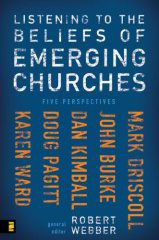
Listening to the Beliefs of Emerging Churches: Dan Kimball

April 4, 2007 · 22 comments

in Books,Emergent,Theology

Listening to the Beliefs of Emerging ChurchesPart 1: Mark Driscoll
Part 2: John Burke
Part 3: Dan Kimball

Dan Kimball: Missional Theology
I like Dan Kimball. And it’s not just because he grew up in Jersey, or because he’s a faithful pomomusings reader (although those are both great reasons for why I should like him). I like Dan Kimball because he loves people. He just does. Anyone who has spent any amount of time with him knows that he loves God and loves people. Period. I was blessed to be able to spend an evening with him at the last Emergent convention in Nashville – he just called me up and said he wanted to hear some of my story. That’s the kind of guy he is. Which I guess is why I get so frustrated when people write absolute crap about Dan.

At any rate, I liked Dan’s chapter. He spoke of theology, openness to new ideas and re-formulations of our theologies, but while still holding on to historic, creedal faith, specifically the Nicene Creed. Dan is a self-proclaimed conservative evangelical – yet he is the kind of conservative evangelical I love to hang around with. He’s alright saying “I don’t know” – he has a real genuine humility about his beliefs and doesn’t hold onto them too tightly.

Yet, he’s also a deeply theological person and has high aspirations for the people of his church. He writes:

“So, we see our church as being students of the Scriptures. We then use the word ‘theologians’ … as everyone being a serious student of Scripture and deep in thinking about theology together…We constantly keep the definition of theologian in our teaching and what we give out to people, as well as try to develop a culture of the church becoming ‘theologians’…” (103-104).

I appreciate this notion of encouraging everyone to “become theologians.” As one who has been around the seminary crowd for the past 3 years, I sometimes run into the idea that theology should only be done by those who have been trained in it. That those who know the ancient languages, have studied the church fathers – they are the ones who can really do theology. That is just bull. Theology is for everyone – and that is something that Dan and his church are working out. All in all, I loved Dan’s chapter, and this was one of my favorite quotes:

“I do, however, wish that worship songwriters would choose to write more songs that focus on the character of God and teachings of Jesus and what we should be like in this life, in addition to the thousands and thousands of songs about the cross and the substitutionary atonement. If we only view worship through the atonement, we don’t focus Jesus’ teaching on this life and on being a kingdom-minded disciple” (100-101).

Amen. I can’t say that any better than Dan has. I generally really like the musical style of modern worship stuff, but the content and lyrics of so many of the songs are uncreative at best, and do seem to only focus on Jesus and me, and the death and cross of Jesus. It’d be great to hear some kingdom songs…

Related posts:

Stay In The Loop!

Subscribe to the Pomomusings feed via RSS or Email to receive notifications when new posts are published.

{ 21 comments… read them below or add one }

1 Kellen April 4, 2007 at 9:20 am

Theology is for everyone… I’m not exactly sure what you mean by this. Perhaps you are exaggerating on purpose to achieve a rhetorical effect. Or perhaps you really do believe that whatever theology is, it is “for” everyone. That is, it is meant to be done by everyone.

I would agree with your sentiment concerning seminarians. I think theology is much more difficult work than seminary students can hope to accomplish. Many seminary students, I think, are not gifted in or called to doing theology. Few seminary students ever really do theology.

But on the other hand, in order for “theology” to be for “everyone,” (and therefore to be done by anyone), what is “theology”? Saying the word “God”? Using the word “God” in a complete sentence? And then would Christian theology be constituted by one’s using the words “Jesus Christ” and “God” in the same sentence?

Reformation + Democracy + Evangelicals = Perpetual Schism

I’m all for trying to broaden the concerns of theologians, and trying to get theologians to become more Christian in their thinking and writing, and therefore more socially located, but I’m not sure that telling a bunch of people who are not theologians by calling or by intention that they can “do theology” will alleviate more problems than it will create. It could well be argued that the idea that “theology is for everyone” is the reason the Christian church in modern America that has split eight hundred thousand times. I think it may be time to try a new approach: theology is not for everyone. It does not come from seminaries, books, or people, but from God. It is a gift of the Holy Spirit, to be nurtured and practiced in prayer, with the blessing of Christian communion.

Reply

2 Peter Z. April 4, 2007 at 9:57 am

Adam, this might open the door for another “What is…?” category. What is theology? I have grown to like Grenz and Olsen’s definition in “Who Needs Theology?”

Theology is “any reflection on the ultimate questions of life that point toward God.” So, I fully agree, theology is for everyone and anyone engaging in such reflection is a theologian. (Grenz/Olson use the example that eveyrone who cooks an egg is a chef…acknowledging there are different levels of “chefs”/”theologians”/etc.)

Reply

3 Chris TerryNelson April 4, 2007 at 10:28 am

Thanks for posting this Adam. This is an especially important topic to me.

Kellen,
I’ll end up with the same conclusion, but via a different route.

The fact is that all congregants are theologians (all people actually, even secularists). That is, everyone has some sort of working theology, some idea of who God is and is not. Now pastors, who are trained theologians, need to engage the theology of their congregants. This means more than just canonizing N.T. Wright (or insert your favorite Barnes & Noble Christian author here). Pastors need to be trained theologians, and a trained theologian can’t help but train others the history of the church and its readings of Scripture. Now I realize that one can be trained in poor theology, and one can be poorly trained in theology, but I don’t think we should react to this by pretending the only theologians are those who are called. In you have a theology, in my mind you’re a theologian. Sidenote: C.S. Lewis, contrary to his own opinion, was a theologian. If he had compared his writings to the theologians, he would’ve written better theology.

We spend most of our time doing what I like to call “bookend theology”: prolegomena (how to begin theology) and ecclesiology (the doctrine of the church). Everything in the middle (Doctrines of God, Creation, Humanity, Salvation, Christology, Holy Spirit to name a handful) gets left out or treated to such a small extent that by the time one gets to ecclesiology, it’s no wonder that we revert to discussions of “how to do church.” With prolegomena, there tends to be a lot of lip service to humility, to “not having all the answers.” This is fine when we say it because we can never fully apprehend Jesus Christ as revelation, but it is dangerous to do theology as if there was no revelation, as if God has not spoken to us through the Scriptures and church tradition. Humility of this sort is actually a form of pride.

Now I know people have serious issues with systematic theology (“How dare you put God in a system!” they like to say), but if we don’t think systematically about these things I’m afraid it will just create more confusion – which is one of the primary reasons why churches split in the first place.

P.S. I have not read Ray Anderson’s book: An Emergent Theology for Emerging Churches. It might alleviate some of my concerns.

Reply

4 jazzact13 April 4, 2007 at 12:45 pm

When I was in high school, I played basketball. In one sense, I was just a much a basketball player as Michael Jordan was. In another sense, I was no where near as much of a basketball player as Michael Jordan was.

I can appreciate that Kimball tries to help people think about the Bible and theology, as I suppose I fit in the ‘not a seminarian’ crowd but also as one who tries to learn and understand biblical truths.

At the same time, I suppose some difference should be articulated between those who have devoted a large part of their lives to theology and those whose studies haven’t been so intense. It may be said to be a belittling of the serious theologian to call the dabbler a ‘theologian’, as if the two should be viewed as equals.

Reply

5 John Santic (Toward Hope) April 4, 2007 at 1:05 pm

Adam, below is a link to a post about theology as work of the people that was inspired by an article that Hunsberger wrote. I am curious about exploring what congregational theology looks like (i.e. all participating in the task of theology). the premise is that every thought about god and every attempt to understand god within the pragmatics of life is in some way theologizing..

I’m also open to the perspectives above on the gifting and calling specifically to theology and a more specialized gift/task. However, to some extent we are all called to theology…

here is the link:
http://towardshope.typepad.com/towards_hope/2006/11/theology_as_wor.html

Reply

6 Chris TerryNelson April 4, 2007 at 2:05 pm

Jazzact13,
Just to be clear, in no way do I mean to belittle anyone. Theologians need to be humbled, I think. However I do think we should ask where the sense of belittlement is coming from. I believe it comes from an assumed hierarchy between the seminary (which we call “academy”) and the church, and one that I have little patience for. There would be no belittling if both seminaries and churches stopped enabling the question of theological practice to be framed in such terms.

On basketball:
You may not be as skilled a player as Kobe Bryant. However, you might have something to teach Kobe about sportsmanship, or some aspect of the game that he missed. This can only happen if there’s no barrier between you, but an assumed common space to talk about the game.

This analogy breaks down, and I realize it creates another sense of belittlement, since many of us detest being the child that got the Best Sportsmanship award in teeball. I’m speaking completely abstractly of course. ;-) Theology cannot be considered professional, even if there are professional theologians.

I think pastors have the ability, like Dan, to empower congregants to be theologians, and that congregants can critique pastors in their theology. I think congregants have a choice in this, of course, and it’s not required that they churn out a treatise or anything. I’m talking about basic catechesis, which is largely lost today in the churches.

Reply

7 Boo Hoo Hoo April 4, 2007 at 2:17 pm

What, you’re claiming Jersey guy now?

Reply

8 Boo Hoo Hoo April 4, 2007 at 2:18 pm

Since when did you become a Jersey guy?

Reply

9 jazzact13 April 4, 2007 at 3:31 pm

CTN–

My comment about ‘belittling’ was not meant towards you, but more as a general idea about how using a term like ‘theologian’ in such an informal sense may be seen as belittling of those who have studied the subject seriously for many years.

If I may use another analogy, then, which may be more accurate but I worry may not be so familiar to many people. For several years, I have played in chess tournaments, mostly local but a few of the larger out-of-state ones. My US Chess Federation ranking is roughly middle of the road, I’m not a master but I’m not a slouch, either.

I have studied the game some, and still do, so when I sit down at a chess board, I usual have some idea of what I’m doing.

I know, though, that my own studies and preparations are paltry compared to those who are the best of the best. While I might know the few openings and variations, they have a much more thorough and deeper knowledge and understanding of the openings. While I struggle to learn what may not even be current now, they are trying to create new variations or give life to variations thought to be dead.

If I were to play a game against one of them, I may make a few good moves and hold my own for a while, there’s even the 1 in 100,000,000 chance that I might win. But the fact would be that they would be far better players then I am, and would see things that I would not see, and know what I do not know, because they have devoted themselves to an intense study of chess, while for me it is something I enjoy but do not devote serious effort to.

I’ve played some people who were not a familiar with tournament chess as I was, and usually when I beat them they tried to call a master. While understanding what they were saying, I usually said that not I wasn’t. I had no intent to be off-putting or rude, but I know what kinds of chess masters can play, and my chess was and still is not up to that level.

Such is like my take on this. I’m leary of taking the word ‘theologian’ from those who have put the effort into becoming one, and assigning it to those who haven’t. I wonder if there isn’t some more accurate word for them (biblical students, learners, studiers, et al) which may be given to them without broadening the title ‘theologian’ to the point where it’s almost meaningless.

Reply

10 Adam Walker Cleaveland April 4, 2007 at 4:03 pm

Hey friends – great conversation here. Wish we could all grab some beers and carry on this conversation. I only have a minute, so there isn’t any way that I can go into depth on this.

And, just so you know – there is going to be a “What is theology?” post coming in the next few weeks, so maybe we can continue this conversation then.

Kellen – when I say “Theology is for everyone” – I mean a variety of things, and one of which is what Chris picks up on – everyone does theology, whether they think about it or not. Everyone has some working idea of God and how God interacts with humanity and the world, and what the implications of that is, etc.

But I think we’ll disagree when I say that “Theology is for everyone” means that I think everyone SHOULD do theology, that everyone CAN do theology. I think we do a huge disservice to our congregation when we think too highly of ourselves as the ones who went off for a few years and got trained on how to “do theology.” We have that luxury – not everyone does. But that does not mean that they are left out of the task of thinking about God and our relation to that God.

Theology is for everyone. That doesn’t mean that everyone’s theology might be right – and there are certainly teachable moments, where we might be able to share some of what we have learned in the ivory towers. And yes, there may be times when Joe, the local farmer in our congregation, will be able to teach us something of God we never thought of before.

Reply

11 Kellen April 4, 2007 at 5:03 pm

I think that in the sense you mean theology, which basically boils down to reflection about God, I can totally agree with everything you just said. I don’t think that we ought to “think too highly of ourselves as ones who went off for a few years and got trained on how to ‘do theology.’” That’s just an arrogant, proud way of living — not Christian at all. I just maintain that doing theology in a constructive way that engages the wider world in its broad, intellectual movement is something that not everyone is called or gifted to do. I would like to distinguish that kind of theological reflection from the kind you’re talking about. I think that we’re both talking about kinds of theological reflection, but perhaps they have different goals. Thanks for this response — and I think I might run into you sometime tomorrow….

Reply

12 Patrick April 4, 2007 at 5:07 pm

Isn’t part of our calling, after we go off and learn how to think theologically, to come back into communities of faith and teach others how to do the same? If we say that not everyone “can” do theology, aren’t we (as pastors) to blame for that?

And for anyone interested, Shirley Guthrie joins in on this conversation in a pretty amazing way in the opening chapter of his book “Christian Doctrine.”

Reply

13 Truth Seeker April 4, 2007 at 5:11 pm

Great post! Good things to talk about here. Thanks for the comments everyone, good things to ponder.

I wanted however to throw out something to link the posting on Mark Driscoll and this posting. Dan Kimball says in this book as Adam pointed to above:

“I do, however, wish that worship songwriters would choose to write more songs that focus on the character of God and teachings of Jesus and what we should be like in this life, in addition to the thousands and thousands of songs about the cross and the substitutionary atonement. If we only view worship through the atonement, we don’t focus Jesus’ teaching on this life and on being a kingdom-minded disciple”

I think this is a straw-man of most churches form of worship. Some may argue that this is the conservative method of worship, but I think it is a gross miscaricature of most churches. Yes, there are songs about the cross and atonement, but most songs today, are more self-help and me-minded. So I would venture that this caricature is off.

But even if this were the case Dan makes a false dichotomy here when he says that if we only worship through the atonement we become less kingdom-minded. I believe Paul in most of his writings never spoke on or even referred to the sayings or teachings of Christ in how they relate to this life. If anything Paul spoke more about the death and resurrection than on anything from Jesus’ life. He was more atonement focused than most conservative evangelicals are today. To Paul the idea of the kingdom of God could not, and he would not, be seperated from the Atonement. Without the Atonement the buisness of the kingdom is useless. Without the Atonement or message is useless and void. Paul said it well when he said that if he didn’t preach anything he proclaimed that Christ died and rose again. The atonement is vital to the Christian faith. It is what seperates us from all other beliefs and that is not bad.

So I think Dan makes a gross mis-caricature in this piece and if this is an indication of what he believes I am leary of his teachings. I can’t wait to get my hands on this book and look forward to engaging with it though.

Blessings,

Reply

14 dave paisley April 4, 2007 at 6:55 pm

With you on the “Jesus is my boyfriend” songs. Bleah!

As for substitutional/penal atonement (there are way too many Calvinists reading this blog) here’s a pretty good antidote from Dr. (almost Bishop, but not quite)Jeffrey John in the UK.

http://www.bbc.co.uk/religion/programmes/lent_talks/scripts/jeffreyjohn.html

Well, I don’t know about you, but even at the age of ten I thought this explanation was pretty repulsive as well as nonsensical. What sort of God was this, getting so angry with the world and the people he created, and then, to calm himself down, demanding the blood of his own Son? And anyway, why should God forgive us through punishing somebody else? It was worse than illogical, it was insane. It made God sound like a psychopath. If any human being behaved like this we’d say they were a monster.

Finishing up with:

On the cross God absorbs into himself our falleness and its consequences and offers us a new relationship. God shows he knows what it’s like to be the loser; God hurts and weeps and bleeds and dies. It’s a mystery we can hardly glimpse, let alone grasp; and if there is an answer to the problem of suffering, perhaps it’s one for the heart, not the reason. Because the answer God’s given is simply himself; to show that, so far from inflicting suffering as a punishment, he bears our griefs and shares our sorrow. From Good Friday on, God is no longer “God up there”, inscrutably allotting rewards and retributions. On the Cross, even more than in the crib, he is Immanuel, God down here, God with us.

Reply

15 myles April 4, 2007 at 9:50 pm

when you qualified your statement about “can” and “should”, i can get on board with that a little better. one thing that’s been lost in the democratization of religion is a sense of training and learning about how one speaks of God. while theology is for everyone, and should be engaged by everyone, not everyone does theology well, or has taken the time and training to know what’s at stake. thus, theologians become the guardians of the tradition, in a sense, knowing how to avoid certain old pitfalls, and guiding the church through new ones.

Reply

16 melissa April 4, 2007 at 10:18 pm

Myles, when you mention the aspect of knowing what’s at stake when doing theology, you hit on what I think is the most important discussion that should be taking place concerning who get to “be a theologian.” I agree that everyone does theology, whether or not they would recognize it or put that name to it, but I also think that there is also some necessary distinction to be drawn between theology as any thinking about God and theology as it has been pursued with intentional study and effort. I’m not in a place to say that one is better than the other, but I also wonder about the relationship among pastors, theology, and seminary.

I come from a view of church and theology in which I hold strongly to some concept of orthodoxy – and by this I mean a functional confessional and creedal subscription. (I’m going to get slammed for that statement, I know it…) I think that there are necessary non-negotiables when it comes to the Christian faith, and that the church should be held responsible for faithful transmission (though also faithful re-framing when necessary) of those fundamentals.

That being said, I think that pastors and “trained” theologians are given the responsibility to constantly be asking the question “What’s at stake?” Our training gives us a framework from which to balance orthodox theology and experiential theology in such a way that we are honest about the implications of all theological thought (“professional” and not). There is a lot at stake in theology – theology deals with the deepest matters of the soul – and I think that pastors are called to be good stewards of these deep matters such that we engage people in theological conversation, take seriously the theological contributions of those who aren’t necessarily “trained” in it, ground these conversations in tradition/orthodoxy, explore beyond tradition/orthodoxy, and to be able to process all of these contributions in helpful ways such that we take care of the precious nature of the soul.

Reply

17 Chris TerryNelson April 4, 2007 at 10:34 pm

Dave Paisley,
Thanks for the quote, because it definitely brings up the problems of propitiation or the “penal” model of substitution. What follows is my Reformed (not Calvinist!) response. :-)

Unfortunately I think it not only pushes atonement far too much into a participationist model, which is necessary but not sufficient (i.e, it doesn’t get at the whole story of what Christ did on the cross), but it is also the wrong kind of participation. Without a proper Hebraic/sacrificial-substitution counterweight, participation becomes meaningless.

While it might be therapeutic to think of Jesus partaking in our suffering in some existential sense, we must remember that Christ suffers with us only insofar as we are united with him in HIS suffering. Thus, we need to keep Christ as the primary acting subject here. It is HIS suffering that is key, so that it defines what it means for us as human beings to suffer. God being with us in the flesh comes to redefine humanity, and we need to look at our union with his humanity instead of imposing our ideas of “what it means to be human” onto Christ. If Christ simply feels the pain we feel, that ultimately has no power to save us from sin.

Reply

18 Chris TerryNelson April 4, 2007 at 10:51 pm

Melissa,
Thanks for your comments, as I think that you cover two important aspects of theological reflection that we need to be aware of today. I see nothing wrong with your statement on functional subscription to creeds and confessions, as long as it’s clear what the function is: it’s not to freeze God’s revelation as a kind of given entity to the church which we need to guard henceforth, but to serve as a marker and witness of God’s faithfulness to the church. Going beyond creeds means serving to match our witnessing of God’s faithfulness with a sufficient witness in our words.

Reply

19 Dan April 4, 2007 at 11:56 pm

adam,

i would certainly give you a call and come over and chat if i was closer to you. i am very proud of my new jersey roots, although i am not sure i would fit in there anymore. maybe next year when you are back and i visit my parents, who still live there.

truthseeker – maybe you are right about the lyrics and songs being “me-minded” as you put it. but can you give some examples of the me-minded songs you are thinking of that don’t have somewhere in the lyrics “thank you for the cross” or “thank you for dying for me” or “you paid the price on the cross for me”? it seems even the me-minded worship songs have the atonement mentioned.

which worship songs sung in churches are you thinking of that don’t have a line with that in it? i’d love to see some examples, as i truly can’t think of any right now as i ponder the worship songs that are popular.

Dan

Reply

20 Truth Seeker April 5, 2007 at 8:32 am

Dan,

Thank you for your comments. I come from a more traditionally based Baptist church (conservative to most people) and I also attend a Presbyterian church on Sunday nights. At both churches we typically sing hymns and tend to stay away from pop contemporary songs, so I am coming from a hymn perspective, which is still common in a lot of churches today. There are a multitude of hymns that speak to the other characteristics of God,to his teachings, and to the history of our beliefs (catechismic).

Some include:”All Hail the Power of Jesus’ Name”; “Behold the Bridegroom Comes”; “Tell It to Jesus”; “Praise our Creator”; etc.. I could go on some more but there are many songs that are not atonement focused, not that this is wrong mind you.

But the current worship songs today may speak a lot on the atonement but they are very “me-centered” and that is the point I am trying to make here is that if it is me-centered than it can’t be atonement centered. If the focus is on the self and we cannot atone for our sins than if the focus is on us it cannot be on the one through whom atonement can come through. We think we are talking about the atonement but we are not because we are not talking about the one who is actually atoning and instead focused on what we can do, or what we recieve, or what happened to us. Those all have its place, mind you but a proper view of atonement focuses on what Christ did, what he imparted, and what he gave to us.

Does this help?

Blessings,

Reply

21 Sellis April 5, 2007 at 12:55 pm

Wow, I’ve been impressed by pretty much everything said so far, on both sides of the discussions.

Myles, to playfully disagree with your comment, I wonder if the church should be the guardian of tradition, not theologins? And by church, I mean each local community of believers. Hauerwas and Willimon (in Resident Aliens) suggest that “the church is the bridge where Scripture and people meet.”(129) They also state that “Biblical interpretation is a political, ecclesial problem before it is an intellectual problem.”(128)

So I agree with and really appreciate Dan’s chapter and Adam’s comments and would stress that it’s the study of and dialogue about the nature of God that’s going on in the congregation of a local church that’s as important, if not more important, than what you nerds at Princeton are studying.

Favorite things from Dan’s chapter:

-View of Scripture: “We approach the Scripture more as a narrative than as a science textbook.”(98)
-That we don’t need self help sermons, but rather “a sermon that moves us into the beautiful and sometimes mysterious narrative of the Bible, helping us become better disciples of Jesus.”(98)
-Vintage Faith’s mission and vision of being a church that is “asking God to transform us into a “worshiping–community–of–missional–theologins.”(103)

Reply

Leave a Comment

{ 1 trackback }

Previous post:

Next post:


Thesis Theme for WordPress: Options Galore and a Helpful Support Community

Pomomusings.com runs off of the Thesis Framework
and your website can too by clicking above.
Here's why you should be using Thesis.


Find us at facebook.com/Pomomusings