I still remember the day during my first year of seminary when our Director of Student Relations and Senior Placement at Princeton told us that we really shouldn’t transfer while in the ordination process if we could avoid it. I don’t remember the reasons that she gave us, but I do remember that transferring (especially as a Candidate) was not something that she recommended.
And now…here I am…in the process of trying to transfer as a Candidate from Kendall Presbytery to the Presbytery of San Francisco. It certainly isn’t ideal, but under the circumstances, it seemed like the best option.
As I’ve learned more about the process of transferring in as a candidate, it has caused some frustration. Most of it stems from the fact that I was Certified Ready to Receive a Call by Kendall Presbytery, and now that they are transferring me, I could be accepted as a Candidate into the Presbytery of San Francisco, but would not transfer in with that status. So I would be required to stay as a Candidate for a specified amount of time (which I understand and think is actually important for allowing the CPM to get a chance to get to know me) and then would go through San Francisco’s Final Examination process. However, I am would also be asked to complete the Presbytery of San Francisco’s Educational Requirements, which are much more specific and detailed than Kendall Presbytery’s requirements.
Now, it’s not like I was naïve to the fact that different presbyteries required different things. I can’t tell you how many conversations I had at the cafeteria of Princeton Seminary with fellow Presbyterian seminarians in the ordination process. And, unfortunately, most of these were horror stories involving CPMs (Committee on Preparation for Ministry). It was often discussed in seminary how unfair it was when we heard about one of our future colleagues having such a difficult time her/his Presbytery’s CPM. So-and-so was being asked to complete an additional year of Field Ed? So-and-so was told that CPE would not be required…but oh, they changed their mind, and are requiring it now? So the student had to completely change summer plans and find a last minute CPE placement?
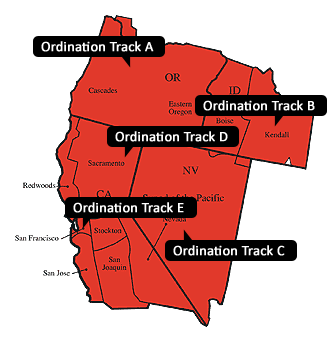
The differences that exist from presbytery to presbytery are definitely frustrating. It is almost as if there are as many different ordination “tracks” as there are presbyteries. I was on one Ordination Track while in Kendall Presbytery, jumping through all the appropriate hoops, crossing off all the items on my checklists…and then they basically say, “You’re good to go!” But then things unravel there, and I find out that there was a completely different Track that I would need to figure out how to get on with the Presbytery of San Francisco. This is something that people all over the country potentially face when needing to transfer presbyteries.
Now, some may be thinking, “Well, that’s what you get for messing up things in Kendall…serves you right.” But what about our friends who have to transfer presbyteries for other reasons? Family reasons? Geographic location reasons? The fact that there aren’t universal, national standards (wait, the ordination exams….?) for ordination seems annoying at best, but possibly even unfair to those “under care?”
However, while I want to argue and push for national ordination standards in these types of situations as a form of justice, another part of me still wants to support the local option of presbyteries to decide amidst themselves on other issues. I think this is just what the Peace, Unity and Purity Report was pushing for: the local option. I think many people who are pushing for LGBT ordination within the Presbyterian Church (USA), while they would obviously want to see the removal of G-6.0106b which currently prohibits openly and practicing gays from ordination, they would also hope for the ability for a local option for presbyteries.
Should there be more structured national ordination standards? I don’t know. Sometimes it seems like it would make more sense for there to be some unified standards that would help in certain situations. It’s unfortunate that the requirements can be so different from presbytery to presbytery. And I’ve not even mentioned the complexities that arise when one gets ordained in one presbytery with a scruple, and then needs to be accepted into a different presbytery.
Perhaps there are some things that should be universally standard across every presbytery (e.g. Educational Requirements: even though those are already laid out for us in the Book of Order, some presbyteries add on to that list), while there are other things (views on controversial topics, G-6.0106b or other theological views) that could be determined presbytery by presbytery. I don’t know if there is really any good solution to this issue, but I’ve love to hear your thoughts on the issue of ordination standards.
Related posts:
- Next Step in my Ordination Process
- Ordination Update
- Ordination Update: Finally, A Decision
- When an M.Div. from Princeton isn’t Enough…


{ 18 comments… read them below or add one }
Adam – I think its hard to have things both ways where it is more “local standards” for LGBT issues but national standards for educational/academic or vice versa. When we move in the direction of a “local option”, we move into a situation where it is then the COMs who are approving whether a specific ordained minister can serve within a presbytery.
That being said, I do think there needs to be a standard that is set by the GA for the academic / educational standards for candidates. Having been a part of three different CPMs in my process and now in my ordained positions, I know there were three different sets of standards out there that were beyond the basics that are laid out by the national body. Two of the pbys required CPE, one did not. One of the presbyteries required the full semester polity course, the other two did not. And so forth. Not only does this make life extremely difficult for those who are going through the process, but it also educates/trains ministers in very different ways depending on that person’s presbyteries.
Personally, I think that the biggest thing that is missing in the current process is the personal connection and the true mentoring that needs to be a part of the ordination process.
If I were to design the process, it would be that there would be a consistent mentor for the person in the process who would (ideally) meet face-to-face with that person at least once per month and was in constant communication with them about their faith journey, their sense of calling, their educational pursuits, their internships, and so forth. This person could be a pastor in the community of the seminary where the person attends or it could be a person on the preparation for ministry committee.
I think that some might say that this is the role of the session or CPM liaisons, but my experience is that those relationships have largely focused on “have you filled out this form” or “when will you be coming for your annual consultation”? This person could instead be one who is able to both challenge and encourage the candidate on a variety of topics even before it gets to the larger CPM. In this way, the process proceeds via relationship and not primarily via committee.
Every denomination I can think of has this problem. I came to the conclusion in the Methodist system that the only way I would ever succeed, not get bitter, and be ordained before I turn 50, having graduated from seminary at 25, was to enter into a congregational system (UCC). I am so happy not bitching about the treatment of gays by denominational polity everwhere I go, which is what it was like before. Now, there are weaknesses to it, and the UCC is a d*nomin*tion, and the pastors aren’t paid as well as Presbyterians, but there’s none of this BS on a widespread level.
I understand that these systems and rules are in place for often good reasons, to keep crazy nutjobs out, but the fact is that often the nutjobs that should have been left out end up on these committees because they like the psychology of being the gatekeeper.
How do these policies serve God? They don’t; they serve Satan, who is alive and well in most American churches, d*nomin*tional and non-d*nomin*tional.
Adam,
Good question. I think we already have the local option in actual point of fact. Your seeing that first hand. CPM do have a broad minimal standard that must be met – however they also have many options they could turn too even in if these standards present problems. The problem is that to use any of these other options, it becomes an act of the Presbytery rather than the committee. Presbytery meeting go pretty darn long anyway in most places. I am pretty sure a CPM chair will be hesitant to go outside of the standards unless there is a very compelling circumstance.
Anyway, when you figure that a Inquirer/Candidate will be on average under care for four years, and the terms on the CPM are two or three, you can easily see where an entire CPM will be just about turned over in the same time frame. Extend the Candidate process out and there may be no one left. I was lucky in that I kept copies of correspondence with my CPM – I was excused from a whole year CPM because of life experience and my work situation. (Note: My Presbytery was one of three that required TWO year long internships/CPE as well as a full time summer placement – Philadelphia and San Fransisco are the other two). One CPM chair excused me and the chair the next year told me it couldn’t be excused – luckily I had kept email messages (which is more a function of never cleaning my inbox out than order in my life!)
I think that Presbyterys need the flexibility currently offered. People are different, it is not just A gift of ministry – it is a matter of what gift of ministry that the process is trying to draw out. Grace allows flexibility. Sometimes Psych testing uncovers an area that needs to be worked on – an these areas need to be held in confidence.
I do think that if Ordained Ministers move Presbyterys we will soon see a much stricter COM and Presbytery review/Exam. It is boundto happen if local options become the standard. Then the real shark will be jumped – what happens when an already ordained person is refused membership? Interesting and ugly thought.
Now this is a much more thoughtful approach to the whole mess. I still object to your using your own personal struggles as a touchpoint, because it tends to magnify unduly your own biases, etc. But at least this is an attempt to work within the church rather than to simply complain to the internet. Thank you.
I think that this is a natural result of our polity.
We have a polity where the presbytery is King, and the General Assembly just gets to set basic rules. We require that each candidate for ordination be examined as an individual, because each has flaws and gifts that form a unique combination. The national standards are a way to ensure that all presbyteries meet a minimum level. The local standards are more a way to avoid having to design a curriculum for each candidate (which is truly ideal, but a LOT of work).
The Book of Order also grants very broad authority to skip or accelerate steps in unusual circumstances. Compare that to … say … getting a CPA. There aren’t any exceptions to the rules for a CPA. Getting an MWS is significantly more personalized.
Regrettably, you’ve been bitten by changing presbytery at the end of the process. If you’d changed earlier, you likely would have managed to make up the coursework. But let’s face it – how much of that situation rests on your shoulders? How well did you ensure that your beliefs were lined up with your presbytery?
The Book of Order is pretty clear, and does provide a solid set of uniform requirements. If a Presbytery tacks on additional requirements to the Book of Order, then a Candidate should be in the position to scruple ‘em.
That said, Tim’s observation is an important one. Local option poses significant challenges, because while it can be used to admit folks, it can also be used to close doors.
What’s missing from groups that focus on standards and metrics, unfortunately, is the “under care” part. There, I’ll second the need for a mentoring component, not as yet another obligation or requirement to layer upon all the other hoops. It’s the primary function a CPM should be performing. Only through those sustained personal relationships can members of a presbytery truly 1) develop the gifts and skills of candidates and 2) determine whether a candidate has or does not have God’s call on their lives.
Amen to David’s comments about the mentoring and the “under care” part. I cannot tell you the number of people while I was in seminary who felt like they were simply a number in a process who just had to jump through hoop after hoop and form after form. I am thankful that I was in a presbytery and working with a session who took the mentoring role as seriously as they could considering I was in NJ and they were in CO. It was also something that I strongly pushed while I was the CPM moderator in the presbytery where I previously served.
That being said, I agree that the BoO provides some uniform requirements, but one needs only look at the PCUSA’s page for CPMs to see that they encourage individual CPM’s to “identify and determine competency criteria for ordination to the ministry of Word and Sacrament” – http://www.pcusa.org/prep4min/pdf/developing_criteria.pdf and http://www.pcusa.org/prep4min/cpm.htm .
The process also has some very vague definitions that Adam has run into here about the educational requirements – “presenting evidence of competence in the fields of theology, Bible, polity, and worship and Sacraments, ordinarily attested by completion of the requirements of G-14.0450; and evidence of ministerial skill attested in the supervised practice of ministry;” (source – http://www.pcusa.org/prep4min/pdf/p4madvhb.pdf ). By what is written there, Adam has completed the standards required. Yet, SF Pby has something else in mind apparently.
So, as I write this, I struggle with the fact that this is a process that is so painfully ingrained in what we have in our denomination today. Yet the moment that we talk about national standards, it is hard (or impossible) to separate these types of things from the questions about sexuality that we are also dealing with. Should they be one and the same? Should they be part of a separate discussion?
Regardless, what is saddening to me is that the “hoops” are getting in the way of ordaining one in Adam who is incredibly gifted and passionate and truly one who is making a difference for Christ in the world.
What is interesting to me about the PCUSA ordination process is that it seems to want things both ways. There are ordination exams, which seem to cover the “universal standards” part of the equation, and then there are the local requirements, which, from observing my Presbyterian friends, seem to confuse or undercut the worth of the ordination exams. It doesn’t make sense to me that presbyteries can specify the whole of a candidate’s coursework; that the ords themselves do not constitute achievement of the necessary educational standard. Either the ords mean something or they don’t…and if they don’t, then why bother with them?
Thinking about my experience in the ELCA ordination process – especially because I took the “hard” way of doing things, going to a Presbyterian seminary for my M.Div, not a Lutheran seminary – I am amazed at how streamlined the process is compared to the PCUSA, even though it feels long and complicated while I was in it. We don’t do anything like ordination exams (I’m grateful to have escaped the stress, though I’m not sure that ords are a bad idea at all), but the ordination process and field ed offices of ELCA seminaries work together very closely. This means that by going to an ELCA seminary, you are pretty much guaranteed to fulfill the denomination’s required coursework because it is built into the structure of the M.Div. CPE is both a denominational requirement and a seminary requirement. Field ed. and internship are part of the ordination process and are integrated into the seminary experience. Even the meetings with your candidacy committee are integrated (as possible) into seminary life. Things get a bit more complicated if you don’t go to an ELCA seminary, but aren’t all that bad – I had to take one extra year of classes beyond my M.Div at an ELCA seminary, but this was well-publicized information from the time I entered the ordination process.
I guess that all of my rambling here is to say that I’m a fan of a more universal ordination process, at least as far as core educational requirements go, and that presbyteries/synods themselves should only have freedom insofar as they are being helpful to prepare you for the particulars of ministry in their context (urban presbyteries requiring a class or field ed. experience particular to an urban context or urban issues, etc.).
Social and political issues, especially controversial ones, are more difficult. I’m not sure that either the PCUSA or the ELCA can or should force individual presbyteries/synods to agree on particular issues, though we would hope that the denominations continue to work to foster diversity and respect within presbyteries/synods for pastors that don’t necessarily fit their ideological molds. But as I said, this is a harder question.
As far as educational standards go, however, I’m a fan of “universal” educational standards, with a bit of flexibility (a course or two) as it relates to the particular context of the presbytery.
Three years after having been kicked out of the ordination process for no particular reason (other than “if you don’t kick this person out, we’re taking our ball and going home”), I can agree with some of the people above that the biggest thing that’s missing from care process is actually caring about the people in the process.
It was amazing to me that in three years of being under their care, not one person on the committee, not even my liason, found the time to pick up the phone and ask me how I was. In fact, outside of committee meetings, the only communication I received from them was “you need to fill out this form and be here at this time.”
Now I need to start the process all over again from scratch in some other presbytery, but I sure have a hard time working up any excitement for the idea.
It needs to stay local, however the vast differences in competencies must be examined. IN particular, it does not make sense that one Presbytery will have much lower educational requirements than another one. This means that we simply cannot vouch for the competencies of our pastors who do serve. Having some sort of accreditation oversight on a national level would make sense so that local control is maintained, yet there would be transparency between some kind of “transfer of credit” between local bodies.
Adam: You did not mess things up with Kendell. They messed things up with you; it is a corrupt presbytery. You refused, unlike many in the system, to lie or play their games. And I applaud you for that. Whatever the answer to this question, I pray that you will continue to speak your mind and tend to your integrity. Many in the system would rather lie, cheat, steal and throw others under the bus – all so they can get in. God forbid you go down that nasty road to hell.
We must not forget that our ultimate goal is to share God’s love with the world. All religions are man’s attempt to put structure to God but man is limited in his vision — we see but through the mirror darkly. Perhaps the question is not ‘is this a raw deal?’ but ‘what spiritual lesson am I to learn in my current situation?’ and ‘how might I best serve God and my fellow man today?’ The Accuser is inclined to throw distractions in our path. Our challenge is to keep our focus. We must not let religion be a stumbling block on our spiritual journey.
@Tony,
Slanderous (or since it is written should I say libelous?). I wonder why they didn’t want you to preach at Adam’s ordination service…
Adam-
Good, thoughtful reflection. And the word that keeps coming back to me is trust. Trust in each other. Trust between presbyteries. Trust in our seminaries. Trust in our ordination exam process. Because we don’t trust, we feel the need to implement rules. It says something about the lack of trust in our denomination that the “Discipline” section of the Book of Order is the largest.
I remember graduating from Princeton, passing my ordination exams on the first try, heading off to my presbytery of call to be examined, passing their examination only to have the chair of the COM from my presbytery of care refuse to release me. She would not sustain or accept the presbytery of call’s examination. How sad. What ensued was a frantic two week process of calling everyone, sending the issue up the denominational tree until it hit the top and the GAPJC issued an official ruling stating that the presbytery of care must sustain the examination of the presbytery of call in this case. All because we do not trust each other.
Is there a way for us to re-discover trust? Frankly, I am skeptical. I think our system is so broken that it is probably beyond the point of return and we who are left labor amidst the ruins of a once-great denomination. Will there be resurrection? I hope so but it will only come as we courageously challenge one another, honestly engage one another, confess our sins to one another, and share our brokenness with one another. In that, Adam, you have given us all an exceptional model to follow and I thank you.
Blessings on the journey, my friend!
@Doug, thanks for the comment and encouragement to continue on in this journey. I echo your thoughts re: resurrection for the denomination. Perhaps…but it can not continue on its current course. Things do need to change…I guess the question is just who will be the agents of that change…people who continue to go through and support the system as it stands – warts and all? Or will change be able to come through those who challenge the current system…
I suppose we’ll find out…
Welcome to the Church of Tony Jones: Population 1.
This week’s sermon: “The logical end of congregationalism”
Adam, I hope you know that the following is not a snarky comment, but a genuine observation.
Wouldn’t national ordination standards be very un-emergent? As people that subscribe to local, contextual ministry, don’t emerging churches like local options?
Maybe the question isn’t local vs. national, but people vs. rules.
Matt, yah man…I don’t know if it *would* be very emergent to do something like that…emerging churches do like local options…but I think emerging churches do also appreciate flexibility and “practical wisdom” as opposed to hoop-jumping and an “abiding-by-the-rules” mentality…which feels more like what I’m running up against currently.
People vs rules….yes…though I think that the folks I’m working with really do care about people…it’s not like they only care about the rules…but the rules are such that there doesn’t seem to be a lot of flexibility within them…