
Some of you will recall my struggles with centering prayer a few weeks ago. I haven’t tried since, but perhaps I will try and find a regular routine of getting a few minutes in every day as classes start up in a few weeks.
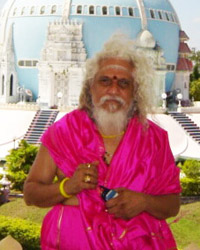
However, on the last day of my summer Clinical Pastoral Education at the hospital, our group had a chance to meet with a swami. A swami ((http://en.wikipedia.org/wiki/Swami)) (the word is derived from Sanskrit and means, “owner of oneself”) is a Hindu honorific title usually reserved learned priest and the most senior Hindu clergy. The swami we met with was Bhagawan Sri Sri Sri Viswayogi Viswamji Maharaj (photo on the right). This is an excerpt from his bio:
“Twenty one years of penance, sadhana, devoted meditation, practice of celibacy, enabled, evolved, Sri Viswanatha Sastry into saint, sai, a towering cosmic source of divine energy…He is recognized and worshipped as Bhagawan Sri Sri Sri Viswayogi Viswamjee Maharaj…Sri Viswamjee enjoins on us the practice of all the four great values, truth, character, purity and unity as our sacred ideals.”
I came into the meeting a few minutes late, but when I walked in, a Christian pastor was opening with a prayer, and then he asked the swami if he might lead us in prayers. The swami, who came with an entourage of assistants, began to lead us in some Hindu chants and prayers, some in Hindi and others in English. It was a very interesting experience, and I think that the general feeling of the group was one of honor that we were able to witness a form of prayer that was new to many, if not all, of us. Some of us even joined in with the English chants (my favorite had a repeating stanza that said, “God is here – God is there – God, God – everywhere”). Another English chant had a few lines that included something to the effect of “God is Jesus, God is Krishna, God is Buddha, God is Allah.”
I know that some of you will have some serious problems with this – but I always enjoy the chance to experience the worship and prayers of another’s religion. It reminded me somewhat of my experience of praying with Muslims at Princeton a few years ago. And I think it is these interactions with other faiths that are incredibly more helpful for our world today, than say these interactions (please watch, it’s short). I don’t know if those comments actually came from US Senators or from people sitting in, but that is reprehensible. That is one of the reasons I believe it is important for me to take part in interfaith dialogues and interfaith activities to try and help people realize that not all Christians are like the ones you hear in that video clip.