Epiclesis Necessitates Open Table

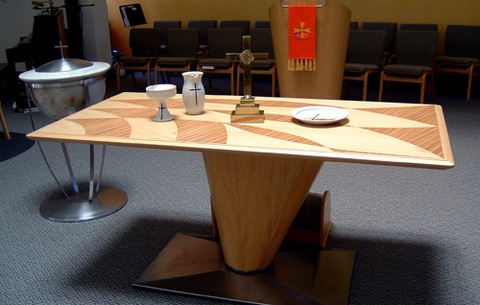
[Photo taken of Communion Table, Font and Pulpit from Anne Lamott's church, St. Andrew Presbyterian Church, in Marin City, CA. I visited this church on June 17, 2004]

Awhile ago at the last Princeton Emergent Cohort we had, we talked about the idea of belonging preceding believing. This is an idea that has been tossed around between many folks, but I first encountered it in Brian McLaren’s book More Ready Than You Realize. I think it is a powerful idea that people today, especially with the rise of the commitment to community; that people today might be ‘converted’ first to a community, to a sense of belonging, and then later to a sense of believing. This conversation eventually led to the question of the sacraments, and how that would work out. I wrote, in a previous post about ‘fencing the table‘, about some initial thoughts about communion and who should be able to participate.

As I’ve sat through my Worship & the Reformed Tradition course this semester, we talked a lot about the epiclesis when we talked about the Lord’s Supper. The epiclesis is the portion of the Great Prayer of Thanksgiving, where we invoke the Holy Spirit onto the gifts of the table. The epiclesis emphasizes the presence and the work of the Holy Spirit – we pray in the epiclesis, “Eternal God, let your Holy Spirit move in power over us…” As we talked about it in class, we talked about how the focus is not on the sincerity of the participant/worshipper, and it certainly isn’t on the sincerity or holiness of the person who is presiding over the Lord’s Supper – rather, the epiclesis focuses the time of Communion on the acts and work of the Holy Spirit.

It seems to me that such a prayer – such a focus on the presence and work of the Spirit, almost necessitates an open table. It’s not about the participant, it’s not about the presider – it’s about God, Christ and the Spirit – so why should we be saying who gets to partake and who doesn’t?

I know that if/when I preside over Communion – I will certainly not say that the Lord’s Supper is only for baptized believers. It’s most likely that I’ll simply say that “All are welcome” and really trust the epiclesis that I pray that it IS all about God and the Spirit’s work, and not up to the faith or participation or worthiness of the person taking part in the sacrament. Wesley believed that the eucharist should be used as a form of evangelism – he commonly welcomed all people, believers and non-believers to the table to partake. Perhaps us Presbyterians may need to become a bit more Wesleyan, because it seems to me if we’re going to emphasize the epiclesis so much, as I think it should be emphasized, then we should also be ‘open’ to the idea of an open communion table.

Comments

  1. - kp - says:

    In other news, it’s Mayday.

  2. jim says:

    I think last GA referred a resolution on this issue (baptism as a requirement for taking the Lord’s Supper) to the theology committee for further review and proposed change to our polity.

    I’ve not checked to see if it’s coming back to this GA for consideration, but I’m all for a change. We had a discussion along these lines in my new members class, someone was surprised at the requirement to be baptised.

    I believe Wesley called it a ‘converting sacrament.’

  3. steve says:

    So what does partaking of communion in an “unworthy manner” actually mean? I always thought it would be for someone who either doesn’t believe or isn’t repentant. (i guess that’s redundant, b/c how is someone who doesn’t beleive become repentant?)
    That’s why i am not necessarily for an open table… at least until i felt more comfortable with what that meant.

  4. Christ welcomes all – sinners and saints. Open the table and allow Christ to do His work. Why would someone at least not interested partake anyways? Let God be God.

  5. lauren says:

    “Why would someone at least not interested partake anyways?”

    peer pressure. you don’t want to be noticed as not partaking… you think everyone is going to be watching you and wondering about you…

  6. Adam says:

    Lauren, I think that’s part of it. However, I remember a conversation I was having with someone who was not a Christian, and we were talking about communion, etc., and I had asked about the invitation of an open table. They said that they wouldn’t partake of it, because they knew it was a very special and holy thing for Christians.

    Not saying everyone is like this, but…I thought that was interesting.

    Another thing, what if we did something like we do at weddings…I’ve heard of the officiants welcoming all to come forward, and those who are not Christian to simply fold their arms across their chest, and they would then receive a blessing instead of taking communion. While that only works if you have people coming forward…

  7. Nathan says:

    While there may be those non-Christian individuals who do not take communion out of deference to the respect Christian’s have for it, in this day and age, I’m much more inclined to believe that people will succumb to peer pressure or simple ignorance in the matter with very little realization about what is going on. I had it happen in my youth group – a foreign exchange student who was a staunch atheist came up for communion at a youth event his host family made him attend, even after I made it perfectly clear that it was a ‘closed table.’ I assumed the evangelistic message I had given (and had been giving all weekend long) had finally taken root, but I was wrong.

    And yes, communion is about the Spirit and His work. However, God doesn’t need communion and the Lord’s Supper is not celebrated for his benefit, but for ours. It is the body of Christ (church) participating in the body of Christ (communion) for our own edification, blessing and growth in the Lord. How can someone not a part of the church (allowing for the broadest definition that is practicable) rightly participate in that? And again, as Steve points out, can someone who denies Christ worthily take part in communion?

  8. Timbo says:

    “[W]hoever eats the bread or drinks the cup of the Lord in an unworthy manner will be guilty of sinning against the body and blood of the Lord. A man ought to examine himself before he eats of the bread and drinks of the cup. For anyone who eats and drinks without recognizing the body of the Lord eats and drinks judgment on himself.”

  9. Mike Noakes says:

    That’s so weird. I have been thinking about the eucharist life and how it relates to protestantism. I came to a very similar conclusion, I think.

    Nice pic. Did you take it?

  10. joel says:

    this is a great conversation, however, timbo, although that is a great verse, care to enlighten us with an interpretation or an explanation as to why you left it? leaving verses without any explanation is akin to someone regurgitating some axiom they heard without the ability to critically or contextually analyze them. here, in the discussion provided, the question was in regards to baptism and the Eucharist.

  11. myles says:

    in other news, it’s MAYDAY. where’s the update?

  12. miranda says:

    A strange thread.

    Presbytarians are an odd lot, but not bad intentioned just tragically misguided.

    People, we are all Gods children but if someone is gay or Jewish, or heaven forbid to the Presbytarians, the Devil on Earth Israeli’s one must be starved and denounced.

    Lets all of us hope in Jesus name for a kinder and more inclusive church than the one we see now.

    I plan to leave, and many more I am sure will go too.

    Anti gay, anti jew, anti this and that. Keep it.

  13. In my tradition of Methodist we maintain an open table to all. Baptism isn’t a requirement, just a desire to be in a reconciling relationship with God and neighbor.

    The reason for this is our understanding that eucharist is a “means of grace”- that God’s grace can preveniently be at work in someone even before they realize it. and eucharist can be a means out of which that is accomplished.

  14. Kate says:

    A pastor I knew called it “God’s Kitchen Table” and that “all who felt called to His presence are welcome”. I love that.

  15. Paul says:

    The more “open” the better, right? You can’t get more open than “Come to me, all you who are weary and burdened…” The only problem is Christ’s openness necessitates a resolved belief–an end to self–a decision to surrender. Solutions are better found when we admit there’s a problem. Cheers!

  16. Erasto Mollel says:

    Open table is there for all those who examine themselves. The Bible is clear that, whoever eats and drinks the body and blood of Jesus is judging himself.

    Open Table meant to reconcile people to God, out of that is meaningless. Reconciliation needs man’s willing together with righteousness. However it should not be used as a
    means of discipline in churches. Everybody who is willing is welcome!

    Erasto Mollel
    Msalato Theological College, Tanzania

  17. Rainy Starc Horner says:

    What is the difference between presbytarians and reformed presbytarians ?I think reformed presbytarians do not use instumental music.Do you have infant or adult baptism? Immersion or sprinkle ?Is ther communion every Sunday? I was just doing some research.Thanks .Rainy.

Speak Your Mind

*