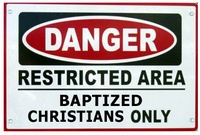
Fencing in the table?

Date November 18, 2005

From the PC(USA) Book of Order, the Directory for Worship section on Baptism, W-2.4011:

“Who may receive: The invitation to the Lord’s Supper is extended to all who have been baptized, remembering that access to the Table is not a right conferred upon the worthy, but a privilege given to the undeserving who come in faith, repentance, and love. In preparing to receive Christ in this Sacrament, the believer is to confess sin and brokenness, to seek reconciliation with God and neighbor, and to trust in Jesus Christ for cleansing and renewal. Even one who doubts or whose trust is wavering may come to the Table in order to be assured of God’s love and grace in Christ Jesus.”

Today in Chapel we were getting ready to receive communion, “This is not our Table, this is not a Presbyterian Table, this is not a Seminary Table, this is Christ’s Table.” And then, I heard something that I haven’t heard before. “All those who have faith in Christ and who are baptized may come to the Table.” Yup, never heard it before, but apparently it’s right there in the PC(USA) Book of Order. And I’m wondering what exactly do I do with that…

When I first heard it this morning, it just didn’t sit right with me. Perhaps it was a slip, because we aren’t in a 100% PC(USA) setting where everyone would have been baptized as an infant or gone through
confirmation, so perhaps it was just a mistake. But I found myself thinking, “I don’t think I could say that.”
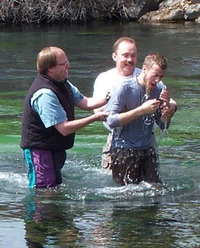
And I think I’m probably a bit more sensitive to some of these issues related to baptism because I wasn’t baptized until I was 23. I was dedicated in a PC(USA) church as an infant, and, because of my mother’s Mennonite values and beliefs, was told that when I was ready to be baptized when I got older, I should do that. And it didn’t happen during college because we were all pretty big church-shoppers back then. So it didn’t happen until I was working in a church in southern Idaho, and it was a pretty great experience, getting dunked and all.

I don’t know - I’m just thinking a lot about baptism today.

And I don’t even really know where I’m at with infant baptism either. I can see arguments for and against it, and obviously I’m coming from a more Anabaptist perspective in my own experience. I don’t know.

I don’t view it as necessary for salvation; so if someone, for whatever reason, hasn’t been baptized, I still believe they should be able to partake in communion and be a part of the body of Christ, so I don’t really know what to do with that line in the Book of Order. I’ve talked to some people today and not many people have ever heard that said in a church before.

Anything that sounds like it’s “closing” off the table of grace and love…that’s not something I’m interested in. But when, how does that work out for me, as a potential PC(USA)-ordained something-er-other, and the Book of Order. How does all of THAT play out?

Tags: , , , , ,

13 Responses to “Fencing in the table?”

  1. welder said:

    Some quick looking makes me wonder where the “…all who have been baptized” comes from.

    It doesn’t seem to be explicit in the Confessions. The closest statement of it may be in the Scots (3.23) which says “the Supper of the Lord is only for those who are of the household of faith.”

    Heidelberg says the people coming to the table should be “Those who are displeased with themselves for their sins, and who nevertheless trust that these sins have been forgiven them and that their remaining weakness is covered by the passion and death of Christ, and who also desire more and more to strengthen their faith and improve their life. The impenitent and hyprocrites, however, eat and drink judgment on themselves” (4.081)

    In 5.204, the Second Helvetic calls for those who take the Sacrament to have faith and that they should do so in a worthy manner.

    And the Shorter Chatechism says, “It is required of them that would worthily partake of the Lord’s supper that they examine themselves, of their knowledge to discern the Lord’s body, of their faith to feed upon him, of their repentance love and new obedience; lest coming unworthily, they eat and drink judgment to themselves.”

    It seems to me that the BOO requirement is “for purposes of order,” and not an essential tenet. But if it came up I would still mention it on an Ord.

  2. welder said:

    The Westminster citation is 7.097.

    oops

  3. Matthew Francis said:

    Okay, Adam, I tried to write a few posts on this topic - certainly an important one, and my words turned into “shabby tools always deteriorating.”

    A regulation like this one seems harsh… until one comprehends what baptism and eucharist have traditionally meant to Christians (including the early Presbyterians who developed these parameters). Then such guidelines begin to totally make sense, and you can actually see them as being full of love. The point is not barring people in need of grace from the table, but rather creating a context in which coming to the table is actually going to be for that person “the medicine of immortality.”

    So I decided I would just mention to you Chapter 4 of Fr. Alexander Schmemann’s book “For the Life of the World,” which is what actually made me think twice about the all-importance of baptism. Yes, he’s an Orthodox priest. But perhaps the Orthodox and the Presbyterians may have a whole lot more in common on some of these issues than we’d ever expect. Or not. If you have the time… go to the library and get this book and read his chapter for yourself. You may not agree, but it might help to see why these types of views are out there.

    And that is trading up traditions for TRADITION.

  4. Katie said:

    I would agree- baptism is not required for salvation nor does it entitle salvation‚Ķ so then why is it required to come to the Lord‚Äôs Table? But then I stop to take into consideration- communion is sacred and should be treated as such… So where do we draw the line? I grew up in the Roman Catholic Church… I don’t like the line there- having to be baptized and go through the proper training-others being a bit ostracized for not being Catholic in a time when the body of Christ is to be celebrated just doesn‚Äôt make sense to me. Since leaving the Catholic Church I played around with all of sorts of ideas regarding communion. I spent a few years even avoiding participation in the ritual altogether- but I was reminded of the beauty in it. The purpose of it to me is not necessarily a means of grace but a reminder of it. So why can‚Äôt anyone who needs this reminder participate? I‚Äôm not sure if I‚Äôll ever understand.

    sorry if these thoughts make no sense or seem irrelevent… you gave a good opportunity to get them out.

  5. Existential Punk said:

    Adam, it reminds me of Catholic and Orthodox churches that don’t allow people the Eucharist/communion unless they are Catholic or Orthodox. There seems to be so much exclusion when this is not what Jesus is about. Thanks for posting this. I grew up Presbyterian as a small child, but do not ever remember hearing this. Adele

  6. Matthew Francis said:

    Perhaps no topic in our Christian faith has raised such controversy as this one, so I want to speak of it with care. From my perspective, the eucharist is a mind/body/spirit reality that transcends our faculty to comprehend fully. Describing it tends to be fraught with struggles. Perhaps it all depends on what the Eucharist understood to be within the particular Christian tradition you inhabit.

    If it is simply a ‘reminder,’ (as many Protestants believe) then, well… perhaps it doesn’t really matter if one is baptized, as a lot of the Churches that hold to such a view see baptism in similar terms. It is a seen to be a sort of personal ’statement’ that doesn’t necessarily accomplish anything.

    If, however, the Eucharist is somehow mysteriously the Body and Blood of Christ (as Christians have traditionally believed) then that is something very powerful, and something that is intricately and organically connected into baptism, which seen as THE manifestation of dying and rising with Christ. Both sacraments, or mysteries as we call them in the Orthodox Church, are for the purpose of uniting our whole selves to Christ, and staying in that communion with him.

    And this regard for individual choice and freedom is one of the intrinsic struggles (and also gifts) that the Protestant Churches have: their members are fully empowered to disagree with them on the basis of their personal reading of the Scriptures. If the PCUSA’s standards don’t seem right to you, then you can work from within to change them, or you can always join some other stricter or looser ‘Presbyterian’ body.

    Your question is an important one, Adam. I think if you don’t agree with the PCUSA’s standards, you owe it to yourself to consider if that is where you want to fully commit yourself in ministry. That said, you would be fully within the Protestant tradtion to live in a constant dynamic tension with your ecclesiastical home.
    Churches are strange things. It’s always easy to fall prey to utopian dreaming on the one hand, or romanticism/nostalgia on the other…

    Seek first the Kingdom of Heaven…

  7. Brian said:

    I’m comfortable theologically with the Book of Order’s standard given the meaning of communion as the feast of the people of God, and the meaning of baptism as the sign of entrance into the covenant community. Having said that, my invitation to the Table never, ever includes this fencing, and says instead “All who trust in Christ….” And it’s a real issue: It is not unusual for me to have several youth in my confirmation class who were not baptized as infants, but have been believing Christians–and participants in communion–for years.

    I’m reminded, though, that Wesley has an even more inclusive invitation than I do. (As I understand it–please correct me if I’m wrong.) I’m told Wesley thought of the eucharist as a “converting ordinance,” and would invite even non-believers to the Table, trusting that God’s grace could work through the sacrament to bring them to faith. This somehow crosses the line for me, although I have to admit that if I think it’s okay for baptized children not yet able to articulate their faith to come to the Table, I’m not sure why I should be troubled by others who are early on their journey joining in the feast.

  8. -drm- said:

    If you thought of salvation as entrance into a community which one can only hope will form you to exhibit Christ, then it might be more clear why baptism (the entrance itself) is necessary for that sanctification, and why Eucharist (the meal of the body of Christ) only can take place amongst those who have entered the Body of Christ. The connection between the two sacraments is both historically long and theologically significant.

    You should spend an hour and read the Lima document from the World Council of Churches, entitled “Baptism, Eucharist, and Ministry,” which is probably the best and most influential ecumenical text on the sacraments from the late 20th century. See:

    http://www.wcc-coe.org/wcc/what/faith/bem1.html

  9. Evers said:

    Great topic, great comments!

    As a pastor, my own practice is that non-baptized persons can receive Holy Communion, but that it ought not be a regular practice. What does this mean?

    If a non-baptized person receives the Body & Blood of Christ, are they doing so unto condemnation? I do not believe so (necessarily; it may be the case that they do so, but the same is true of a baptized person).

    But I would wonder: why would someone repeatedly come to the Table if they do not seek out baptism? As one of my sem profs put it, “If you think this [communion] is good, wait till you see what else you can have [baptism]!” Are they coming to the Table seeking faith? Are they coming seeking a religious experience, without the commitment of baptism?

    This is a delicate issue, requiring much discernment. There is no doubt that the overwhelming judgment of the Christian Church has been that Holy Communion is only for the baptized. That is not something to be dismissed lightly. NOR is this something primarily about hospitality or inclusion. Simply because someone may feel excluded by a practice does not mean that it ought not be done. Any practice a congregation might have could be experienced as exclusionary.

    One of my dear friends, baptized as an adult a few years ago, attended a church for a while where the Table was open to all, including those who were not professing Christians distributing communion. Rather than experiencing this as remarkably open and welcoming and hospitable, it caused her to think, “Well, communion must not be such a big deal if you don’t even need to believe in it to give it out.”

    It comes back, for me, to the question, “Why would you WANT to come to communion, but not to baptism?”

    Peace!

  10. RJSteve said:

    I don’t see the baptism prerequisite for Holy Communion in Scripture. Neither does this type of exclusion seem to be consistent with Jesus’ teaching. We’ve taken this incredible symbol of our redemption (communion) and turned it into one more way to perpetuate the “us-against-them” mentality.

  11. Evers said:

    RJSteve,

    I would argue that Communion is much more than a symbol of our redemption - it is a giving of the very gift of redemption! (But I’m a Lutheran, so I would say that. I fully recognize that other faithful Christians view it as a symbol. I think that understanding, however, impacts how one views the matter.)

    I would also caution (with a post-modern’s sensitivity to the power plays latent within all language) against characterizing it as simply “this type of exclusion.”

    As far as warranting in Scripture, I would lift up the words of Paul in I Cor 11, specifically about examining oneself. My application of these words would be to ask the question: “WHY would one want to come to communion but not seek out baptism?” This isn’t an absolute “wall.” It is, however, an opportunity for discernment.

    I certainly believe that the Lord’s Supper can be an evangelistic celebration. But the ongoing practice of communing without receiving baptism shows an inadequate understanding of either communion or baptism, if not both. This isn’t about exclusion. It’s about wanting to give the gifts of Jesus, to call people to commitment to Christ, and to be honest about what we are doing when we break bread and share the cup. Certainly, some who practice “closed” communion do so in a manner that seems far more intentionally “exclusionary” to me (including a branch of my own Lutheran faith family). But that does not mean that the practice in any manifestation is contrary to the ministry of Jesus.

    Peace!

  12. Dave B. said:

    Adam,

    Thanks for raising this issue, which is important and worth thinking about. It’s also kinda sensetive, since it does relate to issues of exclusion/inclusion.

    A few thoughts:

    1. With many commentators, I’d point out that the consistent practice of the early church was to restrict communion to the baptized. I don’t remember where I read it, but I read somewhere that in the early church the non-baptized were not only not allowed to receive communion, but were actually required to leave church during communion! (Of course, I’d hardly recommend that, but it says something…) The first time anyone took communion was when they were baptized and joined the church. What’s at stake here is not just sacraments, but our theology about how one becomes a Christian and joins the church. The consistent answer of the early church was that you become a Christian not just by what you feel or think, but by what you do (i.e., by being baptized). I’d put a bit of a gloss on that (I’m certainly not willing to say that nobody who’s not baptized is saved), but I’m not willing to throw out that answer either.

    2. I’d be careful about drawing too quickly an equivalence between ‘only baptized Christians take communion’ = ‘a non-inclusive church.’ Yes, some non-Christians or seekers may take offence if they can’t take communion if they’re not baptized, but I think there’s a lot more that goes into being inclusive than simply welcoming people to the Lord’s table. Closed-communion churches can be welcoming, and open-communion churches can be aloof. I think it’s as much about how you explain it and present it as anything.

    3. I think a good way of framing this discussion is to ask if your model of the Communion meal is a) Jesus eating with tax collectors and sinners or b) the Last Supper. In one Jesus ate and drank with everybody, and in the other, Jesus ate and drank with his disciples. I bet (I don’t know for sure) that if you traced the scriptural justification for believers-only communion, it’d derive from that as much as anything.

    This is a hard one.

  13. RJSteve said:

    Evers,

    You make some very good points. In fact, I agree (despite the terminology I used above) that Communion is a means of grace, which is why I hate to see it being withheld. Might not a person may enter the kingdom through the sacrament of Communion as well as through the sacrament of Baptism?

    And while there might be a reasonable case for limiting Communion for baptized believers, it is a shame that many denominations limit it to their own members. In effect, permission to receive the sacrament comes down to a matter of paper work.

    God’s arms are always open. I believe that the sacraments were made for the people; not that people were made for the sacraments.

Trackbacks...

Leave a Reply

XHTML: You can use these tags: <a href="" title=""> <abbr title=""> <acronym title=""> <b> <blockquote cite=""> <cite> <code> <del datetime=""> <em> <i> <q cite=""> <strike> <strong>

Close