Transforming Christian Theology: A Review

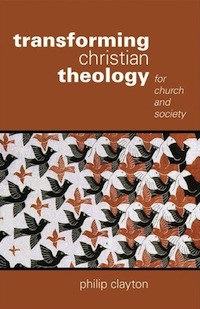
TCTheologyA few weeks ago, I had the privilege of being asked to present at the “Theology after Google” national conference taking place at the Claremont School of Theology March 10-12. I will share more in the future about what I’ll be presenting, but it is going to be a really wonderful event. The event is part of the Transforming Theology project that Philip Clayton directs. I picked up Philip’s new book, “Transforming Christian Theology: For Church and Society” a few weeks ago, and think it’s an incredibly important and timely book for those of us who find ourselves hoping and working for a progressive Christianity. Philip wrote the book in collaboration with Homebrewed Christianity‘s Tripp Fuller – but since I don’t know who wrote which parts, I’ll just be referring to Clayton as the author – though I’m sure Tripp spent a lot of time on the book as well.

I should preface this by saying I heard Philip Clayton read a paper at the Center of Theological Inquiry a few years back, and while there were parts that I really liked – for the most part, I found it to be way beyond me. Sarah and I both spoke with Philip afterward and really enjoyed our conversation; I walked away both very impressed by Philip as a person and a little intimidated by him as a scholar.

So, I found it incredibly interesting that Clayton says this book marks a departure for him of writing theology that is only for the “specialists.” Because of his new understanding of what theology is, more specifically who should be doing theology, he can no longer publish the types of book he had previously been publishing:

“The second step in my transformation is to walk the talk, which means that I must also change how I communicate my reflections on Christian belief and identity. I can no longer publish theology books that are written primarily for specialists. From now on I must write for a broader audience, one that includes ordinary people who are eager to speak clearly and passionately about their faith–and those who are struggling to find out exactly what in the Christian story they really do care passionately about. In this regard, my last book [Adventures in the Spirit: God, World, Divine Action, 2008] represents the end of one era for me, and this book heralds the beginning of the next. Perhaps this will irritate academic theologians and there may be backlash.”

In the book, Clayton walks through three different parts: Theology for an Age of Transition, Theologies That Can Transform the Church, and Theologies That Can Transform Society. One thing I noticed throughout this book is a strong pragmatic bent to it – and Clayton mentions that quite often about the postmodern turn to belief. Theologies today need to work. I think there is an inherent skepticism in emerging generations today if we have air-tight systematic theologies that just…don’t…work. So, this progressive Christianity theology – whatever it ends up looking like – needs to be a theology that works, a theology that makes sense for the world we live in today and one that can be transforming in our lives and in our society.

There is also a call throughout this book to be about the act of rekindling theological imagination. Sarah would like that, as she is always talking about how so many problems we have today in the world and especially in the church stems from our severe failure of imagination. Clayton poses a challenge to many theologians and seminary professors as so much of our theological education today is merely teaching the theology that has been done in the past – and requiring students (those whom we would hope to be creative theologians/pastors in their own right some day…) to simply regurgitate someone else’s theology. How does that help to develop a rich theological imagination?

I know some readers of this blog are skeptical of anything that has the word “progressive” in front of it, let along progressive Christian theology. Many think it’s some namby-pamby/loosey-goosey type of theology. However, one thing that struck me over and over again was Clayton’s call for being passionate and knowledgeable about our beliefs – for holding deep convictions. The oft-quoted 1 Peter 3:15 (“be ready to make a defense to anyone who demands from you an accounting for the hope that is in you”) is not so much about having the right argument or being 100% certain and confident about our apologetics, rather Clayton writes:

“Instead, its primary call is to give a self-accounting – that is, to be able to explain our strongest motivations and reasons. To do this, we have to make sense of our own actions and convictions to ourselves first. Only then will we have any chance of making sense to other people…” (63)

Clayton talks about how so many mainline and progressive folks seem to care deeply about social justice concerns – but have a hard time saying “why.” What are our theological reasonings for caring so passionately about social justice? Can we point to a specific aspect of our Christian worldviews? Is there a specific scripture that speaks to us? Just because we are “progressives” – it doesn’t get us off for the folk for also being Christian and being able to individually know why we feel called to certain things.

For Clayton, anyone who identifies her-/himself as Christian should probably at some point work through what he calls the Seven Core Christian Questions. In many ways, this is what I have been doing through my Credo series. The seven questions Clayton believe are important to reflect on have to do with:

  1. Theology: questions about God
  2. Christology: questions about the person of Jesus the Christ
  3. Pneumatology: questions about who the Spirit is
  4. Anthropology: questions about what it means to be human
  5. Soteriology: questions about what salvation is
  6. Ecclesiology: questions about the church
  7. Eschatology: questions about the “last things”

So Clayton’s definition of theology is: theology consists of all attempts to answer these core Christian questions for ourselves in light of the contemporary world.

Finally, I really appreciated Clayton’s reflections on what it means to define oneself as a “progressive.” For clearly, just as any of our fabricated labels, it has many definitions. He argues that it clearly should not be used as just an updated term for “bleeding heart liberal” because there are folk who are evangelical but refer to themselves as progressive evangelicals. He believes “progressive” is a term that splits the difference between conservative and liberal. Clayton writes:

“…if you are a progressive, you will tend to emphasize change and newness in what the church is becoming. You don’t have to hold to the modern doctrine called meliorism, the belief that the world is just getting better and better. But you do think there are some positive things that we can learn from the contemporary world – from science, philosophy, technology, social movements, other religions, and so on. This doesn’t mean that you disvalue the Christian tradition and seek to replace it with something different. But it does imply that you look for and value partnerships between contemporary culture and Christian faith…being progressive does not mean that you wish to reject the past. But it does suggest a greater emphasis on innovation, on openness to change…I will  use the term progressive to describe constructive theologies that attempt to transform society.” (122)

And what is progressive Christianity’s mission as the church? Clayton looks to theologian John Cobb and quotes him saying that it is “working with God for the salvation of  the world.” Of course – the “salvation of the world” is not some type of colonial desire to “save” everyone and to “civilize the natives” – but rather a more holistic understanding of salvation as both individual and corporate.

This was the first book of Clayton’s that I’ve read, and it’s definitely a very accessible book. I really enjoyed it and think it would have been helpful for me to read as I was starting seminary. If you’re interested in what Clayton’s vision for a progressive Christian theology is – for what a transforming theology might look like and how it interacts with our contemporary world, I’d highly recommend this book.

Subscribe to Pomomusings

Get updates sent directly to your Inbox.

Comments

  1. Adam,

    It will be good to meet you at the conference — as I’ve also been invited to present. I’m just starting to read the book now, as I did the Cox book first.

  2. this book is so awesome i am giving it to my whole family for christmas…..

    thanks adam

  3. Tripp,

    Can you adopt me so i can get the book from you for Christmas? ;)

    Adam,

    i really like that he is getting past academic language and coming to a place where non-academics like myself can access this kind of stuff. Intellectual masturbation is SO overrated imho! ;)

  4. EP – -

    The irony is that it was J. Derrida and his followers who have most notoriously championed that disgusting phrase (“intellectual masturbation”) – - – and it was Derrida who professed to be good at it on purpose ( ! ). Not academic rationalists, for whom Derrida has absolutely no patience. So please don’t lump in academic theologians with the likes of self-centered sophists like Derrida.

  5. Amos,

    i will say that because that has been my personal experience. Theologians and the like talking intellectually about theology in terms not understood by anyone outside of academia and it was intellectual masturbation! i like the phrase as it is accurate and descriptive. Masturbation in and of itself is not disgusting. It is very pleasurable!

    EP

  6. Amos and EP,

    The difference, as I try to show in the book, is that academic theology — the kind that excludes Christians from the dialogue, the kind that I used to write — is damaging to other people. It conveys to people like EP that they can’t really be participants in thinking about their faith, because their own reflections are not complex enough.

    If you train pastors by feeding them this kind of academic theology for three years, telling them that they don’t have enough Latin and German to really understand it, then you send pastors into pulpits with the sense that they can’t “really” do theology in their ministry. Of course, if they believe they can’t think seriously about their faith, then the people in the pews will feel even more excluded. Isn’t this how we have created generations of Christians who think that all they can do is to sit passively in the pews and try to agree with what’s being said from the pulpit?

    Let’s start all over again; everything must change. Is it only the people who are leaving the church and deciding to have nothing to do with Jesus’ message who get ask deep questions and to think seriously about Christian content? Why is it that those of us who are still trying to find out what it means to follow Jesus in today’s world can’t ALSO pursue the hard questions and seek to find strong answers?

    – Philip Clayton

  7. The difference, as I try to show in the book, is that academic theology — the kind that excludes Christians from the dialogue, the kind that I used to write — is damaging to other people. It conveys to people like EP that they can’t really be participants in thinking about their faith, because their own reflections are not complex enough.

    No its exclusionary nature is not “damaging to other people”–it protects them from getting into something that can cause them much harm. Since when is everybody entitled to participate in every conversation? I don’t waltz up to a group of chemists and start telling them how to do experiments. I sure as hell don’t walk into an OR and give a heart surgeon advice. Read Nazianzen’s Orations. For Christian theology, it should be no different: the healing of souls with the intellect is serious business. Amateur’s need to begin as amateurs, but they must not remain so. And not everybody automatically gets to participate–with good reason.

  8. And all of that to is NOT to say that just cuz people need to let theologians do their thing, they CANNOT “think through their faith.” You don’t have to be a theologian to have an intellectual, thoughtfully lived faith. I know plenty of people at my church who are not theologians, but who are very intelligent and thoughtful in the ways they think about their faith. It is a deeply mysterious thing. They take it seriously on an intellectual level. That does not make them theologians.

  9. You know Dr. Clayton, I just noticed something in your response that reveals the real problem here. You must go to church where people in your tradition feel the need to stop going to church in order to “do theology.” Fortunately, people in my tradition–conservative evangelicalism–never bought into that liberal ideal. So we don’t have this problem. Our people both go to church and think hard. So congratulations on coming back around to our way of doing things! ; )

  10. Dr. Clayton,

    THANK YOU! i do not come from a mainline background except once when i was a little girl and my mom was involved in the Presbyterian church. i actually come from an evangelical, non-denominational, charismatic, Bible believing/thumping background that i have been delivered from thankfully! The black and white certitiudes drove me away.

    i have found freedom within the emergent conversation even though here is where i did experience the intellectual masturbation. It was an extreme on one side i experienced as where the extreme on the other side of conservative Bible believing/thumping left me wanting as there was no intellectual interaction. It was ALL touchy-feely emotional manipulation along with using the Bible to manipulate you into submission. Liberals may not have all the answers but at least they allow more voices and interpretations at the table, thankfully!

    i really appreciate your change in direction. i believe we will all be better for it!

    Warmest Regards,
    EP

  11. Why run from one extreme (bible-thumping fundies) to another (confused liberal emergentism) when you could have the best of both worlds in a stable, traditional evangelical church? I just don’t get it, people. Don’t go to wacky churches! Go to healthy churches. And you will find that at the root of the church’s life and health is a steady, tried and true subscription to the worth and work of Jesus Christ and God’s Gospel. It will never get better than this.

    You take the “high” road and I’ll take the “low” road, and I’ll be to Dover before you!

    • go_proton77 says:

      No disrespect but, can you expand a little on (bible -thumping fundies) and (confused liberal emergentism)…What are the characteristics?

  12. i have been to traditional evangelical churches as well and find them sorely lacking. i have found to be most at home in emergent/emerging type places where i can question, doubt, rethink, not have all easy black and white answers and declarations as ‘G-D said it, i believe it, so that settles it’ kind of mentality. i am queer and traditional evangelical churches tell me i am in sin and going to hell. i want NOTHING to do with that, thank you very much.

    So, this is where i really appreciate Phillip Clayton’s efforts!

    Best,
    EP

  13. i am queer and traditional evangelical churches tell me i am in sin and going to hell. i want NOTHING to do with that, thank you very much.

    Yeah. God forbid that somebody should actually tell you to change something about yourself. Don’t go to church there! Too dangerous!

    I’m not interested in “safe” churches. I want to be in a church where I am fundamentally challenged. I want dangerous churches.

  14. Amos,

    ‘Yeah. God forbid that somebody should actually tell you to change something about yourself. Don’t go to church there! Too dangerous!’

    It is one thing to challenge people but it is another to challenge someone on something that is a part of their identity. i do not see being queer as a problem with G-D or sin. i think the scriptures are misinterpreted. That is my opinion and many others think that way too. Those who disagree have the right to their opinion.interpretation of scripture. Challenge me on how i treat my enemies or my neighbor or the poor is fine. BUT something as a part of my core identity as sexuality is, should not be questioned imho. Could i be wrong and missing G-D? Sure. But we all do. i like being in a community that does not have all of life figured out and we experience, discover, encounter the Divine together. i am not interested in cramming my beliefs down the throats of others. i am not out to change minds but to challenge all of our thinking/beliefs, etc because as humans we do not have it all figured out.

    i really find your attitude not very kind and don’t have anymore to say.

    G-D bless you in your journey. May you find your dangerous churches.

    Pax,
    EP

  15. BUT something as a part of my core identity as sexuality is, should not be questioned imho.

    This is the problem. Foucault was right. “Sexuality” has replaced the soul.

    Your core identity is not your sexuality. Your core identity is your soul, which cannot be reduced to any one biochemical aspect of your body’s being.

  16. Amos,

    G-D bless you and your journey.

    Warmest Regards,
    EP

  17. Amos, you seem like a very angry person. Anger is usually a response we initiate when we perceive something to be very wrong. In your case, you feel like emerging and/or progressive Christianity is ‘very wrong.’ I can understand why you feel this way. And yet – I am learning this from my own painful experience – we often project our inner struggles onto the outside world; we externalize our inner drama. As Richard Rohr says,

    “Is your religion helping you to transform your pain? If it does not, it is junk religion. We all have pain—it’s the human situation, we all carry it in a big black bag behind us and it gets heavier as we get older: by betrayals, rejections, disappointments, and wounds that are inflicted along the way. If we do not find some way to transform our pain, I can tell you with 100% certitude we will transmit it to those around us. We will create tension, negativity, suspicion, and fear wherever we go. ”

    I know that if I’m not at a settled place of assurance that something I believe is basically true, I will try to win converts from the outside to help assuage myself of my own beliefs. Hanging around PomoMusings as you do, I think you must be a glutton for this unique form of punishment. :) If you have found the meaning, stability, and environment you’re looking for in traditional evangelicalism, God bless you – truly. But most of us around here come from there; we’ve weighed it and found it wanting. And while we emergents are all about conversation (it’s practically our tagline), ‘conversation’ doesn’t mean setting ourselves up for cycles of verbal abuse (and I do mean cycles, where both parties are abuser and abused). Peace be upon you!

    Philip & Tripp, thanks for writing this book. I’m delving into it at the moment, and really enjoying it. My review will be forthcoming. Adam, thanks for your preview.

  18. As Thomas Merton said:
    “The living Tradition of (the Church) is like the breath of a physical body. It renews life by repelling stagnation. It is a constant, quiet, peacful revolution against death.”

    Human traditions bind the Church to earthly objects and thought that are themselves bound to customs that become irrelevent and outdated to humanity, which is constantly growing, constantly changing. This is not to dismiss the basic truth of Christianity which is grace by faith leading to love. But the message has to be relevent to the time in which it is spoken so that people of that era can see Christ present among them.

  19. What I find interesting is Clayton’s summation of what it means to be progressive:

    “..I will use the term progressive to describe constructive theologies that attempt to transform society.”

    He seems to be suggesting that to be meaningfully progressive, you must move beyond deconstruction and into a more constructivist mindset. Sounds about right.

  20. OregonJohn says:

    “So, this progressive Christian theology – whatever it ends up looking like…. ”

    This is simply a man-centered, humanistic world-view. This is no longer Theology (“Study of God”) but something else. It is no longer Christian either but a syncretistic blend of man-made philosophy, religion and self-serving agendas that are not new.

    God and his nature have been redefined so as to accommodate “whatever is right in their own eyes”. What God really thinks, feels and has done (the very purpose of theology) is now irrelevant. What “I” think and feel matters. There are no absolutes as the Absolute himself has been abandoned.

    The utter disdain for the clear message of scripture is a sure example of Paul’s statement that in the last days “men would be lovers of themselves”.

    Please — go find some other god to redefine, some other book to rewrite, some other virtue to debase and destroy.

    This is no theology. It is not “Christ”ianity but just some old, tired, dredged-up, recycled lie from antiquity with new clothes. You fight against the good and call it evil. You are warned and you call this “hate”. You take evil and call it good and think yourself wise.

  21. OregonJohn,
    Why is it that so many people want to filter Christ message through the writings of Paul or even the Old Testament? We have no place deciding for others what their relationship with God should look like. Read John 21:21. When Peter began to compare his relationship with Christ to John’s relationship with Christ the response from Christ was what does my relationship with him have to do with you (paraphrase).
    It will take a lifetime for each of us to deal with our own sins. Stop wasting time defining sin for others.
    God has better things than that for you to do.

  22. OregonJohn says:

    Larry C — you don’t get it. God defined sin for us already. I don’t define it. You take that chapter completely out of context. It has nothing to do with definition of sin.

Trackbacks

  1. [...] just read a read a review of Philip Clayton’s Transforming Christian Theology, over at pomomusings.com. In describing the book, Adam talks about how Philip Clayton is transforming his theology from [...]

Leave a Reply