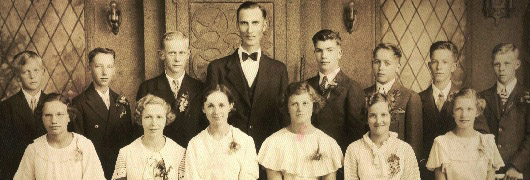
For those of you who are youth ministers in mainline churches, you’ve probably been in charge of Confirmation class. I grew up in a Presbyterian church for awhile, but left around middle school (to join the ranks of the Nazarenes for awhile), so I have never had the opportunity to go through Confirmation.
I share the same frustrations that many of you have with confirmation…it is often viewed more as a “graduation” from church for many of the youth who go through it. It’s viewed as this great accomplishment, and then once they’ve been “confirmed” – then they’re free. They’re done. And many times we don’t see them back in church.
Such an odd thing.
I met with our two Confirmation teachers this past week, and we had a good conversation about what is working well, what we could be doing better at, and they are hungry for new, creative ideas and resources for a United Methodist Confirmation class. The Confirmation youth here meet Sunday mornings during the Sunday School hour and go through a Confirmation curriculum for one year. In addition to that, they worship with at a Jewish synagogue to learn about the Jewish roots of our faith, have a lock-in, go on a Confirmation retreat with other youth from our conference, and have a Confirmation Banquet.
It’s a solid program, but they are looking for some new ideas. If you do something that you think is really unique with your Confirmation class, or have heard of other programs that you really respect, please share some of those ideas below.
Related posts:
- Being Liturgical On-the-Go
- Sex & Youth Ministry
- Sponsored Post: The Thoughtful Christian
- Rethink Church: A Collaborative Sermon


{ 14 comments… read them below or add one }
Hey Adam – I’ve been asked to create/lead a confirmation class for our youth this year too. One thing we did in the church I grew up in was to have the youth create banners that hung in the sanctuary on confirmation Sunday. The banners had their names, a Bible reference of their choosing and symbols/images that represented things of importance to the students. The older members really appreciated the banners because it gave them more information about the confirmation class and helped them connect with like-minded folks.
If Confirmation is traditionally understood as an affirmation of baptism, and if in infant baptism parents make certain faith commitments while being surrounded by the promises of God, I think that Confirmation should have an intentional parent/child connection. One church where I worked had a required – REQUIRED – retreat where the student and their parent attended, fostering faith conversations between parent and child, among parents, and among children. It was excellent.
I’m also a big fan of getting kids into the world … take a scavenger hunt in a local mall, looking for things such as The number of ads/posters/mannequins featuring scantily clad women (vs. the # featuring scantily clad men) (for example) … and then reflect on what you see at the mall in terms of our faith.
Also, we just took a few of our kids to an urban immersion event to explore issues of homelessness and hunger. It was an excellent experience for our suburban kids ….
We do a mentor-based model for confirmation. We use Willimon’s “Journey to Discipleship” curriculum, but we team up every young person with an adult church member. They meet once a week at a time and location of their choosing and go over the material in the schedule we’ve created for them – that includes the curriculum as well as some “Following Jesus” activities near the end of confirmation. The latter is intended to remind them that it’s not just about believing in Jesus but following him – so they help out at a local homeless shelter, bake cookies and take them to the fire stations in town, etc.
I can’t say enough good things about the mentor model. While they do have a few group sessions with me as pastor to talk about sacraments and church history, the spend the vast majority of their time with their mentor. We tell our mentors they are not there to answer questions but to journey alongside their young person. It’s wonderful to see these relationship develop and be sustained over the years. It’s also great that the experience is not only life-changing for the confirmand, but the adult as well.
Ropes Courses: take the kids to a low or high ropes course midway through the confirmation experience or towards the end to give them the opportunity to connect with one another at a deeper level and have a real-world experience of what it means to work together as the Body of Christ.
Exposure to Other Traditions: like your current church’s practice of taking the kids to synagogue, when talking about worship why not take kids to some high-church and low-church sanctuaries (with the pastor or priest’s permission). I have seen kids really start to understand why and how we worship the way we do by considering how Roman Catholics or the local Community Church chooses to engage in worship of God.
Journey to Discipleship: I have used this resource half a dozen times in a small town small church as well as in a medium sized suburban church and it has been well-received and beneficial. Harvey G. Throop is the author and the curriculum is a survey of the Bible along with subject matter considering what it means to be a church, worship and sacraments, and spiritual disciplines.
Oddly enough, I just posted an idea for Confirmation Ministry (a few hours before your post went up, I swear!). http://erikullestad.blogspot.com/2009/05/one-word.html I’m looking forward to seeing what your readers have to say about this important and challenging ministry.
see http://www.faithink.com
what’s unique there is that they are centered around the process of “incubating” faith in every home, every night
the center is the Faith Five (practiced at home and in confirmation)
1. share highs/hows (a form of the examen for regular people)
2. read Scripture
3. talk about how the Scripture speaks to the highs/lows
4. pray, giving thanks for the highs, asking for help with the lows
5. bless each other before turning out the lights
it’s about equipping households for the process of faith formation
tim
Mentor models can work well, but make sure the activities aren’t in opposition to any church policies you have designed to prevent child abuse (for example, don’t have a youth and an adult meet one on one in a private place. ever).
In the past, I have had youth create some form of faith statement–they can either write one, or create one artistically. We’ve seen beautiful paintings, sculptures, and other art pieces come to session meetings. They can’t just put a piece of play dough on the table, of course. It also requires them to interpret their creative works in light of their faith. That can engage kids on many different levels.
I like the other ideas mentioned and look forward to reading more.
We incorporate mission so it includes not only learning about their faith but also how to live out their faith…..Our mission projects include “worship on wheels” after church we take worship to the home of a “shut in”, feeding breakfast to the homeless, helping our older member with yard work…we also have them plan and lead a worship service. What ever the church does, we try to involve the kids in as well.
During the course of the class (ours meets for the whole school year) the class wrote a joint statement of faith. We used that statement during Sunday morning worship the day they were confirmed.
Though we’re a small church and don’t have the opportunity to do this every year, in past I’ve blended my confirmation class and my adult new members class.
And no, it isn’t just because I’m lazy.
It’s because I want to say to these young human beings, “Hey, you, you’re not a child anymore. When you take this step, you are becoming a full-fledged member of this church and follower of Jesus. I expect the same things of you as I expect of the older folks who are committing themselves to this ministry.”
dang, don’t let the ordination process find out you weren’t confirmed or they may make you go through that process again too! :D
What we do that I didn’t hear in your post:
1. Mentors – each youth is asked for up to 3 church members who they would like as their mentor. Assuming they are acceptable (they usually are), we ask the mentor telling them that they were specifically requested. The confirmands meet with the mentors ideally every other week.
2. Service retreat – we do a service weekend retreat at Broad Street Ministry in Philadelphia in December.
3. Variety of teachers – just about every class is taught by a different person from the congregation. I’ve taught the unit titled Presbyterian 101 and the unit titled Creeds, Catechisms and Confessions. We get a rabbi friend of our youth director to teach the unit on world religions, usually doing Jewish-style scripture interpretation.
4. Ceremony – after the Session meeting where the confirmands are received, we have a special prayer ceremony recognizing each confirmand and their special gift.
All these comments seem to point at what we do, too, which is , action. I don’t know that our curriculum is particularly amazing, but we do get teens saying they learned a lot, so I suppose that’s a win.
We teach them to make communion bread all the while talking about community.
We do lectio divina (or artio divina, as I call it) with a part of the Christmas story and paint and canvases.
We watch movies like The Mission and clips from Buffy, Firefly, Lord of the Rings, etc.
We do scavenger hunts.
We ask hard questions about how the scriptures got to us and don’t answer them for the kids.
We spend time with them, which I think is the most important of all. Just chatting, asking about their lives, taking them seriously.
We also make a big point to the teens and their parents that, if they’re not feeling it, if they’re not ready to be confirmed, don’t.
This is a great “accidental” find!!
I usually encourage youth to work out some of the “burning” questions that they have, by that I mean the questions that is most likely to keep them from being a really active christian- we let it boil sometimes. Generally they are very grateful and the good news is that we have brought many many persons into a full active church life. These are the adults who come back and say how good it was in their “good old days”.