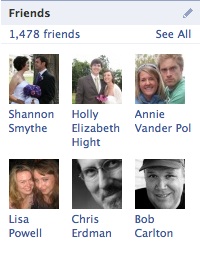
When I’m talking about Facebook, or explaining it to someone who may not be familiar with the social network, it generally comes up that I have a lot of connections on Facebook. As of December 8, 2008, I have 1478 “Friends” on Facebook. Now, many people handle their Friend Requests differently on social networking sites like Facebook and MySpace. Since it is a social “networking” tool, I tend to not be too conservative with how many I accept. Considering that pomomusings has a very high readership, there are many folks who want to be “friends” on Facebook who I have never met and only are blog readers. We have no connection other than that. And I don’t want to alienate any readers of my blog, so I generally accept those Friend Requests. My new policy is that if I don’t know the person, and we have zero friends in common, I will ignore their Friend Request (unless they’ve written a personal message saying why they wish to connect). At any rate, with all of these social networking sites and different ways of connecting, it raises a number of issues to think about, specifically related to how we define “friend” in this web 2.0 world.
What is a friend?
One of the first natural questions is “What is a friend?” I have 1478 friends on Facebook, 179 connections on LinkedIn, 366 followers on Twitter, 682 people subscribed to pomomusings RSS Feed and an average of 700 unique visitors a day here at pomomusings. Am I truly “friends” with each of those people? Would I feel comfortable calling them up and having a conversation? Of course not. There are some people on Facebook who I’ve never met (and probably never will) who I am friends with. There are some people on Facebook who I disagree with very strongly who I am friends with. And there are probably even some people on Facebook who I don’t really like, but I am still “friends” with them for whatever reason.
So, are there levels of friendship? Or do these types of social networking sites simply downgrade our value put on friendship? Does it spread our friendships so wide that they get stretched too thin? In some email correspondence with a pastor I used to work with, he told me he believes that there are some friendships in our lives that are meant for certain seasons of our lives; they aren’t meant to continue beyond a certain specific location or phase of our lives. So, while I know he sees the benefits of social networking sites like Facebook, he would say that it makes staying in touch with people who we should probably “move on from” too easy.
What do you think? Are there friendships that are probably better in the past, rather than continuing them on indefinitely, which is now possible with sites like Facebook? These aren’t questions I necessarily have answers for, but would love to know your thoughts. I’m inclined to believe that perhaps he is right about certain relationships being better off just as memories in the past, than in continuing to develop. But I also think there are those relationships that we want to continue to foster and develop, even though we may be in different geographic places now.
Also, while I certainly use Facebook as one of the primary ways to stay up-to-date with some of my close friends, it’s also a way for me to network and make connections with a large group of people. So, in a way, I suppose that these types of social networking sites, while creating large web-like structures for friendship, as least in my experience, it simultaneously creates a new type of hierarchy, in which there are ways in which I tend to place a higher priority on some of my Facebook friends than others [we'll see if I lose any friends with this post]. Is it just me – or does anyone else experience anything like this?
Un-friending People
Another interesting question is the idea of “un-friending” people on Facebook and other social networking sites. One of my friends from Columbia Seminary, Jeff, has held two rounds so far of the “Facebook Friend Clear-Out” (I actually got cut in the second round, but I’m back in now – no worries). What does it mean to un-friend people in an era of social networking? I went through a phase when I first started with Facebook that I would just accept anyone’s Friend Request that came in. However, around six months ago, I started to think “I should really go in and trim down those friends…” But – are we at a stage yet where that is acceptable Facebook/MySpace etiquette? Or is that something that would still be seen as an affront against the person you’re removing as a “friend?”
Anyway – let me know your thoughts on all of this. Maybe I’m just way off and making too big a deal about this. But it does seem like in our world of social networking, the concept and definition of “friend” is under re-evaluation and it will be interesting if this technology begins to have an impact on sociology and the way in which we relate to one another and befriend one another.
Related posts:
- Contact
- How to Get Work Done and Stay Connected
- Signing Up For and Using Twitter
- Virtual Community IS Community – RIP @gideony


{ 23 comments… read them below or add one }
Most of us probably think of warning teenagers about this… but I think one of the realities we can forget is that unless we alter our privacy settings everyone of those 1478 friends sees every public conversation and status message we post. That probably means that unless 1) our life is an open book; 2) we practice some kind of judicious self-monitoring of what we post; or 3) we have some kind of privacy/filtering levels in place… we will eventually say something we regret.
Besides the general good practice of not gossiping or speaking ill of another, I have learned as a pastor not to say anything in private conversation that I wouldn’t mind being shared publicly… that discipline carries over well into Facebook practice. But even then, one can’t always control what is posted TO you… that also goes out to all friends.
Something to think about…
I’m a relativist on this subject, and think that whatever approach individuals choose on this is what’s best for them.
I love Facebook, and appreciate the opportunity to keep in more regular contact with family and friends, as well as connect further with those I’ve met via the blogosphere, not to mention past friends. I have chosen to un-friend people occasionally. Sometimes I’ve needed to “move on”. I think that is part of life, and doesn’t necessarily have to be negative.
I was interested to see that though we weren’t Facebook friends, we have 83 friends in common. I just sent you an add.
I’m sincerely glad you brought this up. I’ve been curious whether the social networking thing potentially de-values the face to face deepening of friendships. And does it further push an individual to emphasize branding or marketing themselves in order to gain more friends or better web presence? Does my web identity match my real life being?
I also have benefited from the pro’s of social networking, being able to stay in closer contact with good friends that are separated by several states.
I also appreciate your question about how high a value to put on friendships from past seasons of life. Occasionally, as strange as it sounds, I’ll write down a list of people that belong in inner circles or outer circles of my time and attention in an attempt to be more intentional with the folks God has gifted me along the journey.
Great thought provoking and necessary post!
For adults, I think making “friends” with anyone would be acceptable. I try to only add people I know on Facebook because MySpace became so overloaded with tons of people I didn’t know or ever talk to.
However I got more lenient and started adding people I had “heard of” just to get a glimpse of other’s lives and for kind of a networking system like you said.
Hence, I have Adam as one of my Facebook “friends” as I try to learn more about his ideas and different perspective. We’ve never met in person as well as some of my other “friends” like Marko, Griff, McGill, and some other people I have met on other sites. Someday I will meet these guys and we’ll kinda already know each other and it will make our first face-to-face a little easier to cut out the chit-chat and talk about what really makes us tick.
I do have a few people I really have no desire to ever meet in person and it makes me wonder if I should remove them from my friend list. I usually have no problems doing it. I think removing people whom you really don’t know is “allowed”. After all if you have people who you don’t know, it is likely they don’t know you either and won’t notice if you’ve removed them.
I would caution kids and teens from adding anyone though. I think teens above all should be more discerning about whom they add. The thing I have noticed though is teens tend to add as many people as they can get their mouse click on.
“Are there friendships that are probably better in the past, rather than continuing them on indefinitely, which is now possible with sites like Facebook?”
There are people I think about a lot and then people I think about every once in a while. But some of those people I think about every once in a while – would be nice to contact at that time…I think there in is the beauty of Facebook and sites like Facebook. May even more so with Linkedin.
It gives you the opportunity to reconnect at a later date.
@Robert – would love to hear how you use/set your privacy settings. What do you think are some smart ways to handle that?
Most basically, I have a friends list called “limited profile” that limits info to contact/work info and some basic stuff, but doesn’t allow access to all the personal conversation. If someone makes a friend request without comment and I don’t know them, that’s where they go until they message or otherwise reach out. There are a few other special people that get to go there (like ex-g/f)… etc…
I have started to categorize other friends as well into “high school,” “college,” “PCUSA,” etc… – and sometimes make minor distinctions there – like I generally only make photo albums of my children available to my church family and relatives, etc… if the friends’ lists are in place, you can make just about any piece of information available or not.
I’m probably over-cautious… but then, I’m old. :)
Just ran across an article on Slate called “The Facebook Commandments.” It’s over a year old, but still has some interesting thoughts for how to relate to others on Facebook (specifically around friending people and de-friending others).
@Robert, thanks for your thoughts. Yah, I have some pretty extensive Friend Lists – I find them to be pretty helpful. So, I should probably go through those and think about who I want to be able to see what. I think it’s an especially interesting question related to ministry, specifically youth ministry. My Facebook Status Updates come from my Twitter account, and occasionally I’ll say “Damn!” or some other mild expletive on Twitter. So, feasibly, any of my youth (or their parents…) could see those updates.
Is that okay? Should I block my youth from seeing my updates just because I might use some profanity? Or is that all part of the transparency that we are hoping to create in our ministries…? So that they can see that I too am a real person…? I don’t know. Good questions to be thinking about though.
Interesting discussion since I’ve just recently made a Facebook account. I have maybe 28 friends. lol… I got it originally at the request of a young woman who I “met” while playing an on-line game. She lives in a small village in England and seems like a nice person, very funny, fun to chat with. So I added her as a friend. Well then I discovered that her favorite thing to do is go to the pub just about every night. Nothing wrong with that I guess. However — she would then post photos and very x-rated comments about them, which appeared on my wall! (not sure what setting that is that allows photos to appear on others’ walls?)
So — I’ve heard stories about how job applicants lost possible jobs because of what they had on Facebook or blogs. And somehow I didn’t think her photos and comments were appropriate on my wall when also on my friends list are the dean of my seminary, people from CPM, and my pastor! rofl…So I “unfriended” her. I’m going to go read that article now that you linked, about Facebook etiquette. But she’s still banned. lol..
Perhaps the desire I have to share this story on a public blog demonstrates another interesting psychological phenomenon of our time, but I will share it anyway. As to the “unfriending”… Once upon a time I had a very dear friend I talked to at least three times a week. We were “friends” on facebook, but never communicated via facebook, only “old school” phone calls and text messages. One day I found out that he “unfriended” me on facebook. Why? He “friended” his wife. Whoops. It was the end of our real friendship. For real. So there you go…. at least one example un-friending going terribly, terribly wrong… These are good questions you raise.
I keep in mind that the term “friend” is the choice of those networking sites, and not my own. I started to use the networking sites in an attempt to try and see where people from the past were that I had known or had some dealing with. At the same time, I also recognized the potential for keeping up on thoughts from guys like Adam or Tony J that I have similar thinking or whose perspectives I respect, and chose to sparingly add in a few characters like that, though we’ve never met. I don’t categorize them as “friends” per se, unless I have had on-going contact and have “gathered” enough from those interactions to assume that such a title does, in fact, apply. And just like in actual face-to-face relationships, that’s a subjective thing- who I call friend might not consider me as such. I might also add that online sometimes it seems easier to really gather who someone is, as opposed to meeting them face-to-face. If that makes sense.
For me, Facebook is a good way to keep up with people I might otherwise lose track of. This doesn’t mean that our friendship really continues beyond the time and place it was supposed to in real life–people I knew in high school are on my friend list, but it’s not like I call them up all the time or go hang out with them just because they’re my Facebook friend. But it’s nice to know what they’re up to. Friends who are closer are fun to chat with or play games with, and Facebook does make it WAY easier to stay in touch with acquaintances who I know but don’t get to spend a lot of time with. Then when we meet in real life we can say, “So, I hear you went to the City last week…” or something.
But I’m pretty selective about what I put up on Facebook. I add only people I know or people who send friend requests who I know have commented on my blog and they seem nice, or something like that. But there are a bunch of high schoolers on my friend list because I’ve done a lot of youth ministry too–so I don’t say anything I wouldn’t want them to hear.
Your question in your comment about whether we should say whatever it is we feel like saying on Facebook is a good one–in some ways, we need a place to express who we really are and that sort of thing, but in other ways…perhaps the Internet isn’t that place. Everything I say on the Internet is true of me, but that doesn’t mean it’s everything I feel, or that what’s on Facebook is everything I do with my time. I think youth should get to know the authentic “me,” and “you,” but will they get to know that through our Facebook updates, or through hanging out with us in person? And should we say whatever is on our mind to youth? For me the answer is “no,” which I don’t think is belittling them or not being real, but it’s being aware of the developmental stage they’re at, how adults have hopefully learned to use discretion about certain things while high schoolers shouldn’t start doing those things till later because they wouldn’t use that kind of discretion.
I do think Facebook “friends” in some ways reduces the quality of the word “friend,” but at the same time, most people I know use the term “Facebook friends” in quotations (even in conversation), meaning yes, I’ve added these people, but they’re not necessarily true friends. So there are kind of two different meanings for the term developing, maybe.
Good thoughts–stuff I’ve thought about a lot, too. Hope you are well!
Some comment you made caused me to think about the fact that I tend to be more active on Facebook with people who are also active on Facebook – whether they’re close “real” friend of mine or not. In some instances this has caused me to become more engaged with people I’ve lost touch with over the years.
There is another level of weirdness for women out there as well. There are a number of guys out there just trying to see how many women they can be friends with and then send creepy application crap to. So even if we have friends in common, if a guy only has female friends its a no go.
The weirdest thing about Facebook friends though is running into people in real life. A couple of times now I’ve had people approach me in random places like the grocery store and say – “You’re Julie, we’re Facebook friends, I read your blog.” So this is a whole new level of social dynamic. Its not like someone approaching a favorite author or something, but they know that I was up all night with a sick kid. One one level its creepy, but on another level it cuts the crap out of conversations and gets to the reality of life that much quicker.
I navigated to this from Tony Jones’ website, where I was checking to see if the link he posted to my blog yesterday (crikey!) was back up (it’s not, which is totally fine with me). So that’s a window into my starting point here…
I’ve had a growing sense of discomfort with Facebook, although I am also a total addict. Everytime I post a status message I think “who am I offending today?” among my 572 “friends”, although there is, of course, never any offense intended. Some notes I’ve posted have resulted in vigorous debate between various sets of “friends”. I think this debate is basically positive and healthy, but I always wonder if I am jeopardizing myself professionally by having all of this personal interaction online where it could possibly be misinterpreted.
That being said, I have connected, and re-connected with folks over Facebook whom I would definitely not have run into in real life, and this has almost always happened when I’ve gone out on a limb and put up a status message or a post that gave voice to something possibly too intense or controversial. Also, as a raging introvert who can barely summon a mono-syllabic “gurg” when in a room with total strangers, much less handle full conversations, being able to do all of this interaction in writing is a total God-send.
I particularly like the above-mentioned idea of creating several different lists, which I think I’ll do. I work at a university, so I do have a limited profile list for my students, but I don’t have anything similar for other “friends”. This does seem the better part of wisdom to me.
I would like to echo what Julie said – I deliberately choose to leave my relationship status and my birthdate to avoid creeps from searching me out. I did the same thing on MySpace and the stalking was kept to a minimum. I also don’t give out my phone number or address on Facebook. But I’ve lost track of the number of people I meet who know me via Facebook, God’s Politics blog, my books, etc. – it does create a weird level of intimacy but as Julie noted, it does cut through a lot of the conversation crap.
Adam – re: your Q about profanity. My suggestion is if you want to swear, then set up a list of people who don’t mind if you swear and send those comments to them only. I’m not a techie but sounds like others here are and can help with that. I have caught serious heat for using what I thought was mild profanity (such as crap – that’s why I invented the term crapola) in blog postings by a select group of Christians tolling the internet looking to slam me. That’s also why I post on blogs only using my first name and why I keep my MySpace and Facebook pages relatively clean. Lessons learned.
You raise a larger Q that some have addressed in the comments – IF you are a professional in ministry (and yes that includes anyone who publishes a book and markets themselves to the US Christian market), then you need to think about the image you present to those who are in a position to hire you. For example, would you bring anyone in as a keynote speaker or even a workshop leader, who has photos of themselves getting drunk (you can untag photos that people post), has girls commenting about how ‘hot’ the dude is (you can delete comments), posts status updates talking about how bored they are while speaking at X event (wonder how the sponsor who paid for them to come speak feels here), complains that they’re stuck with publisher y when publisher x wants them (in today’s tight economy, that’s a double slap to those who just lost their jobs or found their book proposals suddenly circular filed), let’s people superpoke to drunk dial and grope them (that’s why I never accepted that application), pretends to stalk people, and so on? These are moves I might expect from a teenager but not a professional with a postgraduate degree. I don’t hire people to speak, so I don’t have an answer but this strikes me as a disaster waiting to happen.
A friend of mine in higher ed told me once about an article she read for work discussing how social networking is changing the way college students develop social connections on campus. Since it is now so easy to stay in immediate contact with high school friends through social networking sites like FB and myspace, college students (especially freshman) living on campuses far from their high school friends are not “letting go” of these relationships as easily as they did a few years back, and are not developing the strong ties they once did to the people on their floor or in their dorm — the people they actually live with 24 hours a day now. Very interesting.
Hey Adam! This was an interesting read for me. I know I’ve been un-friended a couple of times but couldn’t tell you by whom…I just notice that my number is down. I kind of wish that FB would tell you when you’ve been unfriended or when a friend has cancelled their account. I think sometimes this could be a hint to a conflict that I’m completely unaware of and I’d like the chance to respond.
Does that make sense? I have lots of people I refer to as “friends” (complete with the air quotes) on the internet. People like you who I like to bounce ideas off of but I haven’t actually met in person. I really appreciate that we live in a world where this is possible.
I would like there to be a social networking site that allowed one to distinguish between different types of relationship:
close family
extended family
close friends
old friends (once close, but whom one hasn’t seen for some time)
work colleagues
business contacts
acquaintances
online friends
online acquaintances
I must say I get a bit annoyed when I read that someone has made me a “friend” on blog catalog, for example, when they haven’t even looked at my blog. I’d really like to unfriend them.
“Online friends” would be people I’ve talked to regularly on mailing lists or private e-mail for some time.
“Online acquaintances” would be those whose blogs I read, and who read mind, and who’ve commented on my blog posts a few times.
But people who have never communicated with me in any way, and haven’t even read my blog — those I would like to unfriend.
Adam, thanks for this great post, especially the part about “unfriending.” I have been thinking about Mark Twain’s statement that “To the man with a hammer, everything looks like a nail.” It seems that eventually our use of social networking with “friending” and “unfriending” will subtly affect and shape the way we see relationships in the real world.
Something you have not touched on that is an interesting trend is how companies are looking at individuals Facebook and/or MySpace to “see what kind of person they are”. I as well do not censor my facebook statuses and have members of my church on my friends list. I am also a 1000+ friend Facebook member.
My name is Jonathan and I have a Facebook problem.
Interesting thoughts…
I do have a facebook account, but the friends I have in my list are mostly the people I’ve been around with in the past, and in the present as well. I am well aware that I’ve got almost everything about me on my facebook profile, and I prefer to allow only those I’ve been close to, to be in my list of friends. Well, there are a couple of new ones, who have visited my blog, and of course, I accepted their friend request…
I would hate to un-friend anyone, so I guess it would be much better to accept those I know I truly consider friends…
{ 2 trackbacks }