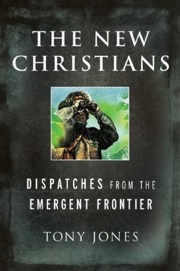
The New Christians: A Review

March 10, 2008 · 6 comments

in Books,Emergent

UPDATE: Book giveaway. I have 4 copies of “The New Christians” to send to the first four people who email me with a picture of Tony’s footwear of choice while he’s on the road.

Prior to reading The New Christians, I have always told everyone that Pete Rollins’s How (Not) to Speak of God has been the best emergent church book written yet. I’ve read tons of stuff from Brian McLaren, Tony Jones, Doug Pagitt, Tim Keel and others, but I thought Pete did an excellent job of presenting the theological and philosophical foundation (or, I suppose that would be a non-foundation) for Emergent, as well as showing very practical ways in which that worked itself out in his own faith community, Ikon.

However, there is a new kid on the block: Tony Jones’s The New Christians: Dispatches from the Emergent Frontier. I received an advance uncorrected proof of this book a few months ago, and I read it in a day and a half I think. However, I just got the hardcover review copy in the mail the other day, and let me just say that in addition to being a great book, it just feels like a great book. The design and layout of the book is impressive, and other than the publisher spelling Dan Kimball’s name as “Don Kimball” – it looks great.

This is an extremely ambitious book by Tony Jones, the National Coordinator of Emergent Village, and a good friend of mine. He has written the book that I think many people have been waiting for. This book gives a very honest portrayal of the beginnings of what became Emergent Village (including some very revealing statements about Mark Driscoll’s initial involvement with Emergent), tries to explain who these emergent Christians are, looks at the theology of emergent Christians, and gives us some practical “on-the-ground” encounters with emerging churches and “dispatches” from those who are involved with the emergent church movement. This is a helpful book; but it is also, primarily, a hopeful book. It exudes hope for the church; hope that comes through a process of deconstruction and reconstruction, but hope nonetheless. Tony talks about how emergent folk have a “hope-filled orientation toward the future,” and this book exemplifies that hope. After reading this book, one can’t simply accuse emergent Christians of “deconstructing everything to death.” Emergent Christianity, as Tony puts it, “is an effort by a particular people in a particular time and place to respond to the gospel as it (once again) breaks through the age-old crusts” (37).

There are 20 “dispatches” from the emergent frontier that Tony mentions in his book – here are some that I really appreciate and find helpful:

  • Emergents find little importance in the discrete differences between the various flavors of Christianity. Instead, they practice a generous orthodoxy that appreciate the contributions of all Christian movements.
  • Emergents reject the politics and theologies of left versus right. Seeing both sides as a remnant of modernity, they look forward to a more complex reality.
  • The emergent movement is not exclusively North American; it is growing around the globe.
  • Emergents see God’s activity in all aspects of culture and reject the sacred-secular divide.
  • Emergents believe that an envelope of friendship and reconciliation must surround all debates about doctrine and dogma.
  • Emergents believe that theology is local, conversational, and temporary. To be faithful to the theological giants of the past, emergents endeavor to continue their theological dialogue.
  • Emergent believe that truth, like God, cannot be definitively articulated by finite human beings.
  • Emergents believe that church should function more like an open-source network and less like a hierarchy or a bureaucracy.
  • Emergents start new churches to save their own faith, not necessarily as an outreach strategy.
  • Emergents firmly hold that God’s Spirit – not their own efforts – is responsible for good in the world. The human task is to cooperate with God in what God is already doing.
  • Emergents downplay – or outright reject – the differences between clergy and laity.

If you’re not familiar with the emergent church, you need to read this book. If you are familiar with the emergent church, you still need to read this book. Tony has written a great book here, and I hope you’ll take some time to give it a read.

Related posts:

Stay In The Loop!

Subscribe to the Pomomusings feed via RSS or Email to receive notifications when new posts are published.

{ 4 comments… read them below or add one }

1 Shawn Coons March 10, 2008 at 9:13 am

My father-in-law is the new General Presbyter of Transylvania Presbytery. He’s a year or two past 60 and was visiting us this past weekend. He picked up my copy of “The New Christians” and got almost all the way through it in two days. He’s going to buy his own copy when he got home.

It’s exciting to have a book that you can feel comfortable pointing people towards to get a sketch of what this “emerging” thing might be.

Reply

2 jeremy z March 10, 2008 at 10:18 am

I just pick up my copy at Barnes and Noble on Saturday. How can a Christian bookstore not have Tony Jones, while Barnes and Noble has Tony Jones on their front table? Instead the Christian book store had MacArthur’s new book on the front table. I about puked up my eggs and bacon.

What is this world coming to?

Reply

3 Danny March 10, 2008 at 10:02 pm

Yes. I have read from a number of sites that Christian bookstores simply aren’t selling Tony’s book, why is this so? It seems so strange.

Reply

4 Dan Morehead March 21, 2008 at 11:37 am

Maybe I’ll read it this summer, although I did have a bit of a gag reflex while reading over the bullet points. Shall we?:

* Emergents find little importance in the discrete differences between the various flavors of Christianity. Instead, they practice a generous orthodoxy that appreciate the contributions of all Christian movements.

You can do the latter without the former. The former tends to lead to simplistic mode of understanding one’s faith a la the problems inherent in Mere Christianity.

* Emergents reject the politics and theologies of left versus right. Seeing both sides as a remnant of modernity, they look forward to a more complex reality.

Glad for this, but this isn’t exactly a new thing with emergent.

* The emergent movement is not exclusively North American; it is growing around the globe.

But predominately North American, no? [Honest, though unimportant, question.]

* Emergents see God’s activity in all aspects of culture and reject the sacred-secular divide.

Glad for this, but this isn’t exactly a new thing with emergent.

* Emergents believe that an envelope of friendship and reconciliation must surround all debates about doctrine and dogma.

Glad for this, but this isn’t exactly a new thing with emergent.

* Emergents believe that theology is local, conversational, and temporary. To be faithful to the theological giants of the past, emergents endeavor to continue their theological dialogue.

But would seem to eschew theological dialog that would grow out of concentrated attendance to one’s tradition. [We're back to the C.S. Lewis book club.]

* Emergent believe that truth, like God, cannot be definitely articulated by finite human beings.

Did you mean definitively? As a human possibility, I’d agree. And yet, God’s revelation in Jesus Christ and the creation and instrumental use of tradition and scripture makes articulation a divine possibility.

* Emergents believe that church should function more like an open-source network and less like a hierarchy or a bureaucracy.

Blah. I just take this to be silly point. You will always have both aspects. Hierarchy is unavoidable and it might be helpful if emergent stopped running from it.

* Emergents start new churches to save their own faith, not necessarily as an outreach strategy.

“Go into all the world to save yourself.”

* Emergents firmly hold that God’s Spirit – not their own efforts – is responsible for good in the world. The human task is to cooperate with God in what God is already doing.

Human efforts can’t be responsible for good? Yes, of course divine agency is significant. This is a new idea?

* Emergents downplay – or outright reject – the differences between clergy and laity.

Again, blah.

Emergent = Rightfully Disenfranchised Evangelicals Who Refuse to Mend Their Anemic Ecclesiology and Intellects, Retreating Instead To Pietism, Anabaptism, and the Fetish of the New

Reply

Leave a Comment

{ 2 trackbacks }

Previous post:

Next post:


Thesis Theme for WordPress: Options Galore and a Helpful Support Community

Pomomusings.com runs off of the Thesis Framework
and your website can too by clicking above.
Here's why you should be using Thesis.


Find us at facebook.com/Pomomusings