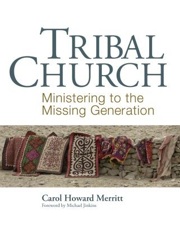
I first ran across Carol Howard Merritt last fall. Her husband (pastor and blogger Brian Merritt) informed me about her blog, Tribal Church, and her book, also called Tribal Church. Carol is graduate of Austin Theological Seminary and is currently a Presbyterian pastor at Western Presbyterian Church in Washington, D.C and a friend of presbymergent. The subtitle to her book is “Ministering to the Missing Generation” and in it, she talks about one of the demographics that is probably the least-reached in Mainline Protestantism: 20-30 somethings or “emerging adults.”

In her book, Carol argues that there is a new younger generation that is looking for spiritual community, and she says many of them are looking for small to medium-sized, traditional churches. She argues that it is the mainline church that can offer spiritual community to this group. In many ways, Carol is doing similar work as Diana Butler Bass, in that I saw many similarities between Tribal Church and Diana Butler Bass’s “Christianity for the Rest of Us.” One of the biggest similarities was a strong hope in the mainline church amidst all of the talk of the death of the mainline.

I don’t interpret Carol’s hope in the mainline as a blind, ignorant hope, a hope that says, “Oh – we have tons of money, and a great pension fund, so stop worrying…” Rather, she is rather pragmatic and knows that some things will have to change if the mainline is going to be able to make an impact on this generation. She focuses on six primary ways in which the mainline church is prepared for, and can make changes to work toward meeting the needs of the “missing generation.” The six ways are through intergenerational relationships, economic understanding, unambiguous inclusion, affirming traditions, shared leadership and spiritual guidance. I think she’s right in identifying these six characteristics, and I think they are very important to the future of the church. In light of my recent post on pluralism, I found this quote especially insightful:

“As young Christians approach religion, we know that Christianity is true; yet, we also have the humble sense that our infinite God could never be contained in our limited creeds or our most voluminous theological libraries. We sense that God reveals Godself through other cultures and other systems of thought…Throughout these discussions [interfaith dialogue], we realize that we may have one brilliant perspective on God, but divine character is much more varied than we can imagine, and so while we may have a glimpse of who God is, we know we cannot behold the face of God, and we can humbly admit that others may have a worthy perspective that broadens our own” (66-67).

As I’m in the process of searching for my first call right now, I can tell you that the six characteristics Carol mentions are ones in which I am hoping to find in a church as well. If you’re interested in ministry to youth or young adults, I would highly recommend Carol Howard Merritt’s book Tribal Church.

Related posts:

Stay In The Loop!

Subscribe to the Pomomusings feed via RSS or Email to receive notifications when new posts are published.

This website uses IntenseDebate comments, but they are not currently loaded because either your browser doesn't support JavaScript, or they didn't load fast enough.

{ 1 trackback }

Ministry and the Social Needs of Young Adults | Notes From Off-Center
March 8, 2008 at 6:43 pm

{ 7 comments… read them below or add one }

1 Drew March 5, 2008 at 8:11 pm

“many of them are looking for small to medium-sized, traditional churches”

Does she offer data to support this? I just get very weary of a lot of claims on what churches need to do without data to drive the conclusion. We have seen a lot of this regarding the recent publications of the Pew Survey of the U.S. Religious Landscape – McLaren among them. What is clear is that mainline church numbers have been declining for decades, and the two major effects that interact are 1) the demographic imperative (more “conservative” groups have more babies) and 2) religious switching.

We also know from various studies (see Regnerus, et. al., 2007) that the age cohort that she is discussing do tend to decline in attendance due to lifecycle effects (see Chaves, 1990 as well). They tend to come back when kids come into the picture and it’s the mothers that drive the return more often than not! So does she focus on young married couples and singles who are, by lifecycle, less inclined to go to church anyway? Even so, I am not sure how those variables I list above make sense. Also, what social needs of this group are being met with those six characteristics? I am not convinced this is a theological problem at all.

Reply

2 Gordon March 6, 2008 at 2:32 pm

wow, drew stole my question. about both books, is there data to support the claims that people are seeking small to medium-sized, traditional churches?

Reply

3 Cody Stauffer March 6, 2008 at 3:29 pm

Hey, Adam, want to move back to Idaho and plant a church with me in Boise?

Reply

4 carol howard merritt March 6, 2008 at 3:29 pm

Thanks, Adam for the review. And Drew, for the thoughtful questions.

For the data about young adults looking for small to medium traditional churches, I’m relying on Diana Butler Bass’ research in The Practicing Congregation (pg. 13).

Am I saying that we’re all looking for small to medium tradition churches? No. But many are. It’s an important trend that needed a voice. Some of the religious switching’s happening from the evangelical church to the mainline.

You’re right about the life cycle effects. But I’m hoping that we’ll begin to break the life-cycle mentality. I often hear, “They’ll come back to church when they grow up.”

The problem is that the boomers didn’t all go back to church. Add to that, we’re a generation that marries late, if at all. We don’t always have kids either. And, I hope that we can be church for all people, not just those with kids.

And Drew asked, “Also, what social needs of this group are being met with those six characteristics?”

I’d be happy to answer that as well, but I have an appointment I need to get to. I’ll be back…

Reply

5 carol howard merritt March 7, 2008 at 7:11 am

What social needs are being met with the six characteristics…

We live in such an age-segregated society, with intergenerational relationships, YAs gain an understanding of economic/life situations, wisdom on how to raise families, and a clearer grasp of sickness and death. Plus, older generations could begin to understand us. Especially concerning our economic situation (this seems to be the biggest shock for people as they respond to the book).

The social needs that could be met with economic understanding? Right now, young families are going broke at record rates, college graduates enter the workplace buried with loans, and a large percentage of YA’s have no medical coverage. What can the church do about this? Well, we could quit being so classist. Then we could stop perpetuating the belief that God’s blessings are equal to a big bank account. If we were really smart, we would all follow the African American church’s lead and begin fighting usury.

The social needs that could be met with unambiguous inclusion? It would make a new generation feel like they could go to church without being attacked, since 68% of adults under the age of 30 believe that same-sex marriage/unions should be legal. And most of us are friends with people of other religions.

This is getting long, so I’ll just say that nurturing affirming traditions, shared leadership, and spiritual community are all ways that the church can begin to respond to a new generation. In all of this, I believe that we have some deep theological wrestling to do.

Reply

6 Drew March 7, 2008 at 12:15 pm

Thank you for the response Carol. I would have to check Bass’ data as well to see how the variables tease out since that is where the rubber hits the road so to speak.

My question of social needs comes from reading the National Study of Religion and Youth at UNC on the one hand and the results from the Pew Study. Taken both together along with the various studies on church attendance that do regress the cause and effect variances, it seems that church has a function of a social meeting place not unlike the intent behind Facebook, mom groups, Meet-Ups, etc. I would venture an hypothesis that religion and religious affiliation is a function of the social function of meeting others. Now we can argue that it has always been that way. The difference now is that the church is no longer at the town center as its vehicle for cultural and social norm construction. it is rather very much relativized in importance to any other social grouping. Hence the ease with which people can switch their religious communal commitments. So I do not see this as a theological competition (and I am in no way saying you made such a suggestion, I am seeing where this might actually go). I see the function of the church competing with various social interests that people not only crave, but need as integrative structures. So I think people crave social integration and if we can toss a little theology and “meaning” in the mix so be it.

Looking at life-cycle effects, my question regarding the six characteristics (and I have not read the book so it all might be in there anyway) is if you think these can meet what I am hypothesizing to be a need for social integration on varying levels of interaction between young adults as they face big life questions such as vocation, marriage and children (which translate into the three main causes for divorce by the way – money, sex and kids). And all of this, I need to emphasize, is completely contingent on the data in both its structure and source.

Thanks!

Reply

7 carol howard merritt March 7, 2008 at 5:49 pm

Yes, yes! I completely agree. Church does have a function of a meeting place– something that we crave and need.

I haven’t read the UNC report. Can you link it? Is it on your blog somewhere? And of course, the Pew Study came out after I wrote the book… but I’ve spent some time with it and it’s very interesting.

Again, in TC, I wasn’t trying to present a detailed picture of every religious trend of my generation. I was trying to present a brush-stroke, to tell the story of movement that seemed to be neglected (my editor, DBB’s husband, gave me CFTROU the day I handed in the manuscript). But it’s one that I’ve been living and watching as a pastor in the mainline.

And the book’s as much about presenting a hope as it is about presenting data.

So, do you see theological competition as a bad thing?

Reply

Leave a Comment

Previous post:

Next post: