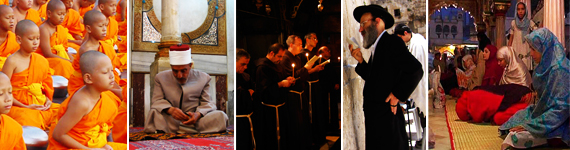
I’ve been thinking about pluralism in the context of ministry for the past few days because of an interview question I received from a church in the Bay area. These are some of my thoughts on what it means (or should mean) to do ministry in such a diverse area as the San Francisco/Bay area.
In dealing with the issue of pluralism, it’s important at first to simply acknowledge that pluralism is a fact. It’s not worth having a conversation about whether pluralism is good or bad – it just simply is. That is our world – the one we live in and do ministry in. We live in a diverse, multi-cultural, multi-faith world. As engage with others, I think there are some important things we can keep in mind.
First is the importance for us to engage in conversation with others. Conversation is always important, for many reasons: so that we can become more educated about the others in the world, so that we can experience dialogue and friendship with others, so that we might be changed by others.
Second, as we engage in these conversations, we need to hold our beliefs deeply but with open hands. As we engage with others and in the world, there is no reason that we need to “water down” our beliefs or not be honest to who we are or what we believe. But at the same time that we deeply hold our beliefs, I think it’s important that we hold those beliefs with open hands rather than with clenched fists. As the history of Christianity has clearly shown, faithful Christians have in the past held beliefs that we now look at and simply call wrong (women in ministry, slavery, etc). It’s important to trust in a God who is bigger than we can imagine, and to know that we just might be wrong – it’s all about having a stance of humility.
Third, when we engage with others, and hold deeply onto our beliefs, we also testify and witness to our experience of God. Again, we don’t water anything down, but we simply share our experience of God with others. However, we do this not “expecting converts” for it is never us who converts anyone. If someone does have a conversion experience, that is attributed to the movement of the Holy Spirit within their life.
Finally, all of this is done with the belief in Jesus’ grace and radical compassionate love. We fully submit all of this to God, whose ways are above and beyond any of our understandings. If it is a matter of having too small a view of God, or too big a view of God, I believe we should error on the side of too big, on grace, on acceptance.
What are your own thoughts about pluralism and Christianity’s response to it?


Thanks for posting on this subject. You may want to interconnect and join in with the discussion several other bloggers have been having about pluralism, inclusivism and Christianity. It started at http://exploringourmatrix.blogspot.com/2008/02/take-flaming-meteorite-challenge.html
Adam,
I think you’ve got this down pat. Pastoring in California is like no other place. Pluralism is a fact of life — especially in the Bay Area. Christianity doesn’t have an assumed place at the table. And frankly, for a large percentage of people the church isn’t even on the radar screen. They tinker with Buddhism and maybe Vedanta, combining them as best they can. Many churches are bewildered by all this and hunker down, hoping for better days. Helping a congregation recognize that pluralism isn’t good or bad, but simply reality that they must come to grips with could be fairly freeing.
Now, of course, I’m negotiating with a church in a Detroit suburb.
Adam – Not sure who you were talking to in the Bay Area, so won’t make any assumptions about intent. But . . . I think for some churches they really want to know how you answer the Christological question, “Is Jesus A way of THE way?”
How might you respond?
Bruce
Well said. I think you did a great job describing the proper Christian attitude toward pluralism—humility before God with unwavering conviction. When we lean on our own intellect or feelings, we lift ourselves up in arrogance. It’s important that we focus on the core issues of Christianity and not confuse those differences with the diversity that is such an integral part of God’s creation.
I like Bruce’s question. I think that is really what it boils down to for most people. Yeah we can speak the truth in love and be open to other people’s thoughts. But when you get down to it, we have to be able to say Jesus is it. He is the only way to Father.
The following is not my own thought, but I do endorse it. I am posting it here at great length because it is so well put on the whole, and because, as the final chapter of a wonderful book, it would serve as an excellent place for you to continue thinking about the problem you’re trying to confront. Cheers!
kp
“Churches, at least in Britain, have been eager to avoid the charge of arrogance. They have been eloquent in their efforts to distance themselves from what is now judged to have been the arrogance of missionaries who talked of the evangelization of the world in their generation. They are eager to repent of the arrogance of their predecessors. In reaction to this arrogance, two moods are widely discernible. One is timidity. This is, I think, the most obvious feature of much contemporary English theology. Most theology in [England] is carried on within the universities whose curricula are governed by the assumptions of ‘modernity.’ It is difficult for theologians to step outside these boundaries. Literary, historical, and phenomenological studies in religious history and practice can be carried on without transgressing these boundaries. ‘Religious studies’ can flourish, since they are — in general — descriptive rather than normative. They do not pass judgment on the truth or otherwise of the religious beliefs studied, much less on what is taught as truth in other faculties. But Christian dogmatics, the teaching as truth of beliefs which run counter to the accepted assumptions of our culture, is much more difficult. Academic theology tends to live within the frontiers which the reigning ‘plausibility structure’ dictates. The resulting tension between academic theology and the beliefs of ordinary church-goers is a familiar matter of comment.
The other mood is one of anxiety. Christianity is perceived to be a good cause which is in danger of collapsing through lack of support. Or — in a quite different manifestation of the same fundamental attitude — there is a strident summons to more energetic efforts in evangelism and social action. I do not mean by speaking in this way that it is not very important for Christians to be active in both evangelism and social action. But I do sense an underlying Pelagianism which lays too much stress on our own activities and is too little controlled by the sense of the greatness and majesty and sufficiency of God. I am saying that there can be a kind of Christian activity which only thinly masks a lack of confidence in the sufficiency of God.
I want to suggest the word ‘confidence’ as the one which designates the proper attitude. In a pluralist society, any confident affirmation of the truth is met by the response, ‘Why should I believe this rather than that?’ Every statement of ultimate belief is liable to be met by this criticism, and — of course — if it is indeed an ultimate belief then it cannot be validated by something more ultimate. Our ultimate commitments are…always circular in structure. Having been brought (not by our own action but by the action of God) to the point of believe in Jesus as Lord and Savior, we seek to understand and cope with every kind of experience and every evidence of truth in the light of this faith. We are constantly called upon to rethink our faith in the light of these new experiences and evidences. We are prepared to recognize…that there are areas of mystery and that there are puzzles which are not solved for a long time. But we expect to find, and we do find, that the initial faith is confirmed, strengthened, and enlarged as we go on through life. And if, as always happens in a pluralist society, we are asked: ‘But why start with Jesus? Why not start somewhere else?’ we have to answer that no rational thought is possible except by starting with something which is already given in some human tradition of rational thought and discourse. Our immediate answer may well be, ‘Why not?’ For the ultimate answer we have to wait for the end of all things. That expectant waiting is part of what it is to live a full human life.
I therefore believe that a Christian must welcome some measure of plurality but reject pluralism. We can and must welcome a plural society because it provides us with a wider range of experience and a wider diversity of human responses to experience, and therefore richer opportunities for testing the sufficiency of our faith than are available in a monochrome society. As we confess Jesus as Lord in a plural society, and as the Church grows through the coming of people from many different cultural and religious traditions to faith in Christ, we are enabled to learn more of the length and breadth and height and depth of the love of God than we can in a monochrome society. But we must reject the ideology of pluralism. We must reject the invitation to live in a society where everything is subjective and relative, a society which has abandoned the belief that truth can be known and has settled for a purely subjective view of truth — ‘truth for you’ but not truth for all. For one thing, I doubt whether such a society can long sustain its integrity in the face of the claims of those who have a firm commitment to some vision of truth. As I write, the press is full of the cries of outrage from Western liberal writers and critics in face of the Muslim reaction to Salman Rushdie’s book The Satanic Verses. But it is doubtful whether these cries have behind them anything that can withstand the determined onslaught of those who hold firm beliefs about the truth. Freedom to think and say what you like will not provide the resources for a resolute grappling with false beliefs. The demand for freedom of thought and expression must itself rest on some firmly held belief about the origin, nature, and destiny of human life. IF it has no such foundation it will prove powerless in the face of those who have firm beliefs about the truth.”
Adam,
Interesting topic. While you are responding to the other questions, I wonder if you might explain why “It’s not worth having a conversation about whether pluralism is good or bad…” I thought that part of being a Subversive Blogger was being dissatisfied with the “status quo.” Wouldn’t saying that something like pluralism “just is” be a comment about pluralism as status quo? Why is it pointless to have that conversation?
These good words from N.T.Wright often remind me how to sort things out as we live in this post-christian, pluralistic world of ours:
“The biblical metanarrative challenges the view of Christianity, or biblical Judaism, as a “religion” in the post-enlightenment sense, and I suspect that many Muslims, Hindus and others would want to do the same. Insofar as post-enlightenment thought suggests that truth lies in Deism, and that all “religions” are different humans expressing their own ideas about or experiences of the one distant and unknowable god, most genuinely religious people and groups are bound to object. Once that point is grasped, it becomes clear that if the biblical narrative is true, the Muslim one is not, and vice versa; and the same for Hinduism, Buddhism and so on. The more open we make the Bible, the more we must expect that dialogue with our friends and neighbours of other faiths will include the clear statement of radically different world views.
Once we are clear about this, we must also affirm that, precisely because the Jewish and Christian scriptures have as their central theme the active love of the creator God for the whole creation, and especially those made in his image, it is vital that we investigate and build on the things we have in common as human beings. Nothing I have written here should imply an isolationist stance. As with Christians and Jews, so with people of other faiths, there is a great deal we hold in common, which can and should form the basis not only of dialogue and mutual understanding, bur also common action in the community. Yet we owe it to one another as partners in such enterprises to be gently but firmly honest about the world views we hold, and the distinctive metanarratives in which these come to expression. “
Of course, this is not a place for advertising, but I could not help but share the description we have been using to advertise a seminar we are presenting with Brother David Steindl-Rast at the Boulder Center for Integral Living. I think that Boulder is probably quite a bit like the Bay Area. Pluralism rules :-) After all, we are the People’s Republic of Boulder :-)
I agree that pluralism is a fact of reality, actually, a lucky stage of development in consciousness that some individuals and communities arrive at…I say, lucky only because it is a better stage than fundamentalism and mere rationalism. The biggest pathology in pluralism is fondly refered to as ‘boomeritis’ by Ken Wilber and the integral community. Boomeritis is when Pluralism meets Narcissim where everything get so deconstructed that nothing has any value or meaning at all!! Anyways….just could not help notice this post because in Boulder and in our community, we are always bumping into the good, bad and ugly of pluralism and wondering how to include and transcend….
Oh, and here is that seminar description. I wish very much that some of you might even come to this seminar! how cool would that be?!
thanks for letting me share my two cents here. Forgive if i stepped on any toes. I hope I haven’t.
—–
INTEGRAL CHRISTIANITY EXPERIENCE
Dates: April 16 – 20, 2008
see: http://bcil.gaia.com/discussions/view/224863#224863
BCIL is deeply honored to present its first 5-day seminar with Brother David Steindl-Rast as leading teacher. Come and join us for this wonderful celebration of Spirit!
We live at a time when the evolution of human consciousness is crossing a decisive threshold. This has an impact on all areas of human concern, with religion and spirituality ranking high among them. In such an exciting and challenging time of unprecedented change, it is not surprising that many practicing Christians have become increasingly aware of both the riches of their tradition and its limitations. We have realized that our understanding of Christianity has to change if we are to authentically embody the grace and glory of the new horizons that are opening before us and beckoning us forward.
Neither rigid fundamentalism nor flatland pluralism will any longer do. Instead, we have realized that we need a new vision of Christianity; an integral vision; one that will more adequately serve as a comprehensive map to the mysterious territory of love’s unfolding that we always and already are. Thus, the term “Integral Christianity” points towards an understanding of Christian faith and practice that is born of this awareness and firmly rooted in this level of consciousness.
It is important to note, however, that none of the treasures of tradition are lost or rejected when our understanding of them changes in accord with the flowering of Integral Christianity. On the contrary, as these treasures are transcended and included in our wider embrace of reality, they take on a greater freedom and fullness – a new and abundant life, pressed down and overflowing. Yet, in the midst of this process of growth, we can easily get disoriented. It is like hiking in the mountains: the landscape remains the same, but our view of it changes dramatically as we climb higher. The same peaks and valleys move into a new relationship to each other, and we must stop periodically to get our bearings. This is what we will attempt to do in this workshop.
As for how we will go about re-orienting ourselves during our time together, we will of course adopt an integral approach, one that engages the whole person – body, mind, and spirit. Intellectual clarification will be one aspect of our sharing, and another will be shared experience: sacred music and dance, silence, prayer and meditation, singing, chanting and liturgy, holy listening, and (if weather permits) a visit to the mountain Chapel of Saint Catherine of Siena, also known as The Chapel on the Rock.
Our foremost goal will be to fill these days with joy – the pure joy of incarnation that everywhere upholds the goodness, truth and beauty of the world. That is the revelation of a miracle called “We,” which springs from celebrating life together as a community of trust – a miracle we can keep, take home and share with others.
For more details, please see here. (http://bcil.zaadz.com/discussions/view/224863)
Great post Adam. It is a timely question to ask.
I think pluralism is a beautiful thing. The fundamentlist response to pluralism is a simple product of not understanding how to approach metaphorical language. Eeach religion uses different metaphors for the same thing. God is not exhausted by any one metaphor therefore God cannot be exhausted by any one religion. No single man-made symobol can fully describe God in every culture.
I’ve written a post about incarnation recently on my blog. How we approach the metaphor of incarnation determines how well we will be able to handle pluralism.
No single man-made symobol [sic] can fully describe God in every culture.
Precisely. That’s why God’s Word — the God-made symbol — subjected himself to words: so that we can talk confidently about the true identity of God in the languages of every culture.
It really seems like it is high time for everybody – especially emergent types – to start recognizing that pluralism is not just a fact about the world, but it is a fact about religious experience, for whatever reason. Why is it that many of the mystical sides to diverse religious traditions look almost identical in practice? What Christians have been ignorant of for 2 millennia is finally becoming a reality – in terms of religious experience… we are not alone.
I had the following as the ‘quote of the day’ on my blog yesterday, which relates to the last comment:
“Applying a kind of philosophical Golden Rule, it would be unreasonable not to grant to religious experience within other traditions what I affirm of it within my own tradition” (John Hick, “Who or What is God?” p.6).
I think that we actually need to be willing to grant that God is working through other faith practices/traditions, and be willing to hear how God is working in their lives as well when we hold these conversations, then celebrate together how rich in grace and mercy God is. In those same conversations, we need to not only be willing to hear what they have to say, but actually get a clearer, richer, and more in depth view of who God is- in other words, to actually learn from them as they learn from me about ultimate reality.
You simply cannot talk about Christianity and pluralism without at least acknowledging Newbigin. His distinction between plurality and pluralism strikes at the very heart of this question as a Christian.
Well done KP!
“So in everything, do to others what you would have them do to you”
The edict that Jesus gives in Matthew 7 has to come into play. Just as intolerance is something we would resist, so must we not inflict it upon others.
Thanks for sharing your thoughts. The effect of pluralization depends upon how one defines the term. You never really do that, so it is hard to know exactly how to respond. I agree conversation is good, but without a shared frame of reference, conversation can also be impossible.
One of the best movies I have ever seen that demonstrates this concept is the movie “Pleasantville”
Check out this guide I wrote titled, “Lessons From the Movie Pleasantville” where I also give my own definition of pluralization.
I would love to read your thoughts in light of your social context.
On a personal note, I’d just like to say how my faith has been enriched, deepened and strengthened in the Bay Area by such pluralistic interactions. I spent a few months talking religion with a Hindu monk and came away with a deeper, more affecting faith in Jesus than I ever got from my conservative evangelical upbringing.
Pluralism is only a bad, scary word for those who have never experienced it. For the rest of us, it is something we treasure — if only for the amazing food and the gift of not noticing race (as much).