
This review will be appearing in Sharing the Practice, the journal put out by the Academy of Parish Clergy.
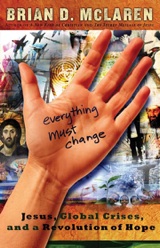
In his newest book, Everything Must Change, Brian McLaren tackles two questions: first, What are the biggest problems in the world and second, What does Jesus have to say about these global problems? Through the title alone, one can guess McLaren thinks Jesus’ perspectives on our global problems will lead to change, and more importantly, to a revolution of hope, a theme present throughout the book. This is admittedly a difficult task: presenting a succinct analysis of the world’s greatest problems and then attempting to provide a solution to these problems. But that doesn’t stop McLaren.
McLaren’s predominant metaphor for our society throughout the book is that of a suicide machine. He writes, “When the social, political and economic machinery of a society gets out of control, or through some flaw of design or operation begins to destroy its creators and intended beneficiaries, then it has become a suicide machine†(54). He believes we have gotten to this point through the framing story our society believes in. A framing story tells what is important in this life, what is worth fighting for, what is the purpose of humanity’s existence. McLaren says we have let ourselves believe the lies of a deficient framing story, and it’s important to both open ourselves up to a new, alternative story, as well as examine the ways in which Jesus spoke truth in love to the powerful and inadequate framing story of his day.
This new, alternative framing story is a story in which the focus moves from the individual to the beloved community, from individual sins to the acknowledgment of society’s sinful structures and systems, all with the hopes that we can turn our “suicide machine into a creative a humane society†(129). McLaren is speaking of the kingdom of God, even though he doesn’t think Jesus would use that language today, perhaps because it smacks too much of empire-language.
In addition to a renewed emphasis in the kingdom of God, McLaren also takes sin seriously. However the focus isn’t as much on personal, individual, moral sins; McLaren believes solely thinking of sin in those terms risks shrinking the gospel. While it may contribute to personal, moral piety among some, this is not the way to help rework the suicidal system in which we live. Systemic injustices must be taken seriously in our new framing story, or else we have simply given in to the old, old story – and continued to “become complicit in our world’s inequitable system†(245).
So what do we do about these systems? It could be easy to slip into a state of utter frustration over the immensity of the problem. Yet, McLaren says there must be a continual conversion in each of us, a time when we look at the way we’re living and ask ourselves if we’re living according to the overarching framing story of culture, or whether we’re open to Jesus’ alternative. He writes, “the revolution starts in us – in our minds, our hearts – as an act of faith, a transfer of trust from the dominant system to a new way of seeing, believing, and living†(271). There is a clear sense of hope, encouragement and potential at the end of McLaren’s book. He is no Pollyanna, not trying to gloss over difficult situations – but he does have hope; hope in humanity, hope in Christ, hope in the God who created the world.
I found McLaren’s book to be one of his best yet, delving more deeply into the world of social crises and politics than any of his previous writing. While some portions of the book are not necessarily earth-shattering, it is a wonderful reminder of what our role in the world could be. I want to leave you with a beautiful portrait of this world of hope that McLaren is working toward.
“At the center of the beloved community is good news – a framing story that calls humanity to creativity, harmony, reconciliation, justice, virtue, integrity, and peace, because these values reflect the character of the Creator whose world is our home and in whose presence we live and move and have our being. In short: we are all part of one kingdom, one beautiful whole, with one caring Creator, who is faithful to us even in our stupidity and sin. God calls us to reconcile with God, one another, and creation, to defect from the false stories that divide and destroy us, and to join God in the healing of the world through love and the pursuit of justice and the common good†(295).