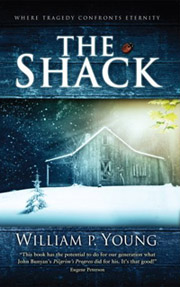
Eugene Peterson describes William Young’s “The Shack” [website here] as a book that “has the potential to do for our generation what John Bunyan’s Pilgrim’s Progress did for his. It’s that good!” Now, it’s been a few years since I’ve read “Pilgrim’s Progress” but unfortunately I don’t think I can say the same. It’s been a very long time since I’ve read any Christian fiction, and I don’t know that the genre necessarily known for producing amazing literature, so I wasn’t quite sure what to expect. The book has an interesting premise: Mack is a father who experienced an incredible loss (which is referred to as The Great Sadness in the book) ends up being “taken up” into a revelatory, vision experience in which he spends a few days with Elousia, or Papa, a large African-American woman (who represents God), a Middle Eastern carpenter named Jesus (who represents…Jesus) and an Asian woman named Sarayu (who represents…yup you guessed it, the Holy Spirit). He spends a few days with this holy Trinity working through his anger, disbelief, frustration and theological issues with God.
Papa, who is a female, yet she insists on being called “Papa” assures Mack that God isn’t male or female, yet it was important that God be known primarily through male imagery.
“But then,” he paused, still focused on staying rational, “why is there such an emphasis on you being a Father? I mean, it seems to be the way you most reveal yourself.”
“Well,” responded Papa, turning away from him and bustling around the kitchen, “there are many reasons for that, and some of them go very deep. Let me say for now that we knew once the Creation was broken, true fathering would be much more lacking than mothering. Don’t misunderstand me, both are needed – but an emphasis on fathering is necessary because of the enormity of its absence.” ((William P. Young, “The Shack” (Newbury Park, CA: Windblown Media, 2007), 94.))
I found it interesting that later in the book, after Mack’s severed relationship with his biological father is mended, he then sees God as an old man with silver-white hair.
Mack spends time walking on water with Jesus; a Jesus who is a free-spirited “buddy” – a guy who doesn’t like institutions (the institutional nature of church or even of marriage) and who is Mack’s favorite of the three. Jesus even tells Mack that he isn’t interested in him being a “Christian” – because, heck, even Jesus isn’t a Christian. There is a slight mention of Buddhists and Muslims being able to be good people and care about the things Jesus cared about, but Jesus very clearly says that not all roads lead to the same place. Jesus does say that he can go to any road to find people, but the author doesn’t lead off into universalism. Mack also spends some time gardening the “garden of his soul” with Sarayu, the Holy Spirit.
With Papa, Mack has lots of theological conversations; their conversations cover the meaning of the cross, free will and predestination, suffering, evil in the world and many, many others. At times, the focus on getting across certain theology seemed forced and sometimes it was a bit cliché as well. I finished the book – but didn’t find it to be all that compelling. It is interesting, and I think that there will be some who will like it. I liked that a Christian author wanted to try some new things and play around with the stereotypes of God as male, God as European and white. But in end, it seemed that Young still came back to the image of God as Father, God as male being the most important image. All in all, to compare it to “The Pilgrim’s Progress” is a little bit of a stretch though. Sorry Eugene. But if someone would like to give it a read, and perhaps a better review, I’ll ship it off to the first person who leaves a comment and asks for the book.


Heck, I’ll give it a read! Mainly because I like getting mail… : )
I’m about 3/4 through the book.
It’s definately challenging my theology in the sense that the trinity is not the “three-in-one” like one person being a Son/Dad/Grandfather but more of 3 distinct separate personalitlies. I’m still wrestling with that. Maybe I’ll have to wait to truly understand this concept in whole in the after life (eternity w/God)
I think the mention to other religions/politics…etc is showing where they came from to coming to know Christ. As you read it you feel lilke you’re walking on a slippery surface, but it’s pretty clear that it’s “an institution” vs “a relationship w/Christ”
I already understand how God does not cause suffering – our desire for independence from God led us there – that’s easy.
And I like how the Holy Spirit’s character – Sarayu, is challenging me to think of what is truly the Spirit’s role and that he/she is really more active then I thought and super creative.
The fact that they all have the scars of the cross expands my theology, and increases my love for God and what He has done for me.
As I read the book I’m looking to make sure it’s lining up with scripture and so far I haven’t found any conflict (I’m also not a theologian) but some really creative challenges to my thinking of who God is.
I love the part of “the judgement” . I won’t give anymore of that away but I hope to write more later after finishing up the book.
It’s an easy read, and I’d love to see a movie on this, but only if it is scripturally sound and not turned into some new age universalism.
I think it can get the non-believing public to start thinking about God again and even get the answer to some hard questions that may be keeping them from knowing the one true God who does want a personal relationship with us more then anything!
I was encouraged to read the “The Shack” by a Christian brother from the website called the “The Band of Brothers” after I wrote him describing some of the frustrations I’ve been having in my walk with the Lord. For me, most of my hard times are due to health issues. I was hoping to find a few answers within this book that would speak directly to me, because it was very highly touted by my web friend.
Unfortunately, after ending the 8th of 15 chapters, I must admit I am disappointed, not so much because my questions aren’t being answered, but because of the track the book has taken.
I’m not a reader of fantasy, which with such a person, this book would more likely find a home. It’s far too fantastical for me to believe that the Holy Trinity would manifest in the likes of those who represent the Father, Son and Holy Spirit, and that they would express themselves as they do in this novel.
Also, it is a major overstatement for one to equate this book with the quality of a Christian classic. Perhaps, if I was to spend additional time focussing on the philosophical meanings of each encounter and activity, the story would make better sense. I don’t have the time to do that.
What I find to be the most frustrating element is the lack of immediacy in addressing Mack’s needs. Since God is “an ever present help in time of trouble,” I am obliged to believe that He is quick to reply to our fervent prayers. Instead, in this book, the Trinity seems to dance around Mack’s yearnings for answers, assisting in making his stay less demanding, but never really speaking directly and profoundly to his hurts and deep sense of loss.
I will probably finish this book, but I’m not anticipating a major revelation of God’s nature or heart.
Dave
I read the entire book, and though I would agree that it is not on par with Bunyan’s “Pilgrim’s Progress”, the story has challenged my thinking and expanded my box that I put God in. It is a wonderful picture of God’s love for each of us as individuals. I, too, have the need to make sure it all lines up with scripture before I will say it is totally theologically correct. However, I think the overall premise of the book is to help us understand God’s love in a visual way, and learn to rest more in Him. I really enjoyed the chapter on being more ‘verbish’ and less ‘nounish’! Those of you who have read it will understand that! Even though there might be some things I question about his viewpoints, it has left me thirsting to know God more. That is a good thing!
I have read several reviews of “The Shack”, and the most in-depth and helpful analysis tht i found was this one. After noting that “because of the emotional impact of reading good fiction, it can be easy to allow it to become manipulative and to allow the emotion of a moment to bypass our ability to discern what is true and what is not”, Challies compares several theological views in the novel with Scripture. He then concludes “It is clear to me that The Shack is a mix of good and bad. Young teaches much that is of value and he teaches it in a slick and effective way. Sadly, though, there is much bad mixed in with the good. … the book has a quietly subversive quality to it. Young seems set on undermining orthodoxy Christianity.”
The book is transparent, tragic and beautifully written. God’s love toward the main character is beautiful and breathtaking at times. (Fot these reasons, I gave the book a 1 and a half stars)It is an emotional journey and for these reasons perhaps people overlook the book’s error. The book argues that Jesus, out of honor for our relationship limited His deity and drew only upon the relationship with the Father. It bodly states that Jesus never drew upon the divine nature to do anything. Here is one quote to further reveal the trinity error. “Although I have only been limited in Jesus, I have never been limited in myself.” Pg 100 paragraph 8. The author also states that if there weren’t 3 persons in the Trinity God would be incapable of love. This is just an example of a book laden with presumtion. I can’t imagine someone feeling free enough to take speculationt his far without fearing the warning in Mat 18:6 “But whoso shall cause one of these little ones that believe on me to stumble, it is profitable for him that a great millstone should be hanged about his neck, and that he should be sunk in the depth of the sea.”
In addition, there are multiple referrences by the author inferring that if the reader does not agree with the author’s unfounded theology, he or she has a religious mindet. One only has to read a few reviews to find the author’s pressure is parroted and thus successful in iis purpose. The author’s acknowledgements go Jaques Ellul a
Universalist,George MacDonald a Universalist, Gibran is a Unitarian Universalist and writer of “The Prophet” and Kierkegaard “The Father of Existentialism”
Do not believe a lie in the name of prophecy. Believe revelation and prophecy based on the truth of God’s word. This age is preying upon the prophetic, seeking to subtley win over those who do not yield fully to the authority of the scripture. The “new” new age will slowly become the belief system of those believers who yield.
***In the end, the subtle strays from the truth reveal more of the serpentine nature that outright lies.
If you know a new believer who has read it, please rescue them from error.
This book and all that it represents repulses me. More troublesome than the book, is the blindness of the masses who imbrace this new age theology without flinching. The word of G-d states My sheep know my voice and they will not hear the voice of another. Confussion isn’t of G-d and the Holy Spirit of G-d who is the revealer of all truth will not tell anything that is contrary to G-d or confussing about his nature. Anything that brings confussion and doubt isn’t of G-d because he is not the author of confussion. I hear a lot of confussed people trying to justify why this book is the answer to all of their problems. The believers in the true G-d of Abraham Issac and Jacob need to boldly stand up and call out the demonic spirits of mysticism and religion which are deceiving even the elect of G-d. I realize that we wrestle not against flesh and blood but against rulers of darkness is high places and that the heavens suffer violence and the violent take it by force. G-d isn’t a soft plush teddy bear pouring out the honey on everyone who calls themselves His followers. I remember Jesus said Many will say on that day (the day of judgement) Lord Lord did we not cast demons out in your name and prophesy in your name and he said I will then say to them depart from me you cursed, you workers of iniquity for I never knew you. Does that fit into the teddy bear mold? I would think not. Many will be deceived because they choose deception. Many will think they are doing the will of G-d and they will find out they were terribly mistaken. Proverbs tells us that there is a way that seems right to a man and the end there of leads to death. What I am saying isn’t politically correct because political correctness is of the devil it is the ultimate chain that binds us to silent passivity. Stand up watchmen and rise up seers and prophets today is the day to avenge our G-d and to take back what has been stolen from us. No longer will we be silent when faced with lies and hellish propaganda.
I have to say that I too was completely repulsed by reading this book. I’ll try not to repeat what’s already been said, but I do think that Heather Thomas (above) hit the nail on the head.
Many people are being led astray by this kind of teaching, that deals with emotions rather than it does truth. In many ways that the author described God and the trinity is a form of idolatry.
Anyone who’s had any kind of traumatic experience, unnecessary guilt, or lacking knowledge of who GOD says He is, is especially vulnerable to this kind of deception.
I will not be recommending this book to anyone, but rather condemning it.
I have read this book and I think that the reviews by Heather and Melissa are quite harsh. This is fiction and one man’s attempt to show God’s love, mercy and grace.
The author never states that his story is to be taken literallyor are in any way taken from scripture. These reviews are quite an insult to the intelligence of readers of fiction. Maybe Heather and Melissa do not know the meaning of fiction. Mr. Young has tried to give us his idea of a loving, caring God, and those who are Christians and know their Bible, certainly know the difference between fact and fiction, and if they do not, I believe this book might inspire them to study the Bible and find out.
Once again, this book is fiction and those who feel Mr. Young is trying to start a new religion, or change a person’s beliefs, are indeed sadly missing out on a wonderful story by trying to judge and pick apart every sentence. Check out the meaning of fiction girls and give Mr. Young a break! He does not deserve this unsolicited, judgemental negativity.
I have to agree with Debbie 100%. I may also add that we are forgetting that this book was written by man just like The Bible. So who is it to say who is right or wrong? Only GOD knows the truth.
I haven’t read the book, and maybe that’s a good thing; but I have read many reviews, pro and con, and spoke with some who have read it. Let me however, give you my observations from a different viewpoint. I am reminded of the CS Lewis and JR Tolken allegorical stories that are loosely based on the bible. These stories received no criticisms to my knowledge because they included all of the fundamentals – God, devil, righteousness, sin, deceit, wisdom, battle of good and evil, mercy, love, hate and so on. Does The Shack represent these basics in a balanced fashion? One of my readers said no; that the devil and sin are not mentioned. I am wary of any book that states a partial truth.
The other point I will make is that most bible believers won’t be taken in by the Oprahs and the blatant new age philosophies of this world. We’re too smart for that. But Jesus said that if it were possible, even the elect would be deceived. The deception that is coming against true believers will be insidious, slowly, and through even respected individuals who have incrementally moved away from the Word of God. Here are a few warning verses:
Amos 8 “Behold the days will come that I will send a famine in the land, not of bread or thirst but of hearing the Word of God….”
Romans 1 “…who changed the truth of God into a lie…”
2 Thess 2:10-12 …because they receive not a love for the truth…God will send a strong delusion that they believe a lie…”
We believers need to go back to the word of God for ourselves to protect us from deception. That is our only hope. Don’t put any person, author, speaker or minister above the Word. That is idolatry.
Debbie said:”I have read this book and I think that the reviews by Heather and Melissa are quite harsh. This is fiction and one man’s attempt to show God’s love, mercy and grace.The author never states that his story is to be taken literallyor are in any way taken from scripture. These reviews are quite an insult to the intelligence of readers of fiction. Maybe Heather and Melissa do not know the meaning of fiction. Mr. Young has tried to give us his idea of a loving, caring God, and those who are Christians and know their Bible, certainly know the difference between fact and fiction, and if they do not, I believe this book might inspire them to study the Bible and find out.”
I think Debbie couldn’t be more wrong. Labeling a work as fiction is not excuse for expounding bad theology. It is imperative that the author be careful about putting words in Jesus’ mouth, whether he calls it fiction or non-fiction, because Jesus is non-fiction. To put Him in a novel and have Him saying things contradictory to, or misrepresentative of, Scripture, is a serious thing. In writing a novel which includes a real person, in this case the Triune God, the author has a responsibility to remain exactly true to what God has told us about Himself in the Scriptures.
We can’t say changing Scripture is OK just because we put it in a novel. Sorry Debbie, the author doesn’t have to state that his story is taken from scripture, because clearly it is – where else do we hear about a triune God and about Jesus who transforms people into sons and daughters of God – oops! sorry, that’s not quite how the author says it. He takes the truth of scripture and twists it, but make no question – it came from scripture, we know that and we know he changed the truth around and if you take the theology of The Shack away with you you’re going away with a different Jesus than the Jesus of the Bible.
A couple theological issues I found way out of wack:
On page 179 Jesus says, “No, I’m not too big on religion.” That is just clearly not the case.
Religion by definition is: “a set of beliefs concerning the cause, nature, and purpose of the universe…usually involving devotional and ritual observances, and often containing a moral code governing the conduct of human affairs.” (Dictionary.com)
God instituted religion when Eve and Adam chose sin and religion became necessary to bridge the gap between God and man whose relationship had been severed as a result. Immediately God instituted the sacrificial system as a method to atone for sin and re-establish relationship. Later He gave the Law containing a moral code governing the conduct of human affairs. God’s people had a religion instituted by Him, by which they established and developed their relationship with Him and which regulated how they interacted with each other.
Relationship and structure, not relationship or structure – the religion God established for His people is both.
On page 181 of The Shack, Jesus says, “Remember, the people who know me are the ones who are free to live and love without any agenda.” WRONG!! Jesus left us with an agenda! Make no mistake – we live and love with a purpose. We have a mission, a goal. We call it the great commission. It is the agenda of our faith, what we are instructed to do, what we work for and pray for.
“19Go ye therefore, and teach all nations, baptizing them in the name of the Father, and of the Son, and of the Holy Ghost 20Teaching them to observe all things whatsoever I have commanded you: and, lo, I am with you always, even unto the end of the world. Amen.” (Matt 28:19,20)
Our agenda is huge!
It’s not touchy-feely “free to live and love” without any responsibility. We live and love and do good works with intention, with agenda, and we don’t need to be ashamed of it. It is our motivator. ”In the same way, let your light shine before men,(WHY?) that they may see your good deeds and praise your Father in heaven.” (Matt 5:16) We don’t do any of it because it feels good. We do it because we were instructed to and so that they will praise God for what we do and how we do it.
On page 182, Mack asks, “Is that what it means to be a Christian?” Jesus replies “Who said anything about being a Christian? I’m not a Christian. ..“I have no desire to make them Christian, but I do want to join them in their transformation into sons and daughters of my Papa, into my brothers and sisters, into my Beloved.”
This flies in the face of all that Jesus came to do and all that He accomplished. Jesus is not going to join any of us in our transformation into the sons and daughters of God! He is the one who transforms us! He accomplished that transformation on the cross!. He is that transformation! We are not on some journey to being transformed into the children of God. We’d get nowhere. It takes more than that. It takes a moment in time when we acknowledge our sinfulness, our need for forgiveness and accept that Jesus accomplished that for us on the cross. At that moment we are cleansed, made new, freed from the bondage of sin. The old man is dead, we are transformed!
This is what Jesus tells us:
“I tell you the truth, whoever hears my word and believes him who sent me has eternal life and will not be condemned; he has crossed over from death to life.” (John 5:24)
In that moment He transforms us! We cross over from death to life. We become sons and daughters of God.
”For you did not receive a spirit that makes you a slave again to fear, but you received the Spirit of sonship. And by him we cry, “Abba, Father.” The Spirit himself testifies with our spirit that we are God’s children.” (Romans 8:15.16)
That’s it, we’re there! Children of God. Jesus walks with us as we grow in Him and become more like Him after He transforms us.
The author tells us that Jesus said to Mack: “I have no desire to make them Christian.” That is absurd. To become a follower of Christ is to become a Christian, has been since the beginning of the New Testament church and is to this day.
“Then Barnabas went to Tarsus to look for Saul,and when he found him, he brought him to Antioch. So for a whole year Barnabas and Saul met with the church and taught great numbers of people. The disciples were called Christians first at Antioch.” (Acts 11:25,26)
“When Paul spoke to King Agrippa he said, “King Agrippa, do you believe the prophets? I know you do.” Then Agrippa said to Paul, “Do you think that in such a short time you can persuade me to be a Christian?” Paul replied, “Short time or long—I pray God that not only you but all who are listening to me today may become what I am, except for these chains.” (Acts 26:27-29) Paul clearly claims to be a Christian and says that he wants everyone who hears him to become a Christian also. Paul gets his message from Jesus. So do we.
It’s what Jesus wants. He wants people to turn from whatever else they are, take His name and become Christians. It is our title and we should bear it with pride. Through countless ages people have lived and died because they bore that name and acknowledged it without concern for the consequences.
“Yet if any man suffer as a Christian, let him not be ashamed; but let him glorify God on this behalf.”
(1 Peter 4:16)
Without question the Jesus of the Bible wants to make Christians of everyone that the “Jesus” of The Shack says he does not.
There are other issues with the book I could go on about. Basically I consider it a wolf in sheeps clothing, as apparently do some of you. I don’t care what you call it, fiction or non, it twists some basic truths of scripture and I don’t recognize my Jesus in the Jesus of The Shack. That’s not good. I have been surprised at some of the truly mature christians whom I admire and respect who have come so close to buying into this. This is certainly a time and reason to be praying for discernment and wisdom.
I must take exception with JDM when he said that this was written by man, just like the Bible. To believe such a statement sheds light on his lack of understandstanding. The Bible is the Holy inspired Word of God. It is not the same as any other “book.” JDM’s assertion would mean that everything ever written can be assumed to be Truth! Or that nothing is Truth. Either way, with his analysis of truth, why would we even bother?
For a very critical review of THE SHACK go to
donholmes.blogspot.com
Ruth Ann,
Although I can see you have found much Biblical basis for your arguments, can I just say – that much of what you are taking exception to is because of a misunderstanding of what the author meant.
When Jesus says isn’t a Christian and isn’t calling people to be ‘Christian’, the author is referring to the way Christianity is seen today – which is the religion, not necessarily followers of Christ. Also – that name only came later – as you quoted – meaning – it wasn’t Jesus’ intention. He never called his followers that – it was a name given by others – most probably non-christians – because it doesn’t say “was the first time we called ourselves christians” but was the first time the believers were called christians.
And the whole transformation thing- that is a VERY biblical notion. The NT writers say that “God will complete what He started in us”. Also don’t know the exact reference, but the Bible talks of “for we are being transformed into the likeness of His [God's] Son” – Rom 8 I think. Although Jesus’ death was something that reunited mankind to God, there is a process (one of John’s letters also speaks of the process the Holy Spirit will take in changing us) that logically has to happen. We don’t immediately no longer sin. I don’t see how you can discount the ‘process’ like you have.
And – I firmly believe that Biblically, the reason Jesus died – was for the same reason the ‘Jesus of the Shack’ said – so that we can be drawn into a deeper relationship with God or Papa. That’s as foundationally biblical as you’re going to get.
The whole religion thing.. Jesus is NOT big on religion. I don’t see Jesus being comfortable in a religious environment. What religion ever really sets people free – like in a practical understanding of freedom?Almost every religion (Christianity included) ignores the fact that it’s all been done and tries to set up some bar that needs to be reached, some set of requirements (moral code?) to be completed before we can get acceptance for that religion’s god. Jesus doesn’t do that. He lays down His own life, reuniting Man to God. That’s what He did. I doubt Jesus is big on religion at all.
I’d like to encourage the people who say this is from the devil, or that it’s demonic spirits that have made this book, or any other such judgemental statements to be aware of what they’re saying. Maybe ask God to show you in the Bible where the things in the Shack are being drawn from – I’ve heard the authors themselves talk of what Biblical foundations they have for almost all the theological aspects in the book.
I personally am so careful when I say what’s of God or not – and especially when calling something demonic – the Pharisees said Jesus was doing things in Satan’s power.. and not the Holy Spirit’s – leading Jesus to talk of the one sin that is unforgivable. I’m not the one to draw that line – I’m just saying – be careful where you point the finger and how you throw that stuff around. Just because the book doesn’t agree with your understanding of the Bible doesn’t mean it’s not true or heretical.
There are many people who love the book that can biblically substantiate almost every ‘dodgy’ or ‘controversial’ aspect of this book. So if you don’t like some of what the book says – fine – if it really gets to you – take it to God – I’m serious – I’m sure He can clear His own name if He wants to. Don’t run around like Peter chopping off people’s ears. Ask God what He thinks of this book, and ask Him to show you if what you’re unhappy about actually does have a biblical basis, and I’m sure He’ll make you aware of it either way.
With the amount of people who are really being touched by this and when the general attitude of these people is that the book is drawing them to a deeper relationship with God – how can so many of you write it off so quickly!? Maybe God is in this. Maybe He is doing a work through and with it. Maybe it’s you who are misunderstanding things. Take a step back from the situation, pray about it and seek God (Papa) before you are so quick to write it off as coming from Satan.
in Him,
Cam.
Cameron said:
“The whole religion thing.. Jesus is NOT big on religion. I don’t see Jesus being comfortable in a religious environment.”
I have just skimmed the book out of impatience to discover plot points, and also only
skimmed some of these reviews. But I have to point out that Jesus as a 12 year old felt very comfortable in the “religious environment” of the Temple, and attended–and led– at least one religious service recorded in the Bible (see John 7). He accepted dinner invitations from Pharisees– even if he did end up chastising them for their hypocrisy….
I have read many reviews and comments over this book, not to decide whether or not to read it, but whether or not to pass it on to someone else who might not be as strong of a christian. I always like to see what others think of something that I like and whether or not my ideas are right on or not. When I read this book I guess I took it at face value and missed a few points that many have commented on. Though I will probably still pass the book on, I might give them a fair warning to seek the Lord for answers and not take Mr. Young’s words as total unabridged truth. I know this book opened my eyes to many ideas about our relationship, not only just with GOD, but with the holy trinity…the three parts of Him.
I like what Cameron said about taking a step back and asking God to help us with our questions or ideas before freely giving our opinions. What we say in response to these reviews, and even the written reviews themselves, have the capability to change someone’s life forever. Would we EVER want to change their life for the worse? This is where I am right now with passing this book on to someone else. Although I have read this book and have taken from it the need to have a better relationship with Him(eg: the need for better prayer life, bible study time, etc.) and the need for unconditional forgiveness, will they take something entirely different from it because, obviously, others have?
I thought it was such a good story with a new look at our relationship with the godhead, but I guess there was more to it than I received.
I have read and given out many copies of the Shack. After reading all the comments so far. I am led to believe that that there are many who presume to Shut God up!
Who says that God cannot if He desires, speak to us in this twenty first century, in a way we can relate to. The religous are only capable of interpeting what has been written, and re written many many times thousands of years ago, who can say that the message has not been mistated, God knows that what was said and credited to Him, is not exactly reported verbatim, but only the thoughts of someone who already had a religious influence on their life and therfore can only use that as their point of reference.
To my christian friends I ask this one question. Why must you judge others when the very book you say is the undeniable truth,and yet you do not fail to judge less you be judged as God cammands you? And why can you not let God handle those who (in your judgement go astray) Is He incapable, is your faith so weak that you cannot stand by and pray to your heavenly Father, to show us the errors of our ways. More importantly, be willing to accept His judgement on this, and so many other matters. “O ye of little faith” It is easy to accept God when the rules apply to your way of thinking! Plesase remove the Gag you have placed on the mouth of GOD. I do not wish to offend anyone who may read this comment, but I am trying, as best I can to follow Jesus, too much is said about what He eledgedly said in HIs Thirty some years on this earth, do you not think He may of said much more than the few things that are written in the bible in HIS THIRY YEARS
I admit that I am still searching for the truth, and I will know it, because it has been wriiten ” The truth will set you free. Jesus Died for our sins, so tha we may enjoy the Love of GOD, and not be told of only the God that is going to punish us if we do not keep laws. IS GOD NOT ABLE TO MAKE US KEEP HIS LAWS?
I can’t stand it anymore. No one is talking about it. It’s the huge, white elephant in the literary room of this discussion.
In every critique that I read, the reviewer briefly—usually in the span of a line—breezes by the fact that the writing in this book is, frankly, amateurish at best, eye-rollingly awkward at worst.
Granted, I’m only about five chapters into the book, but I’m already tempted to put it down (and probably would except that I paid good money for it, so I ought to at least read it).
So far my greatest grievances with it are Young’s use of tired clichés and verbal evasions.
The clichés more than speak for themselves, reminiscent of any story from any first-time student in any Introduction to Fiction class in any community college anywhere. They’re rookie mistakes that somehow leaked into the professional arena. Well, not so much leaked, as came flooding through the entire text. I’m appalled that any editor let that many slide into publication.
But still, none of those are quite as bad—quite as wince-worthy—as his absolute refusal to man-up in his writing. His gratuitous use of euphemisms like “The Great Sadness” and the constant endearment “Papa” would sound convincing coming out of a six-year-old girl, but just aren’t coming out of a sixty-year-old man. I get that the man’s daughter was brutally killed and that’s tough for anyone—from six to sixty—to deal with, but who talks like that? Your character doesn’t want to talk about it—fine—then as an author don’t talk about it, avoid it, let it sit uncomfortable and unsaid in the subtext. Crush your reader with the unspeakable weight of that grief. Don’t give it a cutesy, overly dramatic, capitalized, italicized name. If anything it completely diminishes any sympathy that your reader would have otherwise felt, since no sixty-year-old man I know would talk that way so how can I as a reader help but feel as if the fictional fourth wall has burst. My storyteller is being unreliable, is telling me an unconvincing story—God as a black woman and his views on the Trinity aside.
And maybe I’m being nit-picky. After all, this story was written for his kids and family and friends and was never meant for such wide, national consumption. Except that it is being read by a broad audience and should have been put through the same rigorous editorial process as any other book before it hit bookstore shelves.
Reviewers say that it’s not that bad, good enough for Christian fiction, as if that’s an excuse. Shouldn’t religious fiction—and, in truth, any niche literature—be held to the same standards as mainstream fiction? If not, how can it ever be expected to be taken seriously outside that small niche? Where would children’s literature be without Harry Potter and his plotable hero’s journey or without the literary grace and genius of the Golden Compass series? We’ve begun to ask more from the authors for our children, shouldn’t Christians demand more from theirs?
You want the brunt of the conversation about this book to be about its religious themes—fine. But to ignore its literary value entirely is to ignore a huge part of what this story is: a story. For the love of God, someone talk about it!
So I kept going in the book last night and…I think I understand why so many people are reacting to the portrayal of God as a black woman so strongly—and it’s not for the reason that they think. I don’t think so anyway.
I doubt that many people are that put off by the idea of God as either female or black. Particularly in America, the discussion of race and religion—and gender and religion, for that matter—is hardly a new one. The fact that Jesus was, in fact, Middle Eastern and Jewish is hardly a new realization. Even the idea of God as black or female isn’t exactly new. After all, both Morgan Freeman and Alanis Morisette have played God on screen with little to no real controversy.
So what is it about Young’s choice that makes people so uncomfortable?
I think that it’s because his book is…well, kind of—completely unintentionally and subversively, of course—racist. Now, keeping in mind the song from the Tony Award winning play Avenue Q, it’s true, everyone is a little bit racist and that’s not exactly as bad as it sounds. And despite The Shack’s claims, it seems at least statistically and historically to be intrinsic in the structure of humanity. In order to have an inclusive group—an us—there must always be those excluded—an other (think in terms of Young’s own definition of good and evil; good being “of God” and evil being “without”—same binary idea).
Don’t get me wrong; I don’t think that Young was trying to be racially offensive or patronizing in his book either, but then unintentional, subversive racism never is. But as a white male in a Western country, has he—honestly, now—captured what it means to be colored and female in his portrayal of The Shack’s God? Does the reader ever really—again, honestly—ever really buy the fact that God is a black woman? Or does it feel more like a white, male author trying to write what he thinks a black woman portraying God would sound like through his limited white, male lens?
Through that lens, the holy spirit is personified as an Asian “out-there” (his words, not mine) woman named Sarayu, who’s too exotic and too strange to form any real connection with, making her the least human-like of the Trinity. He can’t even tell the reader what part of Asia her personification comes from (granted because she’s semi-translucent, but these words still seem to echo the old, racist standard of “All you Asians look alike to me”). She is the least fleshed out of the Trinity, getting few if any real emotions or human connections. Again, granted, this is because the holy spirit in and of itself is a less tangible, more lofty notion than either God or Jesus, and that’s hardly Young’s fault or doing. However, then one must ask the question why Young decides an indistinguishably specific Asian, “out there” woman was the best way to portray that being. Does his portrayal echo old (and not so old) ideas of Asians being alien and other and not altogether wholly human rooted more in an intellectually detached mindset than an emotional, relatable connection?
Then there’s God, an unconvincingly Ebonics-speaking, earth-motherly, Aunt Jemima character called “Papa” who never feels honestly black or female. She’s a no-nonsense-speaking black woman full of cheeky “down-home” phrases who hums in the kitchen while she cooks greens. She is a caricature of every seemingly innocuous black female stereotype. Her entire racial identity revolves around talking and acting like a bad black, 70s sitcom mom without any of the underlying racial awareness, tension, or anger.
The fact of the matter is—and this is true of just about all his characters in the book—stripped of these stereotypical moments and character ticks, all their voices sound the same. Underneath every “Sho ‘nuf” (119) and grammatically incorrect use of “is” is just the author’s male, white voice. The core message and phrasing that God uses Jesus uses. The way Jesus explains something looks an awful lot like how Sarayu does. The way Sarayu talks—semantically and word choice-wise—is exactly the way Mack talks. And the way they all talk is, undoubtedly, the way Young himself talks. So, unfairly or not, this means that all these characters, all their speech patterns and contrived actions, are Young and it never feels convincing that anyone else is speaking. None of his characters are believable enough on their own to feel like beings in their own right with their own thoughts and motivations. They are just Young’s mouthpieces. Which, unfortunately, makes it feel as if every attempt at Ebonics—a dialect birthed and built in an often angry and painful culture Young obviously doesn’t understand—is a mockery, a cheap laugh that completely disregards the huge history inherent there.
I think—and I could be wrong—that this is where the true dissatisfaction with Young’s portrayal lies. It’s in the dishonesty, intended or not, that weighs his characterization down and makes The Shack’s God, in all her forms, uncomfortable. Let’s face it, the idea of blacks and women in positions of power and authority isn’t that shocking anymore. It happens in Western societies the world over nowadays in frequent regularity. The idea that God may sometimes appear as colored, female, or both isn’t that much of a stretch. That God would present him/herself as a mockery of either race or gender is. That is truly disturbing.
The fact is that the author and main character are both white males and can’t ignore or avoid racial history just because they don’t understand it or aren’t comfortable with it. If you chose to have female and/or colored characters, you chose to deal with the repercussions. While I don’t believe that white males can’t or shouldn’t write characters of color or female characters—many have and do with great success—I do think that when they choose to tackle them that they should do so cautiously and consciously aware of the vast, heavy history there. You cannot content yourself to only dwell within the most common, placating, insulting stereotypes. It’s not good writing and it shouldn’t be something, as a person, you should want to put out there into the world.
And, yes, I do understand Young’s intention. By choosing to portray God and the others this way, he was trying to say that race and gender shouldn’t matter. And, admittedly, it’s a nice thought. But, by saying that race and gender really shouldn’t matter, you automatically open yourself to the inarguable fact that—morality aside—they do matter. They make a difference. They alter and affect the way you see yourself and the way others see you and no one, no matter how well-intentioned, can deny that. Not without being less than honest.
Wasn’t anyone else uncomfortable to read of God the Trinity giggling over spilt mixture or speaking in forced cliched accents?
Theology aside, let’s remember that we are dealing with the Holy GOD of the Universe, who desires and deserves our worship. This book cheapens GOD significantly in my mind, and I wonder if readers are embracing this loving ‘big-mama/ papa’ God so much because s/he’s more inviting than what they find in the Bible.
I have no issues with allegory or parable, such as Aslan in Narnia or characters in Jesus’ parables – they are separate fictional characters designed to give us a clearer picture of God. Here, Young brings great responsibility on himself to do God justice by referring to Him as Himself.
The day I finished reading The Shack, I also read John’s vision in Revelation. Surely our efforts to portray God should be in line with how He chooses to portray Himself… where in The Shack is the sense of awe, of absolute worship, of holiness that God demands?
Revelation 1:12-18
12I turned around to see the voice that was speaking to me. And when I turned I saw seven golden lampstands, 13and among the lampstands was someone “like a son of man,”dressed in a robe reaching down to his feet and with a golden sash around his chest. 14His head and hair were white like wool, as white as snow, and his eyes were like blazing fire. 15His feet were like bronze glowing in a furnace, and his voice was like the sound of rushing waters. 16In his right hand he held seven stars, and out of his mouth came a sharp double-edged sword. His face was like the sun shining in all its brilliance.
17When I saw him, I fell at his feet as though dead. Then he placed his right hand on me and said: “Do not be afraid. I am the First and the Last. 18I am the Living One; I was dead, and behold I am alive for ever and ever! And I hold the keys of death and Hades.
Shirley,
Your comment is something that seems to be mentioned often enough when talking about The Shack. I think you have 2 large misconceptions on which you’ve placed both your points.
I have a question – How different is the God of The Shack from the God of our Bibles? Is it that the God of the Shack is different to when we read the Bible with our religious, legalistic, ‘fear of God’ goggles? And, oh! how different he is! But, how different is the God of the Shack, from the Fully-God-Who-Is-Fully-Human, Jesus? I’d like to argue that the God of the Shack IS the God of the Bible. That for the large part we’ve missed it when we read the Bible. That we get lost in the ‘Holy’ God and forget the God is Love. OR the way Jesus lived on this earth with the sinners (He said He only did what He saw His Father do!). I’ve read enough and heard enough about the author(s) of The Shack to know that what is written there is DEEPLY seated in the Bible, and biblical topics.
Secondly. The Shack doesn’t take away from an Awesome God. There is a sense of Awe there, maybe not of “woe is me, for I am a man of unclean lips”, but maybe more of a Father dealing with a child. Of the Father from the prodigal son. Of someone who loves us more than we can imagine.
Maybe, in The Shack, God chose to be to Mack who Mack needed Him to be. (The Shack itself says something to that effect).
The Shack is a love story. It’s a story of a God who is so intimately in love with each one of His creation that He takes the time and effort to be a Father to the fatherless and to set the captive free (Mack in this case). It has the Biblical narrative written all over it. It has “For God so loved the World” plastered all over it. It has 1 Cor 13 and a myriad other biblical references woven intricately into the very fabric of what it is.
To say that it isn’t the same God that you find in the Bible, may be true. But that doesn’t mean it’s not the same God of the Bible. Christians of today have walked a long road of losing God, the loving Father, and only wanting to focus on the God of Awe and Wrath. Why!? Why is it that if we speak of how Holy and Awe-full and Majestic God is no one bats an eyelid. But whenever someone focuses on God as a loving caring intimate Father, all the ‘where’s the holiness’ flags fly up!?
I’d submit it’s because of this: We prefer a God who is at arms length. We put Him there. We focus on His holiness, on His separatedness, on His majesty – but, it seems, only to keep this God at an arms length from us, because how can we EVER be intimate, and have a loving relationship with a God who is only those things? And then, we love to strap the ‘wrathful, jealous, exacting, righteous’ God on top of that too. It all just serves to keep God ‘out-there’ so that we can carry on with our own lives, or at best, let God scare us into doing what we think is ‘right’.
How much further from the Biblical picture can we get? It’s a sad state that we are in. The Shack sheds some much needed light on portraying God as the loving, caring intimate Father that He chooses to be to us.
Thanks for your response, Cameron,
I appreciate your concern that we can forget the God of love in our portrayal of His wrath. I agree that God IS love, and I am deeply devoted to Him, as a response of His great love. I have no issue with that and people who only see God as a righteous judge get only a partial picture.
To restate my concern, the God I find in the Bible, while He IS the God of love, the God who likens Himself to a hen gathering her chicks under her wings, the God who rejoices over His people with singing, the God who writes a poem of our lives, ALSO calls Himself a Jealous God and demands our awe.
Sorry, but playful banter about dropped batter and slippery fingers not only diminishes the absolute incredible GODliness of God, it turns Him into a caricature.
You write, “Maybe, in The Shack, God chose to be to Mack who Mack needed Him to be. (The Shack itself says something to that effect).”
Therin is my problem. This is a work of fiction. But people read it and rave about the qualities of God portrayed in the book, finding the god they think they also need Him to be – but substantially miss the extent of who He portrays Himself to be in His Word.
Hi Shirley,
I still think that what you’re doing is over emphasising God as a “Jealous God who demands our Awe”. Although I don’t want to in any way diminish this God who is more than Amazing, and I’m sure any natural reaction in seeing Him in all His glory will induce immediate face-down-on-the-floor, I think that fits within God is Love. Do you think you will be more awed by God if you keep Him at arms length, or if you get to have a deep intimate relationship with Him?
I am beginning to see how God portrays Himself in His Word as a loving, doting Dad. And that’s how He wishes to relate to us, and although we are the objects of His jealous affection, it is a jealousy that is worked out on the things that distract us from Him, not on us.
He is more kind than we can know. To me, it’s like having a King for a Dad – who’s also the most kind, loving person you would ever know. He is also the most awesome person. period. But the truth is He, as a Father would do with a child, comes to our level and treats us with kindness.
There is the chance, that by reading The Shack, that people will feel they can mould a god that suits them. But, that isn’t the God of The Shack. God, in The Shack, doesn’t let Mack get away with things. But He does treat Him with kindness, mercy and grace. The problem, for me, is that pulling on the “Awesome, Holy, Jealous” God-card only removes our focus off what Jesus did and onto the fact that we’ll never EVER be good enough. Which is true. Although, in the same breath, it isn’t – because Jesus did it all. He reunited man to God. He is the full embodiment of God reunited with Man.
I propose that God wants us to see Him through ‘Love goggles’. What I mean is that we need to understand His Holiness, Awesomeness, Jealousy and even Wrath through Him being loving first. When we do that, I believe, the God of the Shack fits quite well within it.
The truth is, whether we focus on the God of The Shack or the Holy-Jealous God who commands our Awe, however true it is on paper, we always stand the risk of people warping that to make a God they want. As strange as it may seem, I think more people hold tight to the ‘Holy’ (read largely unapproachable) God because it gives them the ‘freedom’ to live their own lives and it gives us a proud sense of achievement when we presume that by doing things we think will make God happy, He’ll love and accept us more. The God of The Shack, requires nothing, but everything. All too often our Awe-full, Holy God (the one so prevalent in Christianity today) first off asks too much, and thereby receives almost nothing but lipservice and “dirty rags” from us.
I think we both arguing hypotheticals here. You’re presuming people will take the freedom-slinging God of The Shack and create something that will suite them. I’m saying, people already are doing that with wilful abandon to the Holy God – and it’s getting them no where.
All the shack is doing, is saying – Hey, maybe it’s actually like this. I suppose, either way, no amount of arguing or words will change either of our minds. I know this may sound like a cheap shot, but I really mean it – Ask God to reveal what He feels about it. And if you feel that maybe The Shack is getting it right on some points, then ask God to show you Himself in the Bible the way He really reveals Himself.
I’ve been doing it lately, and so very very much of my religious scales have fallen from my eyes, as I’ve learnt to see God as a loving Father first. As much as the rest is also who He is, I believe He chooses to relate to us relationally in love and submission.
But He will reveal Himself to you, if you’d ask Him, and I propose that it more than likely won’t be as a Holy Holy God – and if it is, it will be so soaked in Love that all you will feel is loved. Primarily loved. The rest needs to be understood from that place of being ‘in Him’.
Thanks again for your thoughts.
Again, I think we’re pretty much on the same page here. I KNOW how awesome God’s love is, and it is inseparable from WHO He is – God IS love. Amen, amen, amen!
I know many people struggle to see God as a God of love, and I see how the intentions of The Shack are to open many of their eyes to His relational love for His people . Great!
At the same time, for me to know deeply that God is love is inseparable from the fact that He is God, far above any of my imagining of Him could be – that doesn’t alienate me from Him, just causes me to worship Him more, knowing that such a God loves us!
Again, my issue is with the cheapening of God’s love even by portraying Him in scenes such as the batter-spilling incident. It’s cute, but God is way bigger than cute.
Let’s never let go of God’s incredible love, but let’s also not turn it into teddy-bears and cutey-pies.
I think we’re on the same page too :)
I think intent goes a long way, although it definitely isn’t beyond scrutiny. I’m pretty sure the intent of the authors (as far as I’m concerned, so I suppose I can’t for sure say this is their intent) was to show that God as the godhead is ‘comfortable’ within and with Himself. I think it was more a picture of saying – God can relate with us (and who knows- there’s a good chance something similar happened with Jesus when He was on earth.
I get what you’re saying, and I know it’s not a ‘I’m writing off this book because I found this small little thing I don’t agree with’ – it’s more ‘I like this book a lot, but there’s this that I’m not entirely happy with’ – but personally I found that occassion in the book to be an encouragement and to challenge my preconceptions of God as a distant being that at the base of it kind of struggles to relate with us. But I’ve come to realise – that it’s us that struggles to relate to Him, and, I propose, it’s mostly because of a faulty view of God – the story, along with the rest of the book, helped me to start to think of God in a different way. I never took everything in the book as fact. But it didn’t challenge me to think – “wow, that’s different, I never thought of God like that… I wonder if that is a better picture of God than the one I have?” – And, so for me, the book has been a great challenge-piece. Something that sometimes harshly, other times with subtlety challenged much of my preconceptions of God, and in a way that most of the time has a firm base in the bible, or is sometimes the author’s thought-extension of what we would find in the bible narrative.
I get that people could get confused by this, or start thinking God is just another buddy (which, in some sense, biblically, He is – Jesus said, I no longer call you slaves (or servants), but friends). So even that language is alive in the Bible. In my understanding, The God of The Shack can fit hand-in-glove with a God that is Holy and more amazing than we could ever imagine, and that could fizzle us where we stood, if He wished.
I fully understand that we do not deserve His mercy. We do not have one iota of ground to stand on, but that He has given it to us. That leaves me in Awe of Him, but that awe drives me to Him, not away (and I think we’re on the same page in that sense).
Do we really need a book like ‘The Shack’ to take on the Holy Spirit’s role of revealing the nature of Jesus to the world? I suppose it just goes to show we are all different! For me an allegorical character such as Aslan works better. C.S. Lewis allows the Holy Spirit to do his work through this character, and what comes across is a beautiful portrayal of Jesus as both demanding our awe and worship and yet an intimate friend. Lewis, just like Jesus in his parables, doesn’t spoonfeed us – he allows the Spirit to bring revelation through his allegory. But then, I love true allegory and believe Lewis was the master of this genre.
Interestingly, one comment I heard repeatedly re the film version of ‘The Lion the Witch and the Wardrobe’ was that Aslan wasn’t big enough!! Doesn’t that tell us that we need the majesty and holiness of God as well as intimacy of a brother.
Obviously Shirley and Cameron see God in a different way because of their different needs, and that’s OK. I personally relate far more to what Shirley says. I feel we need to portray God accurately, revealing both sides of his personality: his holiness and his desire for an intimate relationship with his children.
I agree with ‘Lit Lover’ re the racial aspects. Let a black, perhaps, portray God in some anthropomorphic form as a fellow black for the purpose of communication. That would at least be more believable and less offensive than a white author attempting to do so!
I do find aspects of universalism creeping through at times, and tend to agree with Ruth Ann, Chris and others who wrote earlier comments (I’m a comparative latecomer on the scene!).
While I honour the fact that each of us is unique and therefore is treated by God as unique (as shown by his revealing different aspects of his personality to different people for the purpose of communicating his love to us), I would encourage us all to allow the Holy Spirit to do his work in us, revealing the truth of God and Jesus to us in a way that only he can do. This is all the more necessary today when there is so much deception around. After all, God doesn’t make mistakes – but we are only human! By the way, thank you for all your comments. I found them really valuable.
I read the book out of a prompting from a friend and I read it in one day, in front of my fireplace and had an amazing experience of communion with God. I’ve had a tough year after being “downsized” out of my former congregation. I felt my relationship with God becoming more and more formal and less and less intimate. This book held power for me because it broke me out of theology and religion, and into relationship. I think there are limitations in this book, there are limitations in any writing, our words are not limitless. But I do think there is still value in using this book as a jumping off point for discussion. I have handed this book to two non-Christians and we were able to have great conversations about God and I was able to (hopefully) clear up some of the sticking points.
My current congregation just used the book as the jumping off point for an adult class. I hear that the conversations have been great and that people are being touched by the content. Not that having an emotional response to something makes it worthwhile, but I don’t think we can dismiss it just because it has an emotional base.
I watched a couple interviews with the author on some morning religious tv program and I was pretty impressed by him and his journey and his devotion to Christ. I think the program was called “Life Today.” He grew up in Africa as a missionary kid, at some point in time was on a church staff in America, ended up having an affair with his wife’s best friend for three months, then his wife confronted him and he went through counseling for 9 months, they remain together. He wrote the book for his children after having his own spiritual awakening (post-affair) and they published the book themselves initially.
I don’t know, perhaps I’m not critical enough, but any work that causes as much conversation as this one does has redeeming value. Not everyone was thrilled with Donald Miller’s books, but they also cause good discussion with contemporary readers who aren’t really interested in “the church” or “religion.”
Those are my ramblings. :) Take ‘em or leave ‘em. :)
no one need fight against God. If the shack is not from God, it will be shown to be so. If from God, that too will be clear. One commentor said well, if you think it’s not from God, talk to him about it. He is quite capable of looking after his own reputation.
there is always the reality that God uses EVERYTHING AND ANYONE.
SOMETIMES THE BIG HERETICS HAVE MUCH TO TELL EVERYONE.
SOME OF US HAPPEN TO KNOW THAT THE HINDU BOOK CALLED THE VEDAS WRITTEN ROUGHLY SAME TIME AS THE BIBLE, CONTAINS REFERENCES TO THE SON OF GOD WHO ALONE CLEANSES A MAN FROM SIN.
AND IF HINDUISM IS OBSESSED WITH ANYTHING, IT IS WITH CLEANLINESS OF HEART. INDIAN CHRISTIANS USE THE VEDAS TO PREACH JESUS TO THEIR PEOPLE.
IN CHINESE LITERATURE THERE ARE REFERENCES TO THE GOSPEL.
NATIVE AMERICANS TELL OF A WHITE SON OF GOD WHO VISITED LONG BEFORE EUROS ARRIVED HERE.
STORY AFTER STORY COULD BE SAID, SUFFICE TO SAY, GOD USES WHATEVER HE WISHES. PHARASEES , SMOKE THAT–IN THE PEACE PIPE , OF COURSE.
I CAN SEE HOW MANY WOULD NOT LIKE SHACK. SURE IT HAS FAULTS
EVEN IDOLATROUS HORRIBLE DISGUSTING FAULTS. HAVE WE GOT ANY OF THOSE. WOULD ANY CARE TO THROW THE FIRST STONE ????
GROW UP CHURCH !!
I just read a fantastic review on the Shack here: http://theshackreview.com/content/ReviewofTheShack.pdf
It’s long and detailed, but I really recommend it.
An aside to Cameron, you wrote: ‘I get what you’re saying, and I know it’s not a ‘I’m writing off this book because I found this small little thing I don’t agree with’ – it’s more ‘I like this book a lot, but there’s this that I’m not entirely happy with’
To clarify, I DON’T like this book a lot, or even a little. I think it’s dangerous.
To Tim,
Of course God can use anything He wants to glorify His Name, but are you suggesting that we don’t think for ourselves and examine things against Scripture to see if they are right? Don’t you remember how Paul commended the Bereans for doing just that?
Just because God can use corruption, disease and hunger in the world to turn people to Himself, does that mean we should not be bothered to try to bring justice and mercy, healing and food?
By this token, nearly every act of social justice would be seen as ‘casting stones’, since people saw a terrible wrong and did something to right it.
What about spiritual depravity? Isn’t that far more serious?
Wow people please get a life and stop taking your world so serious ok and your western view of God as the only right interpretation please. This is a great little book about forgiveness, grace and healing. Please stop all the craziness ok. The story is a journey and yes I believe that that God is that personable. He knows the hairs on our head. He knows when a bird falls. He has our name written (yes tattooed) on His thigh. He is the Creator of the universe. And yet He knows when I fall. And is waiting to carry me like the lost scarred little sheep. God was not the wind, fire or rain, no. God was the still small voice. He laughed with the children, He walked in the Garden, and He cried when his son Jesus was on the tree, He celebrated at the wedding, He healed the widow’s dead son and He Loves Me. That is the story called The Shack and for that I am grateful. As simple as Jesus Loves Me This I Know, For The Bible Tells Me So, Little Ones To Him Belong, They Are Weak But He Is Strong, Yes Jesus Loves Me, Yes Jesus Loves Me, Yes Jesus Loves Me, The Bible Tells Me So. Jesus said if you have seen me you have seen the Father so That is our picture of God, a dark skinned, hard working carpenter who could laugh, cry, and cared about me. That is God. That is the story of The Shack. It is not about taking our world view serious because what if we are wrong, It is about God the Creator as seen through the reality of Jesus Christ, you know the one who lived and Matthew, Mark, Luke and John shared with us in the Good News written by dark skinned, hard working men about the one who changed their lives and their understanding of their former Pharsicitical world view. Maybe it is time for us to be challenged to as to who God might be. No the Shack is not scripture, but maybe we have put God in a black, leather bound KJV(isk) box far too long (that is never challenged for fear of damnation or that we just might have misunderstood) and will not allow Him to share with us who he is as seen through Jesus. Come let us reason together my friends. Just a thought.
I browsed through the pages of The Shack at a local bookstore and ended up reading four chapters including the ending. VOOOOM! What a creative power house. Despite some awkward sentencing and some obvious theological loopholes the work is quite moving. Clearly it is not 100% scriptural (no book is), but that is why it is classified as FICTION. I do not believe is it heretical, though that is a strong point of debate. For another controversial and beautiful work read “A Step Into Deliverance” by T. Pugh. It is a riveting autobiography about a pastor’s journey down the road to the deliverance ministry. A real page-turner!
I have not read the book at this point, but did listen to the author talk about ‘why’ he wrote the book (hour long talk on the internet if anyone is interested). When you hear him speak one cannot even imagine what the controversy is about the book. I wanted to comment on a few things. First, this book was NOT written to be published. It was written as a gift to his children. He had no intention of publishing it. He refers to the ‘shack’ as a place in each of us the keeps us away from God. The book is his way of dealing with his ‘shack’. When you listen to him speak, it is powerful. I can understand ‘why’ he sees some things the way he does, he has been through incredible traumas in his life. I can also understand why he uses the characters he does. I would love to ask him about the seeminly misconception of the trinity and other non biblical issues that have been raised here. He makes it clear in his talk about the book that it is written as fiction and as an allegory.
A number of comments have come from people who saw the author of The Shack, William Young, interviewed on the net. I also saw this interview before I posted my comment back on July 19th. Yes, he seems a kind and believable man who has been through incredible trauma. I’m sure nobody would dispute that! However I also believe we need to separate our emotions from our critical thinking, both from the literary and the Christian/theological perspective.
Nobody is likely to be deceived by an out-and-out villain who spouts open heresy. (The devil himself comes in far more attractive forms!) Most deception is based on, say, 90% truth and 10%, and comes in a very persuasive package. That is why we need to be firm in our theology as well as sure of our personal relationship with Jesus. Then, even knowing and appreciating the author’s background of pain, we can judge what he has written by putting it alongside what we know about the Trinity.
This, of course, is quite a separate matter from judging the book’s literary worth. Without wishing to be uncharitable, I find it lacking in depth, forced in its descriptive passages and, apart from being a great way through which the author has dealt with his personal pain through the genre of fiction, should probably have stayed within the family. Yet, if it has allowed God’s people to think through what they believe more clearly, it may well have served a worthy cause.
In conclusion, I am sure we will see many more books of this kind published over the next few years so it is good that we be prepared, as the apostle Peter said, “to give an answer to everyone who asks you to give the reason for the hope that you have.” (1 Peter 3:15) Or, in this case, to be so assured in our own minds of the hope that is within us that we will not be swayed from the truth by anyone, no matter how persuasive they may be.
I found the book very enjoying and it drew me to a deeper relationship with G-d. The revelation knowledge that I experienced was spirit quickening, as well as, enlightening. If you are grounded and rooted in the word, then you should have no problem with this book, because it is just fiction. If you know the truth, then the truth shall keep you free of all deception. Also, if you truly know G-d, this book should not distort your view of Him. The author never said that this was a replacement to the Bible. It is a Fiction novel, not non-fiction. Additionally, the author never stated that this book was the core of Christianity or any other religion. I found compassion, brokeness, forgiveness, love, grace, and mercy to abound in this novel. I believe that we all need something or someone to challenge us, during our spiritual walk, and draw us closer to Him. The Shack will prompt you to experience an encounter with the “true” living G-d and cry out to Papa. Shalom!
If you are looking for theology in a fiction novel, this book is not for you. READ YOUR BIBLE!
Ann, VERY well said!
I read The Shack. I’m concerned it will lead many astray.
For a very good Biblical review:
http://theshackreview.com/content/ReviewofTheShack.pdf
I believe it’s a dangerous tool that the enemy could use to lead many to believe in a god of their own choice and not the One True God, especially those who are not grounded in the Biblical truth of God’s Word. I believe it undermines Biblical principles and distorts and corrupts the truth of God’s Word.
I’m very concerned about the popularity of the book because it is being used as a Bible study tool in some churches!!! It’s the last the thing from a sound Biblical source!
We must be careful in these last days to “preach the word; be ready in season and out of season; reprove, rebuke, exhort, with great patience and instruction.
For the time will come when they will not endure sound doctrine; but wanting to have their ears tickled, they will accumulate for themselves teachers in accordance to their own desires, and will turn away their ears from the truth and will turn aside to myths. 2 Tim 4:2-4.
We must, “Retain the standard of sound words which you have heard from me, in the faith and love which are in Christ Jesus.
Guard, through the Holy Spirit who dwells in us, the treasure which has been entrusted to you.” 2 Tim 1:13-14.
Please join me in praying that the Lord will expose the deception soon and reveal His truth to those who have been misled.
I’m a pastor of a small church in the Rockies, a former student of Eugene Peterson, and I just finished reading “The Shack”. For what it’s worth, this book touched a deep emotional chord in its portrayal of a man locked in grief and anger, but released by the gentle, insistent ministrations of God. I found myself very moved as these themes resonated with the brokenness of so many people around me who so seldom seem to find the breakthrough they need, to rest in the love of our God. As the hymn has it: “Here is love vast as the ocean, loving kindness as the flood, when the Prince of life, our Ransom, shed for us His precious blood.” (And here I am preparing a sermon on Mt. 5:21-27 about not being angry, while William Young’s book touches on my own anger and disappointments and hurts in ministry! For that touch, I am grateful.)
Nevertheless, as a pastor, I cannot so easily seperate relationship and biblical revelation, healing and repentance/discipleship, the way this novel does. In this small town I reluctantly dropped my position in the local Ministerial Association because after several years it was obvious that the majority of pulpits in town, rather than being allies or co-ministers, actually undermine the historical faith, conduct a ministry devoid of the Holy Spirit, and speak a humanist, self-serving Gospel. Christ-less religion has almost destroyed the Church here, nor is the name “Christian” or “child of God” the possession of all who claim it.
I don’t wish to be harsh, but isn’t it obvious to those who are Christ-followers that just as for Mack, seminary, arms-length religion and impersonal doctrine don’t necessarily instill the new life of Jesus, yet neither does a cross-less love devoid of God’s holiness and glory?
And this is what troubles me about Mr Young’s depiction of Mack’s transformation. As perilous as it is to portray the diety in fiction, due to the inability of the human mind to duly render our multi-faceted, transcendent God, the down-home pleasantness and good-heartedness of this Trinity, was genuinely touching. However, even beyond the device of claiming that they were a limited representation for the sake of conversing with the main character, this Trinity leaned too heavilyon the divine characteristics of God’s love and compassion while being almost completely devoid of the equally central characteristics of His holiness, justness and glory. As such, love seemed to cover over a multitude of sins without a proper anchoring in the Cross or the Kingdom. Evil seemed to have no other basis than a misordered soul, not yet immersed in God’s love, while the presence of Mack’s abusive father amongst the redeemed appeared to be despite his lack of an earthly relationship with God, perhaps illustrating that eventually this love will win everyone over for divine apple pie and chummy conversations. But what about a verse like “If it is hard for the righteous to be saved, what will become of the ungodly and the sinner?” What about the risen Lord’s appeal to the seven churches to “overcome”? Isn’t this portrayal too feminized, as in being inclusive and doting to a fault?
One blatant error is that “The Shack” expresses a theology that being human is synonymous with being designated a “Child of God”. But this is not so. We are all made in God’s image, but sin has made us outcasts. Hence the language of adoption in Paul’s writings for the elect, those who have put their trust in Jesus Christ. (Remember that Jesus called some of the Jews disputing with Him “children of the devil”.)
I certainly don’t want to be a spokesman for institutionalized or civil religion, but neither do I agonize in prayer and in the Scriptures, preaching the reality of an intimate relationship with our Redeemer without a sense of the peril that most people are in. It’s so easy to criticize. “The Shack” is worth reading, but it needs interpretation. No doubt, I need to grow as a human being and as a disciple, but are we really “worthy of God’s love”, as the God of “The Shack” exclaims, or does the gracious love of God to those who prefer to be their own gods change us from glory to glory, so that in the end God’s love makes us worthy?
Richard Bowler
Jasper, AB
The Lord our God is a Holy God.
A God that demands respect, and awe.
To downplay that and put God, The Holy Spirit & Jesus all in a mixture of odd characters is *anything* but Holy.
I would be very frightened to be the Author of this book.
Remember, the Bible (The word of God!!) says that even the very elect will be deceived in the last days.
As far as I can tell, many many good Christian people are being taken in by these New Age things and that will just bring people further away from God.
Even if this is *just* a book, just a work of fiction, just something he wrote for the *fun* of t…it still does damage to our image of a Holy God.
Unfortunately, I haven’t read the book yet. So all I have to say is that it would be greatly appreciated if you had the courtesy to actually put a *SPOILER WARNING* on the heading of your review, as you give away WAY too many details. Thanks.
wow Gina who is the god you are talking about?
Father God the creator of all is Abba, Father, Daddy. He is the Great Shepherd. He is not Zeus or some other god of hate (though he is a jealous God out of love for his creation). We are not deceived by a God whom is our Father as by a church whom would never recognize God because He does not fit into the so called church (as a building full of members) because there paradigm is more like the Pharisees that were called vipers and whom Jesus openly rebuked and cleaned the temple than Abba God whom desperately wants his Creation to see Him for who He/She (because he is both if you understand the we are created in the image of God) is and for what we can become through His mighty power. Remember His goal is to be reunited with His creation through the work of His son and servant Jesus Christ. Please she Him for who He is and not whom man created Him to be to control each other through guilt and fear. Please Gina Discover the Holy God, Abba, Daddy, Father. in the true context of who he is rather than the stained glass windows you have been taught to judge the world through. Remember (my paraphrase so please forgive me) we will be surprised at the trumpet call whom is in heaven and whom is not. Please don’t just listen to TV, pulpit preachers and our so called “Christian Leaders” whom sadly are often more political than biblical, with such we do not need to look for deceivers out side the church they are so deeply rooted in the church that we can not even recognize whom God the Father is; please search and discover the Holy God who is a loving Abba, Daddy, Father whom desperately wants to be reunited with His dearly loved children. (I wont even discuss your comment about God the Holy Spirit but I believe you have totally missed whom He is or what he does.)
Please thing about it.
dale
Please discover the God of Power, The God of Grace, The God of Creation, The Good Shepherd, The Abba, Daddy, Father, The God whom sent God the Son to redeem, The God whom provided God the Holy Spirit whom moves as the wind filled with the Creation Power but can not be held or understood by the Creation. You see that is the Holy, Abba God whom I serve. The Shack is a picture of healing, hope, forgiveness, love, grace and peace. It is not doctrine, it is one mans discovery of a very real, very personal God whom desires to reunite with His dearly loved child.
Dale
All the reviews I have encountered assume that the bible is true beyond doubt and that the trinity certainly exists. As an atheist, I found The Shack a whimsical , harmless fantasy, no more real than Dracula or Homer Simpson. I venture to guess that Muslims, Sikhs et. al. would find the theology irrelevant too.
I agree with Cindy Crosby, reviewer at “Christianity Today”, who said, “Rather than slicing and dicing the novel, looking for proof of theological missteps, a better approach might be to look at significant passages as springboards for deeper discussion. The Shack is a novel, after all, not a systematic theology. Keep that in mind when reading The Shack. Despite its weaknesses, this is a story with the potential to wake readers up, to rekindle or reinvigorate their faith. In an era when so much Christian fiction is about pat answers, conventional themes, and the regurgitation of what we already know and believe, such stories are good news for thoughtful readers.”
I am aware that a large number of Christian bookshops sell and promote ‘The Shack’, but that does absolutely nothing to influence my opinion as to its worth. I would never consider this book worthy of any group discussion (other than what is taking place on this web site!), either from a literary or a Christian perspective. For some readers it may give them a warm, fuzzy feeling, but I cannot believe it would ever invigorate their faith or challenge them deeply.
Perhaps the reason this book is selling so well is that it is saying things that people want to hear. A book worthy of intelligent and honest discussion will more likely say many things that we don’t really want to hear. Compare some of the words of Christ:
“It is easier for a camel to go through the eye of a needle, than for a rich man to enter into the kingdom of God” (Matthew 19:24).”
“Don’t think that I have come to bring peace to the earth; I didn’t come to bring peace, but a sword” (Matthew 10:34).
“Love your enemies, and pray for those who persecute you … Be perfect, just as your heavenly Father is perfect” (Matthew 5:44, 48).
Jesus never made statements designed to make people feel good, but rather to challenge them to the very core of their being. Today we live in a feel-good society where people are attracted to the easy option. So we have instant food, interactive computer games, sex without responsibility, reconstructive surgery … the list goes on and on. Is it any wonder so many are attracted to a book that appears to be a panacea for all our hurts and a solution to the hard questions?
In a world that is surely going to become tougher for the Christian to live in, we’d better get used to not being spoon fed! Let’s bring our hard questions and problems to God, not to some fanciful figment of an author’s imagination. It seems we are prone to making God in our own image – that seems so much easier than worshipping a holy God who says things that make us scratch our heads and think! Yet a God we can understand cannot be God.
You’ll have to forgive me for taking all this so seriously, but I’ve seen too many Christians fall away because they weren’t prepared to deal with the hard questions. Now, probably more than at any time in the history of the church, we need to exercise our spiritual muscle. There are bound to be many opportunities out there for us to be deceived, and they won’t be presented as obviously evil but rather as ‘angels of light’ (compare 2 Corinthians 11:13-15).
Shalom! Ann
I’ve just bought this book ..
I’m going to read it tonight and see how I feel about it. The thing is, I put my complete trust in God and what will be will be.
I’m not fearful of being misled, or walking the wrong path, I trust God, its as simple as that.
All glory to the father and his son Jesus Christ.
Amen.
I only hope that all the critics can experience their own loving relationship with God. But a caution, if they then wrote down their own personal encounter, I am sure there would be a world of people ready to tear it apart. God bless us one and all…