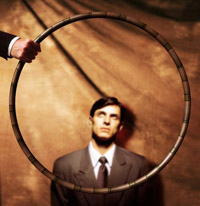
Today marked one less hoop to jump through, hopefully. The Church Polity Ordination Exam was today, and it was the last of 4 (Church Polity, Theology, Worship & Sacraments, and Exegesis) ordination exams PC(USA)ers have to take – and pass – in order to get ordained. I say hopefully because I thought this exam was pretty straight-forward and simple. That post-exam feeling can be good – or it can mean that I totally didn’t get the questions. I’m hoping that it means I just did well and my Presbyterian Polity course at Columbia really paid off.
I’m really not a fan of these ordination exams. While it’s just one way to “test” to see if you’re ready to be a minister in the Presbyterian Church (USA), an incredible amount of weight is put on these timed exams. You have three hours for each of the Church Polity, Theology and Worship & Sacraments exams, and you get about a week for the take-home exegesis exam. If you fail, you fail – and you can’t move on in the ordination process until you’ve passed. Let alone the fact that some people aren’t good test-takers, it is an incredibly inauthentic process. You basically just have to say what you think the readers/graders of the exams are going to want to hear. So whether or not you believe what you write, and whether or not you’d actually act in such a way when you actually get out into the real world of ministry, you still have to “pretend” to be a good, Book-of-Order-abiding Presbyterian Inquirer/Candidate for ministry. And then you have to get a good grader. If any of your own “personal” theology or thoughts on ministry slip through your 40+ pages of writing for the four exams, and your reader disagrees with you, they can mark you down. One reader told me that it also really depends on the reader’s mood. While I’m sure they are told to be as objective as possible – one could argue whether that really happens.
Should we get rid of ordination exams? I don’t know. Maybe. Some might then argue that we wouldn’t know if people know enough “Reformed theology” or if they are proficient enough in their Greek or Hebrew (as if most will ever continue to use it once in parish ministry). Shouldn’t the process be such that relationships are formed between Inquirers/Candidates and their CPMs (Committee on Preparation for Ministry) where the committees should know that anyway because of their history with each person in the process. I suppose that’s easier for me to say when my Presbytery currently only has 2 Inquirers/Candidates going through the process.
There must be a better way. Anyone have any ideas?
Related posts:
- National and Local Ordination Standards
- When an M.Div. from Princeton isn’t Enough…
- A Brief Reflection on Lisa Larges’ Approval for Ordination


{ 14 comments… read them below or add one }
Thanks for reminding me of my seminary days at U. of Dubuque Theo. Seminary and sensing the tensions that mounted when students took their ords. Being Baptist I could only imagine what you must be going through. And while I’m ordained I sometimes struggle with the whole idea of ordination and what that really means. At any rate, my thoughts are with you and thanks again for sharing your experience.
sit at home and have dinner around your table with your friends and neighbors. that’s just me though. seriously, i’ve got respect for you. it freaks me out too much to even think about that. but part of me wishes i would stuck through with it so that i would at least be legit enough to marry my friends.
Josh — true, true. When we were in Idaho I ran into a guy who used to help out with my youth group – he asked about wanting to fly me out there to marry him and his girlfriend. He said there wasn’t really anyone they’d want to have marry them out there. It would be fun…so yah – at least I’ll be able to marry people…
hi adam,
i get your feed and feel your pain, man. i don’t think anyone actually enjoys ords, and i shared your perspective when i had to take them. having sasid that, one of my age-old questions for school is “will i ever use this stuff?” and i do appreciate that the ords at least TRY to make a link between book knowledge and everyday reality. and as stiff and forced as the wierd situation on my polity ord was, i get at least one wierd situation JUST LIKE THAT every week. will i do last rites for a father who just died? will i baptize a miscarried fetus? is it ok for the 28 yr old couple who don’t want to baptize their baby to have a “baby dedication” with the young adult group at their house? it just never ends man. and while i get you on the subjectiveness of the readers, i appreciate that i at least got a heads up on the challenges of connecting theology/polity/worship/exegesis with the day in and day out stuff of ministry.
and even hoop-jumping can be instructional… :)
may God bless you!
robert austell
charlotte, nc
My understanding is that the reason the ords began was that when theological exams were the responsibility of each presbytery they were incredibly uneven across the nation.
In one presbytery you would have to sit through four days of in-depth oral exams and in another they would ask you “Who wrote the Institutes?” and leave it at that.
While I agree that the reader system is incredibly subjective, I actually enjoyed taking the ords.
I’ve spent my whole life listening to people who want to get rid of tests for one reason or another, and I have always hated to hear that because I love tests.
I pretty much only have two talents, I suck at all things athletic, I can’t sing or play an instrument, I can’t dance, but I preach fairly well and I’m an awesome test taker.
It’s just a shame that I can’t get anybody to pay me for either of those skills.
Echoing what Megan said, the reason that the ords exist is because it gives at least some measure of consistency across the denomination for this stage in the ordination process. The ideal is for oral examinations, but where things are in the PCUSA right now, there would be a crazy amount of diversity in who passes, fails, dialogue that takes place, etc.
How beautiful would it be for a return to the days of apprenticeships where one person would truly shadow, live with, learn from, and then be able to “test” one’s readiness to enter ministry on their own.
Call me an idealist…
How frustrating that we would ever have to think of what Ed described above as an “idealistic” vision for true theological education and spiritual formation. It seems to be that any accrediting system, whether it has to do with academics or ordination, that doesn’t center around a community’s affirmation of ones Christlikeness, their giftedness, and their calling, has very little of offer the broader Church. I am not Presbyterian, but plenty of my friends are and not one of them has ever had a positive thing to say about the Presbyterian ordination process. My guess, as an outsider, is that once upon a time this was a very worthy form of assessment, but that its day has passed (actually, this may be an overly generous concession). If I am looking to someone’s ability to serve as a faithful minister, in any capacity, whether or not they are ordained is virtually meaningless – which says not so much about the person, as it does my value for the system.
I’m not sure that ANY committee-based ordination process is any fun. Us Lutherans don’t have any exams, but we have a similar schedule of meetings with representative committees from our ordaining bodies to go through – meetings at which you and your call are affirmed or not. I think that all of these processes are, in theory, valuable, (you know me and my tendency to defend the worth of the church-as-institution), but at the same time, I am skeptical about those processes when I feel that they have strayed from their original spirit and intent.
I love that I don’t have to take ords, but at the same time, I wonder why in the ELCA there aren’t at least some checkpoints in place (other than your seminary grades) to gauge whether or not you have grasped the confessions of the historical church, or have understood why the church stands behind its worship practices, or have learned the Biblical and theological things that will help you provide your congregation members the support, guidance, and knowledge that they will inevitably seek from you. I’m not sure what a good solution is. I’m not really in favor of such a difficult battery of testing, and I feel for all of my Presbyterian brothers and sisters as they push through them, hopefully successfully!
I guess that I would characterize myself as in being favor of an ordination process that would guide you and help you discern your call, help you feel prepared for the tasks of ministry, help you gain sufficient knowledge to carry out those tasks with thought and integrity, and be grounded in a healthy but flexible view of orthodoxy. If only I ran the world…or at least the church…
Here’s my “solution.” (and it would solve Josh’s dillema, too). I am committed to pursuing ordination in the PC(USA) through the normal channels, which includes seminary, and the taking of (IMHO) silly tests. This is the next five years of my life, and I’m ok with that.
But the day after I’m officially “ordained” in the PC(USA), I plan to pursue one more ordination: in the Univeral Life Church. How does one get ordained in the ULC? By entering one’s name in a form, and clicking submit. It’s free, too. I like their philosophy and approach to ordination (and to inter-faith ordination), which (in their opinion and mine) is certainly supported in Christian doctrine and history. And it’s very consistent, for those who use that as a rationale behind the ordination exams. Everyone jumps through one simple hoop: Click.
Why am I waiting until after I “jump through all the PC(USA) hoops, though?” Mostly to avoid the criticism that I was taking an “easy” approach, or that training/education/experience were somehow less important to me.
This idea is not for everyone, I’m sure, but I think the world would be a better place if barriers to entry (to the ministry) were low. When barriers to entry are high, economists call that monopoly or oligopoly. Sure, if there are no barriers to entry, you’ll get some weirdos and crazies (some of which we get anyhow), but that just puts more responsibility on laity to self-educate and be able to recognize what is or isn’t acceptable to them. Kind of like the internet. Anyone can publish a web page these days. And there is indeed a lot of crap out there. But that’s what search engines and filter systems are for… Now there’s an idea: instead of an ordination exam, what if we had better “minsterial search and interview” processes? So the crazies can find their ideal crazy ministers, the fundamentalists can find their fundamentalist ministers, and so on.
I forgot to check the “Notify me of followup comments via email” box, so this comment is for that purpose alone. Cheers!
“…and whether or not you’d actually act in such a way when you actually get out into the real world of ministry…”
Is there a “Ministerial Ethics” portion of the test?
“You basically just have to say what you think the readers/graders of the exams are going to want to hear.”
Describing taking the ordination exams as “one less hoop to jump through.”
Both of these statements demonstrate a cynical view of ministry and the people to whom you minister. Writing what people want to hear in order to gain a passing mark on an ordination exam shows an underdeveloped sense of pastoral identity, pastoral integrity and pastoral authority. For you are compromising who you are as a person and minister in the process. In doing so, you allow other people’s views to define who you are. I am certain that you have good and salutary reasons for pursuing ordination to ministry. I simply offer a word of caution to back off the cynicism. It’s just not healthy for you or your ministry.
I’m one of those people who have taken the ords multiple timed and have not been sucessful. It pains me that I can’t begin ministry because of this process. I’ve been trained as a Chaplain because of my lack of ordination, will not be able to pay all my seminary debts and make a living in a ministry I’m passionate about. I wonder if leaving the denonination for another would really do well for me. I love the Presbyterain Churh, but get dummed out about this process.
I am about to take Theology and Worship and Sacraments for the second time next week. Thankfully, I passed Greek and Polity on the first round. I do not consider myself cynical, but I also consider these exams as “hoops” to jump through. I think they are an obsolete and ineffectual method of determining one’s readiness for the ministry. If I were to consider them from the Meyers Briggs perspective, I would see them as a very “ST” format for a predominantly “NF” profession….no wonder so many of us struggle so with them! As with any standardized tests, what is measured as much as anything else (perhaps even more) is one’s ability to take tests. Furthermore, for someone such as myself, who struggles with dyslexia, these exams are a virtual nightmare. I have the knowledge….that’s not the issue. It’s the physical fact of getting it down on paper….my writing process takes TIME….!
{ 1 trackback }