Re: What is theology?

May 31, 2007 · 12 comments

in Emergent,Theology

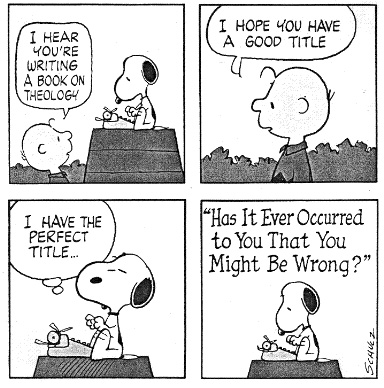
Peanuts Theology

Question 5: What is theology?

One of the electives I chose for my first semester at Princeton Seminary was The Spirituality and the Theological Legacy of the Dionysian Forgery, taught by Dr. Rorem. I really had no idea why I was taking this course, and that became even more apparent during the first class session. And while I struggled with the reading, and while Dionysius was speaking above my head during a number of occasions, I did really come to enjoy one aspect of the course: the chance to read Pseudo-Dionysius’ Mystical Theology and become more familiar with apophatic theology. Apophatic theology is a way in which one discusses not what God is, but rather, what God is not. Gregory of Nyssa described the apophatic way using the Greek word epektesis – perpetual seeking. Dionysius, in his Mystical Theology, seeks to understand the apophatic in such a way that it leads one to a complete surrender, plunging into the darkness of the Unknowability of God. Apophatic theology presupposes a transcendent God who is beyond human comprehension.

However, this doesn’t mean that we have absolutely no ability to make any statements about God – for some would say that is what theology is – humanity’s attempt to grapple with who God is and to communicate that both to God (in prayer) and to Others (in theological discourse).

One of my favorite emerging theologians, Pete Rollins, writes about this in his book, How (Not) to Speak of God. He writes:

“…I discovered a way to embrace both the wisdom of those who would say that God is unspeakable, and must therefore be passed over in silence, and the wisdom of those who would say that God can, and must, be expressed. The union can be articulated like this:

That which we cannot speak of is the one thing about whom and to whom we must never stop speaking.

…those within the emerging conversation perceive a very different way of understanding theology. It is no longer thought of as a human discourse that speaks of God but rather as the place where God speaks into human discourse. In other words, theology is understood as the site in which revelation makes its appearance in the world…If theology comes to be understood as the place where God speaks, then we must seek, not to speak of God, but rather to be that place where God speaks…Our ‘theological’ musings can thus be called a/theological insomuch as they acknowledge that we must still speak of God (theology, as traditionally understood) while also recognizing that this speech fails to define God (a/theology).” ((Peter Rollins, “How (Not) to Speak of God” (Brewster, MA: Paraclete Press, 2006), xiii, 21))

Pseudo-Dionysius, who Rollins is deeply informed by, said something similar:

“Since it is the Cause of all beings, we should posit and ascribe to it all the affirmations we make in regard to beings, and, more appropriately, we should negate all these affirmations, since it surpasses all being. Now we should not conclude that the negations are simply the opposites of the affirmations, but rather that the cause of all is considerably prior to this, beyond privations, beyond every denial, beyond every assertion.” ((Pseudo-Dionysius the Areopagite, The Mystical Theology, MT 1(997B); Luibheid ed., p. 136.))

Because God is God, we should be speaking of God – we should make statements (affirmations) about God – we should reflect on God and God’s role in the world and in relationship with humanity. However, since God surpasses all, we should also negate all of these statement we make – knowing that nothing we ever say will be “true” of God.

I don’t know where this leaves you – this idea of theology as both making statements while almost simultaneously negating them. When I took the course, it became very meaningful to me. I think it works very nicely with a postmodern humility that is prevalent in many after modernity’s certitude and sureties.

So, what is theology? Theology is any action in which we put ourselves in a place to both speak about God and receive from God; it consists of both our thoughts and statements about God while at the same time, our experience of the God who is beyond all thoughts and statements.

Related posts:

Stay In The Loop!

Subscribe to the Pomomusings feed via RSS or Email to receive notifications when new posts are published.

{ 10 comments… read them below or add one }

1 Truth Seeker May 31, 2007 at 10:34 am

So than can we negate your definition of theology then?

I think your making a false dichotomy here. One can speak of “true” things of God and they can be true. This is not certainty in the way postmodern’s like to pretend to make of the ‘modern’ movement, it is facing reality. The so-called humility of the post-modern movement is in reality shifting sands upon which one cannot base their beliefs in. If you make a statement about something and then negate it, and you do it continuously, one will not think you are humble, but rather they will think you are double-minded, confused, maybe even insane.

I trust the man more who can confidently say this is who God is (even if they are wrong) than one who makes a statement and then negates it. Hard to trust a double-minded, speaking out of both sides of his mouth kinda guy. Isn’t that what he abhor in our Senators and Congressmen; double-speak?

Reply

2 RevDarth May 31, 2007 at 11:26 am

I like your theology statement, but I would add one bit further…what about vision in the discussion? Where does what we see fit in with our experience of theology? Too often the concept of theology is tied in with the written word and thereby becomes far too black and white. How is our theology shaped by what we see around us? Is that where Snoopy’s idea comes in – the part of theology acknowledging that we may be wrong?

Reply

3 Darren May 31, 2007 at 1:46 pm

I think that this is helpful to a degree, and the turn toward a humble appreciation for the limits of human speech about God is very good. But the note of revelation is too sparse for my tastes, and so it feels that you are suggesting that theology and the attempt to speak of God’s identity is a fundamentally human undertaking. I think this view would benefit from a more explicitly theocentric perspective, which does not fail to regard Jesus Christ as our source of knowing who God is.

So I would always want to put the “receiving from God” bit at the center, for theology, if it is to be of any use, ought to be born from divine disclosure.

Reply

4 Mike T. May 31, 2007 at 3:46 pm

I don’t know where this leaves you – this idea of theology as both making statements while almost simultaneously negating them. I think it works very nicely with a postmodern humility that is prevalent in many after modernity’s certitude and sureties.

I think it leaves you exactly where you stated…falsely saying “I don’t know” to things that God has made apparent. Kind of reminds me of …mt 21:23-27

23 And when he entered the temple, the chief priests and the elders of the people came up to him as he was teaching, and said, “By what authority are you doing these things, and who gave you this authority?” 24 Jesus answered them, “I also will ask you one question, and if you tell me the answer, then I also will tell you by what authority I do these things. 25 The baptism of John, from where did it come? From heaven or from man?” And they discussed it among themselves, saying, “If we say, ‘From heaven,’ he will say to us, ‘Why then did you not believe him?’ 26 But if we say, ‘From man,’ we are afraid of the crowd, for they all hold that John was a prophet.” 27 So they answered Jesus, “We do not know.” And he said to them, “Neither will I tell you by what authority I do these things.

God is not honored by our asserting we cannot be sure or certain about anything he has revealed. Otherwise, how could we know Jesus as Lord and Savior who was crucified, died, and rose again in accordance with the scriptures (1 cor 15:3-4)? This is not humility, but arrogance of the rankest form which denies that God has spoken and acted on our behalf. HE has spoken of Himself through the apostles and prophets. All this talk of God being unknowable is pure nonsense unless you have yet to meet Christ. Like it or not, theology (and our knowledge of God) is inextricably tied to scripture. So, by whose authority do you negate the Word of God?

Theology is any action in which we put ourselves in a place to both speak about God and receive from God; it consists of both our thoughts and statements about God while at the same time, our experience of the God who is beyond all thoughts and statements.

Can we come to any understanding of God that is not initiated by Him?

Reply

5 Thomas Just May 31, 2007 at 4:56 pm

Funny isn’t it that so many people’s beliefs require other people to agree with them? That we as human race display such a proclivity towards the illusion of absolute certainty? People who ask questions and challenge the status quo are viewed as threats and even heretics. And yet throughout human history we have gone through numerous paradigm shifts. Every time this happens, the things we thought we knew are now looked at as primitive and obsolete. Makes one wonder what the next generation and the one after that will think of the things that we hold on to as absolute truth. I think it was C.S. Lewis that said (I’m paraphrasing) he who marries the ideas of his age will be a widow of the next. I think that when we speak into the void it withers and dies but when we let God speak into that same void then it teams with life and vitality. I think too often we try to define the unknowable into our nice neat little boxes and paradigms. Maybe we are not meant to define the ineffable but to allow ourselves to experience Truth and to be transformed and to more accurately reflect our image bearing nature.

Reply

6 toddfc June 1, 2007 at 11:01 am

I guess I shouldn’t be surprised by some of the critical responses, but I am. I agree with you, Adam. I think when it comes to the things we say about God and our faith, we make these statements because they are the best we can do, the closest we can come. We can know some things–a lot actually, especially because of Jesus, and Scripture, but even these things don’t give us the full picture or complete understanding of God. It’s not a rejection of Jesus or Scripture–but an acknowledgment that as humans we don’t fully get it.

I don’t think Adam is saying we can’t be certain of anything (correct me if I’m wrong, Adam); but that we shouldn’t hold on too tightly. That cuts us off from learning, and I know I’ll never be finished learning about God.

I also don’t think he’s encouraging us to negate the Word of God (as Mike T. implies), but perhaps suggesting negating the statements we make in interpreting or responding to Scripture. (is that close, Adam?)

I’m not wild about the word negate, in connection with the statements we make about God; and see that some others responded strongly to that idea…but for me, the idea is that the statements we make about God are never enough–as Rollins says, God is bigger and better than any language we can use about Him.

I like that you use the word “action” in your definition of theology, Adam. Much of the anti-emergent rhetoric is so focused on believing the right things, and condemning those who don’t agree. It seems that Jesus was a lot more concerned with how people lived out their faith than he was on the details of what they believed.

I like Thomas Just’s comments about experiencing truth and being transformed. Rollins talks about this in the book.

BTW, I’m blogging about Rollins’s book at http://toddfc.blogspot.com/. I’ve been reading your blog for a while, Adam, and appreciate what you have to say!

Reply

7 Ringo June 2, 2007 at 6:28 pm

MikeT

Very well put sir. I couldn’t agree more. You have hit upon one of the fundamental problems with the “pomo” worldview. We like to ascribe the world of ignorance to humility rather than to the arrogance which it is.

As Christians we proclaim a God who has revealed himself to us. If we don’t proclaim that, we are not Christians, we are agnostics, and should just stop playing around.

Reply

8 Elmo June 3, 2007 at 1:12 am

I’m with toddfc in that “I’m not wild about the word negate” in this instance, but I agree that the statements we make about God, though they may be true, fall short of His magnitude. He’s always better than we think or say. Perhaps our descriptions connect with the attribute of God we are describing, but do not contain its entirety.

I think that when we speak into the void it withers and dies but when we let God speak into that same void then it teams with life and vitality.

God has spoken into the void, in the incarnation. Christ’s coming is the perfect revelation of God that “teems with life and vitality.” So, and since we cannot “come to any understanding of God that is not initiated by Him,” our theology must be based in the revelation of God’s incarnation, which is found only in Scripture.

And, because God has spoken to us with what Bloesch calls “an incommensurable divine revelation that intrudes into our world from the beyond,” we can know some things about God – those which were revealed to us through the prophets, Jesus himself, and the Apostles. Beyond those things there is mystery…Paul even says that there is mystery behind those revealed things that we can be sure of. But to say that God is ineffable is untrue.

As I said before, we can’t understand or describe the depths of the divine essence, but we have been given clear statements of God’s character: He is holy, just, merciful, graceful, jealous…the list goes on. Those are things we can speak of, knowing that we’ve only scratched the surface, but confident because they are self-descriptions of God.

So I would always want to put the “receiving from God” bit at the center, for theology, if it is to be of any use, ought to be born from divine disclosure.

Exactly.

Reply

9 Travis June 4, 2007 at 10:22 am

We make it too difficult and resultantly become discracted from living theology. Theology: From the Greek “theos” and “logos” meaning “God” and “word, account, expression” respectively. Theology is the expression of God. Expression may be in dialogical speech but I would rather express who God is by living the way of Jesus.

Reply

10 Kellen June 5, 2007 at 4:49 pm

For what it’s worth, Adam, what you’ve outlined here isn’t incongruent with the “critically realistic dialectical theology of Karl Barth” (perhaps minus that “realistic” moniker?). I’m not sure how you feel about that, but when Bruce McCormack calls Barth’s theology “critical,” he evokes Barth’s conception of God’s divine aseity and God’s eternal position as Judge that provides an eternal check on any and all human attempts to speak of God. Barth’s position satisfies your concerns about “modern” epistemological hubris.

In addition to that, sympathizers with Adam’s “apophatic” position who are truly open-minded may also like to take a look at this interesting and concise counter-position-slash-rant — at least, if apophaticism is really self-consistent, i.e., it has its own anthropo-limits.

As far as I can see, the biggest problem with apophaticism is that it threatens to rob the Christian of the instinct to proclaim God’s good news. Surely the pomochurch doesn’t want to go down the same road the modern church has already hobbled down….

Reply

Leave a Comment

{ 2 trackbacks }

Previous post:

Next post:


Thesis Theme for WordPress: Options Galore and a Helpful Support Community

Pomomusings.com runs off of the Thesis Framework
and your website can too by clicking above.
Here's why you should be using Thesis.


Find us at facebook.com/Pomomusings