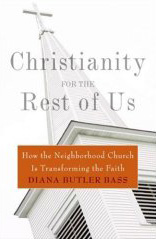
Christianity For the Rest of Us: A Review

Date May 23, 2007

Christianity For the Rest of Us

There is a nasty rumor going around, and Diana Butler Bass decided it was time to debunk it. Think “MythBusters Meets the Mainline.” The rumor is that only the large, conservative evangelical churches are growing, and that liberal, Mainline churches are dying. Now, is the myth completely false? Perhaps not. The Presbyterian Church (USA) has been losing members and we’re not doing a good job of reaching younger generations. But is the church dying? Are all liberal, Mainline churches becoming irrelevant?

Not so, says Diana Butler Bass.

Christianity For the Rest of Us stems from Bass’ research project, the Project on Congregations of Intentional Practice. The research pool consisted of 50 congregations from six denominations: United Church of Christ (UCC), Evangelical Lutheran Church of America (ELCA), Episcopal Church (ECUSA), United Methodist Church (UMC), Presbyterian Church (USA) and Disciples of Christ (DOC).

Bass begins the book by asking the question of what happened to the influential, neighborhood church? The church where everyone went because…well, because you just go to church. That’s just something you do. Bass works through the social and religious forces that have caused that church to not exist anymore, but talks about the new churches that have replaced the old churches, and how they are growing. These churches are politically and theologically progressive/liberal, and they are growing. They are actively reaching out into the community, engaged in a variety of forms of evangelism and calling people to a deeper spiritual life and commitment. Not exactly what you think of when you hear the term “liberal, Mainline church”? Then Bass’ book is one you need to read.

Since the book stems from her research, it is filled with vignettes from the ten, core churches of the study. Bass uses ten Christian practices as the ways in which she sees these progressive churches seeking to follow Christ in the world. The ten practices are hospitality, discernment, healing, contemplation, testimony (what? testimony in liberal, Mainline churches? Yup.), diversity, justice, worship, reflection & beauty. Finally she looks at how these particular practices are transforming lives, congregations and the world.

Many of these congregations are ones where a hierarchy of leadership is generally accepted. However, in some of the congregations Bass researched, she noticed a new trend among these Mainline churches:

“I observed congregations that had moved away from being hierarchical, top-down communities of authority toward more participatory forms of church, thus flattening their congregations. Instead of reasserting the ministerial or doctrinal voice of authority, they had opened their congregations to more voices, bringing a multiplicity of perspectives to bear on community life…The congregations along my way navigated between the extremes of spiritual individualism and authoritarian religion by emphasizing the power of relationship in community. Flat church.” 1

Diana Butler Bass has been running with the Emergent-crew recently, and many are asking her about the Emerging Mainline, and what the relationship might look like. In the below passage, she lays out a view of tradition I think is helpful:

“In an age of forgetfulness, I met communities of memory - not of stilted traditions, but living ones that connect people to the past. People were not seeking tradition because they desired answers, authority, social order, or doctrinal purity. They simply wanted to remember. By remembering, spiritual nomads locate themselves in a story, find new-old traditions, discover a heritage that makes sense of their experience, and recreate family. Remembering meant just that - pulling together the fragments of fractured existence and putting them back together again.” 2

Finally - Bass shares with us a vision of what a “Christianity for the rest of us” might be about:

“Transformation is the promise at the heart of the Christian life…Christianity for the rest of us is not about personal salvation, not about getting everybody else saved, or about the politics of exclusion and moral purity. Christianity for the rest of us is the promise of transformation - that, by God’s mercy, we can be different, our congregations can be different, and our world can be different.” 3

Christianity For the Rest of Us is 284 pages of hope for the future of the church, especially the more progressive, Mainline churches. Do things need to change? Of course. Do Mainline churches need to rethink hierarchy, blind acceptance of all tradition and be open to the movements of the Spirit? Of course. But Diana Butler Bass gives us hope for the church in her book - now if one of these churches would just have an opening when I need a job.

Footnotes
  1. Diana Butler Bass, “Christianity For the Rest of Us: How the Neighborhood Church Is Transforming the Faith” (San Francisco: HarperSanFrancisco, 2006), 234.
  2. Ibid., 237
  3. Ibid., 281
Tags: , , , ,

11 Responses to “Christianity For the Rest of Us: A Review”

  1. Ringo said:

    So, I wonder if Diane thinks “religion” is a good thing? Just because a mainline (one of ten core churches?) is growing, does that mean its a good thing? I think we would all assume that some churches with horrendous theology will grow, just as some with solid theology will falter. What is her point?

    /Many will still maintain that the death and resurrection of Jesus Christ for the salvation of the world is the best news of all…and only that will bring people to church in a lasting and salvific manner.

  2. Kellen said:

    These churches are politically and theologically progressive/liberal, and they are growing. They are actively reaching out into the community, engaged in a variety of forms of evangelism and calling people to a deeper spiritual life and commitment.

    …they are growing? Well, maybe. But that’s certainly not my experience. And are “liberal/mainline” churches really “engaged in a variety of forms of evangelism”? I guess that begs the question, what’s evangelism? I think it’s rather simpler than we’d all like to admit. Even in the face of Bass’ presentation, I still think many “liberal/mainline” churches are not growing because they are not really engaged in evangelism. I just had a long conversation with a pastor of a small, very liberal church in a large city nearby (where I did my year-long field education), who told me that she was just now beginning to urge her congregation even to think in evangelistic terms! (Her words!) She said it was time to begin a program for evangelism because they just aren’t growing. People in her church simply do not bring other people to church. The problem? Fear that results from the Gospel of Tolerance. People in liberal churches are often paralyzed for fear of offending the Jew, the Muslim, or the already established Episcopalian with an invitation to Sunday School. Point being: if “liberal/mainline” churches do want to swim and not sink, rather than vague promises that we’ll be “different,” a healthy dose of proper confidence in God’s Gospel could be the antidote to misplaced modern fear.

  3. Bob Cornwall said:

    Having read Diana’s book — reviewed if for Congregations — i can say that Diana has shown the Mainline a way forwrd. It’s not a quick fix nor is it one size fits all. She does believe, as I do , that Mainline churches have a message that is worth hearing. Here are churches that are finding a way to do so. It is a message of humility, service, graciousness, love, and Christian practice. It’s not radical, really, but it’s important to hear. And yes, she thinks this is all a good thing. And of course the question as to whether a theology is good or bad is likely in the eye of the beholder! Having been a Conservative Evangelical, I’ve discovered what I think is a much better theology over in the Mainline.

  4. John 316 said:

    It’s the preaching. Good preaching fills churches regardless of the theology, so yes there are progressive churches that are growing. Nobody will invite a friend to come be put to sleep by a boring sermon. The mainline is also fearful of commercialism and so they stay away from TV. Drive by a big church and it has a “television ministry”. Drive by a little church and you won’t find a TV, and I’ll bet the preacher is a snooze.

  5. seamus said:

    Pleazee! TV ministry equates good preaching? Since when?

  6. Bob Cornwall said:

    The real question is: what is good preaching?

    Am I a good preacher? I don’t have a TV ministry. I don’t even have a radio one.

    So how do we know that good preaching brings people in?

    By the way, one of the churches that Diana speaks of here that is quite vital and growing has as its pastor someone who isn’t by any means a great preacher. And yet . . .

    Yes good preaching helps, but what is good to one person might not be to another, and what many consider great preaching is really a knock off of Letterman or Leno.

  7. John 316 said:

    I’m not equating good preaching with TV ministry, I’m just making an observation that big churches always seem to have TV in them, and the little ones don’t. It’s fair to say that the big ones use the modern medium. I also note that no matter what else is going on at a church, beautiful liturgy, killer choir, no one ever invites a friend to come hear a bad preacher, but the guys that can hold an audience as it were, seem to fill the pews, regardless of their theology.

  8. Elmo said:

    …what’s evangelism? I think it’s rather simpler than we’d all like to admit. Even in the face of Bass’ presentation, I still think many “liberal/mainline” churches are not growing because they are not really engaged in evangelism.

    I’m part of a midsize ELCA church, one that’s been growing by 5 or 8 families a year for the last 5 years or so. Out of those there’s usually one family that was out of church for any significant period of time and became active in our congregation. Mostly it’s people who come our way from other churches.

    I think the reason for it is that, as i recently found out, the majority of my staff, and presumably the congregation, believes that all religions are valid paths to God. This is something you’ll see reflected in the words of many mainline/liberal theologians like Borg, or Spong, and in statements from ECUSA PB Schori. That thinking, along with the “Gospel of Tolerance” leads to apathy regarding the spread of the Gospel.

    My church equates evangelism with hospitality. Our evangelism committee’s responsibilities are Sunday morning coffee, greeters, and keeping the foyer clean. And advertising, I forgot about that. But there is no drive to reach the lost, unless they’re poor and we can do benevolence work for them. Do we not care about the souls of the middle class or the wealthy? Do the people who have it good in this life deserve less of an opportunity to find Christ then those who don’t ?

    Sorry, I got a little off track. Anyway, I think “what’s evangelism” is a valid question. If we say it consists of doing good works and hoping people become curious about Christianity, we should ask ourselves, “Doesn’t Christ deserve more? Does he deserve anything less than our full-throated advocacy?” If we say it consists of us shouting at people we don’t know (and likely have no intention of getting to know) about their sin and its consequences, we should ask ourselves, “Doesn’t Christ deserve better? He loved those who hated him, and told us to do the same.”

  9. Sarah said:

    I’ve been a music minister at a small rural UCC church for 8 years. These are great folks and they care about each other and missions. However, we are nearly depleted in numbers. Our minister (79 years old) admits she’s not great at preaching (correct), even though we love her. we know we are going to have to do something when she retires. It’s just good to read of others like ourselves who seem to be succeeding. I have said to them that we need strong preaching, and I don’t mean conservative. I mean enthusiastic. I feel enthused about my faith and I’m quite progressive. I believe we also need much more attention to families. We feed the poor in Africa and neglect our teenagers. What’s up with that!

Trackbacks...

  1. The Minority Report « Topics for Polite Conversation
  2. Tribal Church: A Review | pomomusings | progressive theology & design

Leave a Reply

XHTML: You can use these tags: <a href="" title=""> <abbr title=""> <acronym title=""> <b> <blockquote cite=""> <cite> <code> <del datetime=""> <em> <i> <q cite=""> <strike> <strong>