
The first Barbara Brown Taylor book I read was The Preaching Life which I instantly fell in love with. Taylor’s way of telling stories and making the text come alive is very engaging. Taylor serves as an Adjunct Professor of Christian Spirituality here at Columbia, so I was looking forward to hearing her preach while I was here. That opportunity came just a few weeks ago, when she preached for Columbia’s 2007 Colloquium; she preached on humanity’s relationship to creation. I knew she was a good preacher because we watched a video of one of her sermons for Preaching at Princeton, but it was even better to see her preach.
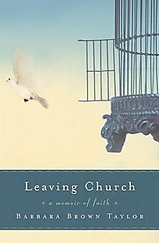
Sarah’s mom read Leaving Church first, and then gave it to Sarah, who read it a few months ago. I am a little late on reading it, but am so glad that I did. I went to a lunch a few weeks ago that Barbara Brown Taylor spoke at, and did some Q&A about her book. I had only read a few chapters at that time, but hearing her speak about her transition from ministry into the teaching world sounded very intriguing. Her book is basically a memoir of her journey into the ordained ministry in the Episcopal church, and then her journey out of church. When I heard her speak at the lunch, she said some very interesting things about her time as an ordained priest:
- From the beginning, it was doomed because of the neverending job description.
- She felt more like a mayor, than a priest. Always present at community events, leading prayers at Rotary events, etc.
- She thought the church/synagogue/mosque should model a different way of life; but she found the church simply reflecting the lifestyle of the culture.
- She found herself defending the institution a lot, and at times wondered, “Why?”
At the lunch, she always shared what her ideal church would be. She said it would consist of 52 people, and it would be a community of pastors, in that all of the leadership would be shared. Hopefully they would be a community of social activists, a community of leaders, and they would never own a building – because she said as soon as you have a building, then the problems begin. Some interesting thoughts for would-be emerging church planters.
The book is great – a wonderful story of Taylor as she comes to terms with ordination as her calling in life and her constant desire to be in ministry and to “help people.” Unfortunately, one of the main reasons many of us go into ministry is because we want to be able to “help people.” It’s natural. And perhaps it’s not all bad. But as Taylor found out, and as many of my peers going into ministry will soon find out, you cannot help all the people in your church that need help. As much as we’d like to be, we can’t be “all things to all people at all times” (no matter how much we’d like to). Taylor tried to, and it eventually became the beginning of the end for her. The idea of being a priest, and being holy and “set apart” was eventually too much. She describes, beautifully, a party she went to after she had taken a teaching job at Piedmont College and left her parish. She had many conversations with people who were members of the parish who she had never gotten to know because they had any crises for her to figure out. She then relates a story about how some adults starting throwing each other in the pool, and some people looked to throw her in, but then decided not to, which saddened her. Eventually a few people came and threw Taylor into the pool, and she reflects on the experience in this paragraph:
“I never found out who my savior was, but when I broke the surface, I looked around at all of those shining people with makeup running down their cheeks, with hair plastered to their heads, and I was so happy to be one of them. If being ordained meant being set apart from them, then I did not want to be ordained anymore. I wanted to be human. I wanted to spit food and let snot run down my chin. I wanted to confess being as lost and found as anyone else without caring that my underwear showed through my wet clothes. Bobbing in that healing pool with all those other flawed beings of light, I looked around and saw them as I had never seen them before, while some of them looked at me the same way. The long wait had come to an end. I was in the water at last.” ((Barbara Brown Taylor, “Leaving Church” (San Francisco: HarperSanFrancisco, 2006), 120.))
In the second half of the book, Taylor relates on her struggle to learn to just “be” and experience Sabbath. Without all of the duties of pastoral life, all the problems to solve, phone calls to return, people to visit…she had to learn how to relax and be fully human and experience God in the world and in others. She discovered the need for all of humanity to live into their humanity: to become fully human.
“…it remains possible to see Jesus not as the founder of a new religion but as the exemplar of a new way of being human – a new Adam, in the language of Paul – who lived and died with such authentic faith in God that he gave his followers the courage to try to do the same thing.” ((Ibid., 221))
Taylor says that becoming fully human is a conscious choice that we must make every day – to live into our humanity, to live into the life abundant that Christ hopes and dreams for each and every one of us.
While the book is called Leaving Church, Taylor has both good critiques of and hopes for the church in this book. Here is just one more passage which I loved:
“All these years later, the way many of us are doing church is broken and we know it, even if we do not know what to do about it. We proclaim a priesthood of all believers while we continue living with a hierarchical clergy, liturgy and architecture. We follow a Lord who challenged the religious and political institutions of his time while we fund and defend our own. We speak and sing of divine transformation while we do everything in our power to maintain equilibrium. If redeeming things continue to happen to us in spite of these deep contradictions in our life together, then I think that is because God is faithful even when we are not.” ((Ibid., 220))
Perhaps leaving church is going to be necessary for some clergy to learn how to live, to be fully human and to connect with God again. I will tell you it’s quite an interesting book to read as one who is on the tail end of the ordination process. Many of the traps that Taylor fell into are very real, and still potential pitfalls for those of us who are entering into ministry today. At the very least, Taylor’s book is a reminder of what “not” to do in ministry. But her book goes beyond that, and gives a prophetic vision for what the church could be in this world.