
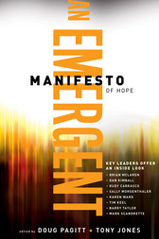
I just finished my copy of “An Emergent Manifesto of Hope” and I really enjoyed giving it a read through. There have been some reviews of it already – just read Jonny Baker’s this morning and thought it was a pretty fair review. One of his critiques was just that it was spread pretty thin. I found that to be true as I read through it. But I don’t think that has much to do with the quality of the writing – it’s just that there are 25 of us trying to share some of our stories, and so that’s a lot to fit into one book. I think it really serves as a “taster” to the conversation – kind of a ‘teaser’ in a way. In some ways, the book says, “Yah? Yah? You like what you’ve heard? You wanna talk more? Well, let’s do it. Let’s engage on a blog. Let’s grab coffee at this event or this one. The conversation is just beginning!”
And as with any book that has 25 fairly diverse authors writing on all sorts of different topics, there will be some stuff you really jibe with, and other chapters you might not really get into. But I think there really is something in the book for everyone. While I did enjoy most of the chapters, a few really stuck out to me that I wanted to mention.
Nanette Sawyer’s chapter, “What Would Huckleberry Do? A Relational Ethic as the Jesus Way” is a wonderful story of her journey and the journey of her church, Wicker Park Grace. Nanette speaks about the way they talk about their church, and she focuses on being “centered in a generous and dynamic Christianity.” I love her ideas of being centered and being more concerned about where they find their center as opposed to the edges; being generous in finding ways to love and serve the world; and being dynamic, in that they are not afraid of a Christianity that is dynamic and not afraid of change.
Samir Selmanovic has a great chapter entitled, “The Sweet Problem of Inclusiveness: Finding Our God in the Other.” In his chapter, Samir talks about the idolatry of Christianity and asks some wonderful questions about finding God in the Others we encounter. I don’t know that more conservative folk will be as interested in a chapter that calls for a very strong sense of humility in regard to our claims of truth, but I found it to be a very engaging chapter.
Sally Morgenthaler, probably most known for her work in Christian practices and worship, wrote a wonderful chapter, “Leadership in a Flattened World: Grassroots Culture and the Demise of the CEO Model. She discusses various leadership theories, collective intelligences, patriarchy still reigning prevalent in the church today and offers some new ideas for leadership in the church today. I think this is something I will continue to get more and more into as I get closer to thinking about my own ordination into the Presbyterian Church (USA). I think there are some new ways that we might begin to think about leadership, and I’ll be intrigued to see if more ‘traditional’ pastors are open to new ideas concerning leadership in the mainline.
Finally, my friend Dwight Friesen wrote a wonderful chapter, “Orthoparadoxy: Emerging Hope for Embracing Difference.” I met Dwight at the first Emergent Convention and have been following his blog ever since. I remember sitting in a restaurant in San Diego with Dwight and some others, and having absolutely no idea what Dwight was talking about…and I loved it. He would talk with you, and ask you questions, and all of a sudden you’d be talking to, not quite sure what you were saying, but Dwight would be listening intently and discussing with you. I’m sure that is what makes him a wonderful seminary professor. At any rate, Dwight wrote about his topic of choice: orthoparadoxy. Dwight explains it best:
“Orthoparadoxy is an effort to make God’s main thing the main thing for all the people of God: reconciliation. Not sameness or agreement but differentiated oneness – where the fullness of one can be in relationship with the fullness of another. Orthoparadox is right paradox – holding difference rightly. Orthoparadox seeks to hold difference, tensions, otherness, and paradoxes with grace, humility, respect, and curiosity, while simultaneously bringing the fullness of self to the ‘other’ in conversation, not to convert or to convince but with the hope of mutual transformation through interpersonal relationship” (205).
I commend this book to you – you may not like all of it, but it serves as a great introduction to Emergent for those of you who may not have read much, or any, Emergent/Emerging Church material.
BakerBooks provided me with 3 copies to give to readers, and I gave them to 3 people who fulfilled two requirements: FIRST, this was their first Emergent/Emerging Church book and SECOND, they will blog about the book after they’ve read it. The three winners were Steven Good, Kevin Germer and Rachel Pennington.