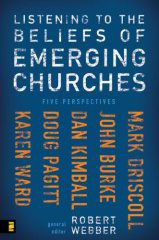
Listening to the Beliefs of Emerging Churches: Summary

Date April 7, 2007

Listening to the Beliefs of Emerging ChurchesPart 1: Mark Driscoll
Part 2: John Burke
Part 3: Dan Kimball
Part 4: Doug Pagitt
Part 5: Karen Ward

I’m glad I had the chance to read this book, and I continue to look forward to more Emergent books that come out using the collaborative method of writing. I will be blogging through some chapters of An Emergent Manifesto of Hope in the next few weeks - I think you’ll really enjoy this book if you haven’t gotten it already. In fact, as I blog through it, I’ll have 3 giveaway copies, so be looking for that.

Robert Webber, the general editor for Listening to the Beliefs of Emerging Churches ended the book with a summary chapter that had some helpful pointers in it. One thing I found interesting, that I will close this series with, was his comment on seminary education:

“The third matter these five writers have in common is that their backgrounds, and particularly their seminary education, have not prepared them for ministry in a postmodern world. In particular, they share three problems inherent in modern seminary education. The first is the compartmentalization of the seminary curriculum…Second, their seminary education has been strongly analytical and oriented around evidential apologetics, logic and reason…And third, little attempt has been made in seminary to show the relationship between theology and ministry” (197).

Seminarians — what do you think? What about Princeton or Columbia Seminary students? Do you think this is the case with your own seminary education?

Tags: , , , , , , , , , , ,

18 Responses to “Listening to the Beliefs of Emerging Churches: Summary”

  1. Kellen said:

    And third, little attempt has been made in seminary to show the relationship between theology and ministry

    I don’t think that can be said about PTS. My field education supervisors and teachers have been more than willing and able to help me integrate theological reflection with ministerial practice. And we certainly have not been trained at Princeton in “evidential apologetics, logic and reason”!!! I’d actually like to see more formal logic and philosophy taught at this seminary, because when you get down to it, most people make arguments with their feelings here — and thus, they don’t make arguments at all.

    As to the rest, I don’t understand Webber’s (cynical) point, especially given the fact that these five individuals actually appear to have quite successful ministries in various parts of the country. At least Karen Ward, Dan Kimball, and Doug Pagitt are the golden children of the emerging church phenomenon (are they not??), and say what you will about Driscoll, but he does apparently pastor a thriving congregation. Only if we considered the churches these pastors oversee to be failures, which, obviously neither Webber nor the others, Driscoll perhaps excepted, do — could we claim that seminary education failed these pastors — and even then to make such a sweeping claim would be a stretch. Actually, it would appear that seminary education did prepare these people for SOMETHING! We can’t expect to learn everything in two or three years, but we can expect God to turn our water into wine, can we not?

    Reminds me of some words Clifton Black said that marked me in a class on Mark’s Gospel. He stopped mid-lecture and looked at us with candid expression: “The most important things you need for ministry we can neither give to you nor take from you.” And he was silent for about thirty seconds. I think Paul would have agreed with him.

  2. Anthony said:

    Reading your blog over the past several days I have now placed this book on my “need to read” list. I am attending an emerging seminar in Seattle later this month w/McLaren so I’m trying to read all I can about this movement.
    Thanks for sharing your thoughts

  3. Kate said:

    I’m with Kellen. Most of the professors and preceptors I have had here at PTS make a concerted effort to connect what we’re learning with how we minister, preach, teach, and live. As an example, I am currently taking a class on Daniel and, as our class project, we are preparing an entire curriculum centered on the book. Other assignments have included preparing lesson plans and sermons based on this sometimes difficult book.

    I also agree with Kellen that many people at this seminary do little “arguing” and more “sharing.” Perhaps analytical study shouldn’t be devalued so quickly. I doubt that the folks who wrote this book would have done nearly as good a job if they hadn’t had such an education, but I suppose I could be wrong about that.

  4. Dan Morehead said:

    Kellen, I think you’ve misunderstood Webber [though this itself would be understandable since you're going off a block quote -- Webber, btw, is another former professor of mine]. His point is that each write from a dissatisfaction with their preparation for ministry (or I might say, how Christianity is conceived). Sure they could have gone on to have faithful (this perhaps a better word than successful) ministries, but the point is that their preparation for ministry resulted in them needing to find/form a new way to express or understand that ministry. Feeling unprepared (or lacking the resources to embody and make sense of Christianity) is frustrating and their work attempts to overcome this.

    On a larger scale, one is likely best to understand emergent/emerging in this sort of way, namely, an attempt to return to sea on driftwood after learning that the epistemological walls of conservative Christianity in America cannot keep out the winter chill and after the ecclesial ships have already been burnt.

  5. Kellen said:

    Dan,

    If Webber means that each chapter’s author writes “from a dissatisfaction with their preparation for ministry,” then I do not think that I have misunderstood him. I seriously doubt that any minister, five or ten or fifteen years on, given the occasion to reflect, will remark that their seminary education “prepared” them for service in the churches. Every minister’s life’s work and calling is an attempt to overcome a certain lack of preparation for embodying and making sense of Christianity, i.e. an attempt to pray for and receive faith! These Emergent people may think themselves special with regard to their experience of, say, epistemological unpreparedness, but I seriously doubt that they are so unique. Your statement that “they could have gone on to have faithful…ministries, but the point is that their preparation for ministry resulted in them needing to find/form a new way to express or understand that ministry,” could easily be said about any minister in any Christian church. I would bet that every minister has at one time or another sympathized with the sentiment that seminary was an inadequate or insufficient ordeal.

    And that was my point: seminary is, in itself, insufficient! It’s necessary, I would say, but also certainly not sufficient. You can be no more “prepared” to enter ministry than you can be “prepared” to get married, have children, or become a monk. Nor do I think that the intellectual aspect of “preparedness” is in any way exempt from the participatory knowledge requisite for maturity, which, in the Christian life, is known as faith. Hence the remark from Dr. Black, which implies that it is not from seminaries as such that the gift of faith or, as you put it, the resources for making sense of Christianity, originates: only from and by God’s Holy Spirit do this gift and its subsequent blessings end up in our hands.

  6. Dan Morehead said:

    We agree on your point about seminary being insufficient, but insofar as you think it is necessary it seems that you think there is some good in it. I’d agree here as well, but if there is some good in it, then that good can be marred by poor conceptualizations, poor organization, or poor understandings of the nature of ministry. I think Webber’s point was not about the insufficient nature of seminary [that he would surely grant], but the problematic presuppositions and formulations upon which seminary education of the authors in question was based. C’est tout.

  7. jazzact13 said:

    Second, their seminary education has been strongly analytical and oriented around evidential apologetics, logic and reason

    The other two observations were ones that perhaps I didn’t really understand, but this is the one that stood out most to me, as in “Why would such a thing as this be considered a bad thing?”

    I have had little contact with seminaries, but my understand of them has been that they are much like universities in that their aim is to teach, more specifically to teach the various aspects of Christian thought and ministry, and perhaps other aspects I don’t think about at present. While granting that things like ministerial training and gaining experience are good things, it would be considered incumbant on the student to first be grounded in the basics of the faith, which would require that they be taught why they believe what they believe.

    As such, then, rather then criticizing the seminaries for being analytical and logical, I would much rather say that in being so they were doing their task, with the added aside that perhaps some should have been paying more attention in their reason and logic assignments.

    As with almost all college graduates, I’ve no doubt that seminary graduates have much to learn in the ‘real world’ once their education is finished. Such is a fact, that while college is a step in preparation, it is only a step, often the finishing touches of preparation must be done in the real world of post-college work.

  8. Kellen Plaxco said:

    Dan,

    As I used to put it in instant messages as a teenager:

    OIC.

    Thanks!

    Kellen

  9. Dan Morehead said:

    jazzact13 –

    Webber’s point is not that intellectual pursuits are not important [again, it's worth remembering that he's a teacher....at a seminary...and writes books...etc.], but the particular way that some seminaries have theologically operated — focusing on “evidential apologetics, logic and reason” — have traded heavily on propositional conceptions of Christianity or assumptions about rationality which in effect reverse fides quaerens intellectum, faith seeking understanding. Operating is such ways affects how a seminary will see its task in training ministers.

  10. jazzact13 said:

    Dan–
    Yet for the most part, seminary students are already persons of faith (no doubt exceptions can be found, but again, for the most part). I suppose one way of seeing seminary is a place where persons of faith go to gain more understanding of their faith and the focus of that faith. Perhaps to rephrase it, the student has already made the confession of faith in Christ, and is seeking more understanding so as to grow in faith.

    I do not see reason, logic, and apologetics as being bad things; quite the contrary, I think that Christianity is an ultimately reasonable and logical faith, and apologetics is simply showing those traits. Does Christianity go beyond reason and logic? I can think of the Trinity, how God who is One is also Three, and I realize that such a concept is one that I can make no reasonable picture of, but one that since I trust God to be true, I accept as true based on His own words. Such would be one example of the limits to reason, except insofar as it is still reasonable to trust a God who is trustworthy.

    Judging solely by what was posted in the opening and my understanding of the meaning, I can only it as being a criticism of apologetics and reason and logic in regards to ministry to postmodern people. I can’t agree with that. If ultimately postmodernism is a denial of truth, then what is needed most is a message that “God is true and His Word is truth”. Perhaps that message would not be accepted, but that doesn’t make the message any less true.

    Or, to put it as I remember one place in the Bible putting it, “Let God be true, and every man a liar”.

  11. Chris TerryNelson said:

    Thought you guys might be interested in this rather lengthy critique of postmodernism. It’s done by Keith DeRose who teaches philosophy over at Yale.
    http://fleetwood.baylor.edu/certain_doubts/?p=453

  12. Dan Morehead said:

    jazzact13 -

    I would agree that Christianity is reasonable, hence the intellectum in my previous comment. Further, I’m aware that most seminarians are Christians, which would seem to take care of the fides. However, that does not mean that seminaries cannot operate with epistemological assumptions or overly confident takes on apologetics. I agree with Barth that we should simply think of good theology as our apologetics. What is ruled out by people like Barth, Webber and myself is the notion that you could reason someone into faith. In the past, seminaries have been operated as if it is the goal to be able to give seminarians the rational tools to do just that. In a less foundationalist landscape, some of the authors of Listening to the Beliefs of Emerging Churches have needed to break out of the outdated and theologically problematic molds in which they were formed. I take that to be Webber’s point.

    No one I read claimed postmodernism is a denial of truth. Thanks for your thoughtful comment.

  13. jazzact13 said:

    What is ruled out by people like Barth, Webber and myself is the notion that you could reason someone into faith.

    Whether true or not, I don’t know, but in reading Chesterton’s Orthdoxy, I get the impression that he didn’t turn from atheism to Christian until the faith began to be reasonable to him. Perhaps many people do not care about the reasonableness of Christianity, but many do care about making it seem unreasonable–thus, the constant, if often amateurish, attempts to discredit the Bible or Jesus’ divinity (can anyone say ‘Da Vinci Code’? And it’s not even the most recent). Perhaps not many people will be reasoned into Heavan, but no doubt many will be unreasoned into Hell.

  14. jazzact13 said:

    Concerning what I said about postmodernism, Dan, it seems that even those in the middle of it cannot say what it means. As far as it being a denial of truth, from what I’ve read of some of those considered to be early postmodernists, and their claims that literary meanings cannot really be known so readers in essence create their own meanings, it seems then we are left at least with the claim that truth is unknowable, because truth is conveyed through words which have meaning independant of the reader or writer. And there is only the thinnest of edges between “Truth is unknowable” and “There is no truth”, because in the end they both end up meaning the same thing.

  15. Dan Morehead said:

    jazzact13 –

    You read my mind. I had thought to say something about the place of ad hoc confrontation of another’s claims. Well said. In all of this, my point was to clarify what Webber’s point was in the block quote. Enjoyed the interchange.

  16. Lon said:

    thanks for the book summaries!

    and as i’m wrapping up my seminary education soon, i agree. i wouldn’t say it was totally analytic… there was plenty of reflection… and even practical applications… but you can’t fully learn the heart of ministry in a classroom or while writing a paper

Trackbacks...

  1. Power of Suggestion » Listening to…Emerging Churches, Part Deux
  2. Listening to the Beliefs of Emerging Churches « My World

Leave a Reply

XHTML: You can use these tags: <a href="" title=""> <abbr title=""> <acronym title=""> <b> <blockquote cite=""> <cite> <code> <del datetime=""> <em> <i> <q cite=""> <strike> <strong>