SBL/AAR Day 2/3 & What is Emergent?

Date November 20, 2006

Emergentpete

Days 2 and 3 brought quite a few hours of working at EIS and running into some fun folks like AKMA, Matthew, Jake, Justin, Myles and Sarah. I was able to catch up with two good friends from Princeton (Kellen & Dan) and Sarah and I ran into a lot of people last night at the Princeton Seminary Party.

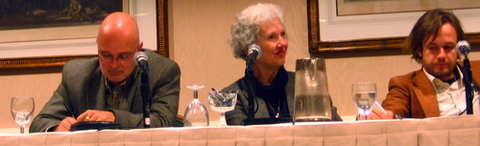
Yesterday, I finally made it to a session, "What is Emergent?" Brian McLaren, Phyllis Tickle and Pete Rollins (pictured above) led a lively and packed discussion about Emergent and its role in the church and in theological discourse. The day before, a friend asked me why Emergent still needs to have seminars entitled "What is Emergent?" He said, "You know, all you guys have to do is put out a Press Release and then you can move on!" To some degree, I agree. Since I’ve been involved in this conversation for around 3.5 years, it does start to get a little ‘old’ to go to sessions that seem to rehash much of the same things…but as was clear yesterday, there are still plenty people who are either just getting wind of Emergent or still have many basic questions to ask about it.

At any rate, Phyllis Tickle gave a wonderful introduction to Emergent and its place within the history of Christianity. She talked about how every 500 years, the church has gone through a dramatic revolution and reformation (1517: Protestant Reformation; 1054: East/West Split; 500…something about popes…I was never great with history). She believes that Emergent is the new movement of reformation for this 500 year period. She also is so bold to say that Brian McLaren is to this new reformation what Martin Luther was to the Protestant Reformation. Bold claim. Of course, Brian is so humble he just shakes his head.

Brian talked about different issues within the Emergent conversation (pragmatic, philosophical, theological, missiological, liturgical and issues of justice, globalization and postcolonialism). He also spoke of the global south and how he has traveled to over 20 different countries of the world and met people who are asking the same questions that Emergent is. I find this encouraging, specifically when people are, rightfully so, still asking the question of Emergent, "Where is your diversity?" Someone asked that question yesterday, because the room was primarily white (and primarily male). But Brian makes a good point. He said that the 95% of the evangelical church’s leaders are men. This is a horrible statistic, and makes me glad that I’m part of a denomination that encourages and supports women in ministry. However, Brian followed that statistic with another, that approximately 85% of the Mainline church’s leaders are men. Not much better.

Pete Rollins is brilliant. I’ve mentioned before in my review of How (Not) to Speak of God, that I think Pete’s book is the most important book for the emergent (theological) conversation. His book really does present the theological and philosophical foundation for emergent, and to hear him in person, is quite the experience. Simply put, he’s brilliant. And if you’re anywhere near him on his US Speaking Tour (Princeton Seminary students - I HIGHLY recommend Pete to you: go see him when he’s on campus Nov 29-Dec 1, more info later).

Below, you can sift through my rough notes from the session, and if you’re really interested, you can download some of the presentation and Q&A in MP3 format here (sorry Mark, it is 40mb).

Phyllis Tickle
Every 500 years the church has a big rummage sale.
1517, 1054, 500 (popes, etc.)
Could this be the next?
Each time, what was left has become a viable expression of Xnity, none of them ceased to visit.
We are now in one of those 500 yrs.

Faraday & Darwin brought about the beg. of this reformation, our current time of upheaval. In these times, one simple question exists: where is the authority? Sola scriptura won’t hold water now…so where do we find authority now?

What is emerging is not a new form of Protestantism, it’s a new form of Xnity. It’s emerging in the 2/3 world, and in the Western world.

When we speak of Emergent Xnity, it’s not Protestant, Oriental, Orthodox, etc., it’s different. It must deal with where is authority?

Also, we don’t know what it means to be human. Cogito ergo sum doesn’t hold up in light of nanotechnology, artificial intelligence. And we don’t know what we think about a theology of religion.

We’ve developed a society/Xnity that consists of people separated into four parts:
*liturgical
*social-justice
*conservative/Evangelical
*charismatic

There is also a diminishing of denominational-loyalty - part of that means that we throw away that which doesn’t access God for us.

There is a new form of Xnity and we aren’t exactly sure what it is.

Emergents are characterized as being:
*deeply incarnational
*concerned about ritual
*huge sense about social justice/environment
*deeply embedded in wherever they are

One of the great questions is whether or not the Emerging church will integrate with the reconciling churches (indigenous forms of church that exist in areas that were not colonized).

Brian McLaren
Questions that led to Emergent:
*How do we reach these people? (pragmatic)
*Philosophical
*Theological: What really is the story, what is the gospel?
*Missiological
*Issues of justice/globalization/failure of the nation-state to address emerging global problems?
*Liturgical discussion

Desire to link this conversation with the global south.

Postmodern & postcolonial are the same conversation - postmodern is a conversation among the former colonizers, and postcolonialism is a conversation among the ones who were colonized.

Pete Rollins
IKON - transformance art. Can we create a space where God can give God?

Modernism — reason  & wonder.

Fractured/fragmented discourse.

God is received, but never conceived.

A more phenomenological faith.

I absolutely believe in intervention, but sometimes believe in whether there is a God.

Believe - behave - belong?

No. We start with belonging. I’m not going to reason you into the faith community. Just give it a go. See how it plays out.

We speak with wounded words of a wounded Christ. We speak with words of ikons…not idols. When we hold our theology not as a signpost that points, and not an idol that holds, but as an icon where we gaze upon the invisible and the invisible gazes upon us.

Anselm has a non-ontological argument. God is a being of whom none greater can be conceived. See Jean Luc Marion’s article on Anselm.

Where is the role of clergy in the emerging church?
Network theory.

Networks can co-exist with hierarchies.

The pastoral contract - there is a change coming in this unwritten contract.


19 Responses to “SBL/AAR Day 2/3 & What is Emergent?”

  1. Neal Locke said:

    I caught McLaren at the PCUSA New Church Development conference in FA this summer, finished Pete Rollins’ book a month ago, but missed the opportunity to meet YOU this month when my wife and I visited NJ for a “Princeton Seminar” Weekend–apparently you’re in GA, a few doors down from my friend Glen Hunihan. Oh, Well. Someday… Thanks for being a refreshing voice in the presbyterian blogosphere.

  2. mark said:

    thanks for posting the info adam!

    and for the nicely encoded 40MB file..

    look forward to listening to it!

    re: Derrida..ive found that the best way to approach it is as follows..

    other: “Derrida says XXX” (insert anything for X)
    you: I think you are misreading Derrida there. (and then walk away)

    mark

  3. Steve K. said:

    “(Tickle) believes that Emergent is the new movement of reformation for this 500 year period.”

    Shouldn’t that say “(Tickle) believes the emerging church is the new movement …” ?

    Or does Tickle really believe Emergent Village (emergentvillage.org) is the movement?

    I wasn’t there to hear her comments obviously so it’d be great if maybe you could clarify that for us, Adam.

    Thanks for posting this!

  4. Adam said:

    Steve, yah, I think if Phyllis was asked, she’d be referring to the whole of the emerging church movement, and not specifically Emergent, though I think that theologically and ideologically, she’s right there with that crowd.

  5. suz said:

    Adam,
    thanks for posting the notes and the lecture. I look forward to listening.

    Did Phyllis touch on those of us that are having an idenity crisis? I.e. those of us that identify with each of the four parts either in our thinking/beliefs or in our spiritual heritage.

  6. Tim said:

    Adam,
    I’m a pastor/clergy-type in a mainline church and agree with the idea that networks can co-exist with hierarchies. I want to know more about your following notes concerning the pastoral contract. I’m young, 2 1/2 years into ordained ministry and really loving what I’m reading about Emergent movements. Tell me more! I also want to know more about those of us (per Suz) who find ourselves bridging across more than one of those four categories of emergence.

    Tim

  7. Tim said:

    Ok, let me get this straight…the Bible is not our sole authority? Then what is? Subjective feelings that drive us to community? I understand much of what i’ve read above, but not the jetisoning of sola scriptura. Seems we want to throw out the baby with the bathwater….

  8. timmy teknon said:

    Tim writes:

    “I understand much of what i’ve read above, but not the jetisoning of sola scriptura. Seems we want to throw out the baby with the bathwater….”

    Is sola scriptura the baby? Sola Scriptura is the reason for the season? This seems to be where paths diverge.

  9. Tim said:

    Yes, ‘in the beginning was the word..’ Does that not seem to indicate an equivalence between his word and himself? You are correct, paths diverge around this issue: one remains built upon what orthodoxy considers truth, the other finds its’ basis in subjective need for common understanding. Two very diverse paths indeed.

  10. dh said:

    Yes the equivilence of the Word with Himself means that ALL Scripture is from God. So yes it is Himself. We all agree. :)

  11. dh said:

    Sola Scriptora doesn’t deny thereason for theseaon being Jesus. I have no idea about this overgeneralization by Mr. Teknon.

  12. Tim said:

    I just wanted to clarify that I’m the ‘Tim’ from 21 November at 3:00 pm. I did not post at 3:09 or 9:44. There was another Tim that quickly followed. I may try another name for clarity.

    Rev. Black

  13. J Bren said:

    It seems a bit ostrich-like to claim that Emergent is the newest “reformation”. It sounds like an old cartoon where a North-American points to a globe and says to his kid, “The world is made up of US and all those other places that fill it up until it is round.
    “Emergent” will be little more than a radar blip unless it listens to, and partners with, what is happening–or rather, been happening–in the rest of the world.
    On that note, I’m not surprised McLaren spoke about the global South, fresh off a speaking tour in Latin America, with Rene Padilla. Padilla and other global leaders have been talking and writing about some of these “Emergent” themes for over 30 years! (for example, see integral-mission.org)

    In any case, I hope others will follow-up on this path and participate in a global discussion already in progress.

  14. Virgil said:

    Many thanks to Adam for posting this article - it’s good to know what is happening out there. Just a few quick comments I would like to make:

    I do not believe Emergent to be the “next Reformation” nor do I think Brian is a neo-Martin Luther (plus I don’t think he would like that characterization anyways). In all my interactions with Brian, he proved to be a very humble and soft-spoken man; to be a Reformer one has to almost have a few kills under his belt (and yes that’s a jab at the violence of the Reformation)

    I do however believe that Emergent has the potential to be a means to a reformation, just as Preterism has the same potential

    Preterist eschatology and Emergent hermeneutics and conversations create an invaluable and unique environment for a means to a reformation that we could perhaps experience in our own lifetimes. Brian recognized this in the interview I did with him. I personally do not believe the Church (Emergent or otherwise) will make much headway without reconsidering our eschatology.

    The Emergent Conversation continues to be the stage on which the key contemporary debates of our faith take place

    Important PROVOCATIVE issues that are not being touched with a ten foot pole by traditionalists are discussed and tackled by Emergents: role of women in ministry, sexuality, social justice, environmentalism, ritual, universalism, fulfilled prophecy…etc.

    At last, one of the more important points (a lightly critical one) I’ve shared in the past: As long as Conservatives are being somewhat (unwillingly I believe) marginalized, Emergent will again not make much headway into the mainstream — I really hope and pray that the lines we are drawing among ourselves and the labels we so much love to put on each other will some day fade away into a distant past, otherwise the fuzzy feelings we all get when we meet with our Cohorts will not last long.

    Again, great blog entry Adam!

  15. Richard H said:

    I think it’s a little short sighted to put Emerging/Emergent on the level of the Reformation and other 500 year events. If I needed to nominate a movement for this I’d put Pentecostalism way ahead of Emerg.

  16. Existential Punk said:

    Adam, glad you got to see Pete! The 3 of them had just come up from Richmond from a 4 day conference here. i was going to come up to DC but was exhausted. Sorry to have missed you. Adele

  17. Lon said:

    awesome, thanks for the notes.

  18. dh said:

    I believe Emergent will fall by the wayside or in a positive sense is a waypoint toward post-post modern Christianity. I see post-post modern Christianity as being modern with a proper attitude, lack of harshness, but with no change in the message given. I feel much of the problem of modern Christianity has nothing to do with the theology but the attitudes and actionsof the people within the belief of that particular theology. I see people who are asking questions truly wanting answers and I see Emergent just not providing answers sufficient enough for those asking the questions. As people see the modern Christian taking on a kinder more sensative approach but with no change in message I feel that a major revival will take place and many Emergents will have to decide between universalism (thus never been a Christian in the first place) and becoming a post-post modern Christian where actions, heart and attitude match the truth of God’s Word.

  19. Tim from 11/21 3:09 & 9:44 said:

    Excellent points DH and one I was getting at in my posts. From what little I know of Emergent it seems more of a ‘movement’ aka Seeker Target like Wllow Creek than a radical reformation. Emergent even has a website to gain the young demographic attention, the ‘new’ terminology to appear fresh, and the loosening of theological distinctions to appear inviting. Actually, it is a brilliant marketing campaign not unlike Willow! It reminds me of the Fundamentalist/Neo-Evangelical split of the early 20th century which marginalized the Fundi’s and ended up with neo’s becoming mainstream. But the third often overlooked segment were the more liberal theologians who remained in the mainline protestant churches. I think emergent is more along the lines of evangelistic methodology and seems to attract regardless of theological stance. Thus it could hardly be a reformation since it isn’t, as I understand it, reforming anything substantive. Question: when are Bible believing Christians going to stop jumping on bandwagons and start just being authentic? ’cause this ain’t any more authentic than whats gone on for the past century. jm2c

Trackbacks...

Leave a Reply

XHTML: You can use these tags: <a href="" title=""> <abbr title=""> <acronym title=""> <b> <blockquote cite=""> <cite> <code> <del datetime=""> <em> <i> <q cite=""> <strike> <strong>