
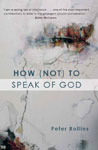
“How Not to Speak of God”
by Peter Rollins / Published by Paraclete Press (book page here)
Author Pete Rollins: Peter Rollins has a B.A. in Scholastic philosophy, an M.A. in political theory and criticism, and a Ph.D. in postmodern theory. He is the founder of the Ikon community in Northern Ireland (a group which describes itself as iconic, apocalyptic, heretical, emerging and failing) and a working philosopher who has come to believe that the emerging church presents a singular, unprecedented opportunity to transform the theological and moral architecture of the Christian community [link].
Author page here (includes interview and US speaking tour dates) / Pete’s blog here
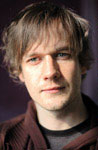 I was given a chance to read Pete’s book a few months ago, and I think it is one of the best books about the church emerging to come out recently. As it says on the back, Pete’s book explores the philosophical and theological underpinnings of the emerging church movement. I think if anyone asks me what “I” think (I use the quotes because what “I” think Emergent is about may be vastly different than what “you” think it’s about) Emergent is about. One of the things I like best about this is that it speaks directly from Pete’s experience – coming from someone who has been involved in things from IKON to YWAM, and from backgrounds as diverse as the Pentecostal tradition and a strong penchant for the writings and theology of the Christian mystics. After I had spent an entire semester studying the theology of Pseudo-Dionysius [paper here], it was exciting to see someone incorporating some of his theology in ways that I had been thinking about during the course.
The book is a wonderful balance between theology and philosophy and praxis. After developing what I believe to be some good philosophical & theologial foundations to Emergent, Pete shares how Ikon has incorporated these foundational concepts into their community life. Pete also has an incredible way with language, and you will be drawn into his world of language from the very beginning. I commend this book to anyone who is interesting in learning more about Emergent or the church emerging.
Below, I want to highlight a few concepts and quotes I particularly enjoyed from Pete’s book:
- Transcending the Binary
- “The reversal from ‘right belief’ to ‘believing in the right way’ is in no way a move to some binary opposite of the first…; rather it is a way of transcending the binary altogether. Thus orthodoxy is no longer (mis)understood as the opposite of heresy but rather is understood as a term that signals a way of being in the world rather than a means of believing things about the world” (3).
- Being & Becoming
- Pete emphasizes the need to reclaim the idea that we are constantly in a process of being saved, becoming Christian and becoming Church – but he does so in such a deeper way than simply saying “It’s not about the destination – it’s about the journey…”
- Evangelism + Answers
- “In contrast to the view that evangelism is that which gives an answer for those who are asking, we must have faith to believe that those who seek will find for themselves. If this is true, then the job of the Church is not to provide an answer – for the answer is not a phrase or doctrine – but rather to help encourage the religous question to arise. In contrast to the type of sermon that aims to answer thought by providing a clear explanation of a passage or area of Christian life, the emerging community is in a unique place to embrace a type of communication that opens up thought by asking questions and celebrating complexity” (40-41).
- Seeking
- One of the most interesting sections in this book was the chapter entitled “Inhabiting the God-shaped hole” in which Pete writes the following: “Rather than desire being fulfilled in the presence of God, religious desire is born there. In short, a true spiritual seeking can be understood as the sign that one already has that which one seeks, or rather, that one is already grasped by that which one seeks to grasp. Consequently a genuine seeking after God is evidence of having found” (50). I think this is a refreshing understanding to the concept of “seekers.” Seekers are not the ones we should be trying to get to come to our churches so that we can “save” them – but rather, we are all called to be seekers. And perhaps, there are many seekers “out there” [i.e. not in the church] who are experiencing more of the Divine that many of us…?
- Believing in the Right Way
- Pete writes about the definition of orthodoxy traditionally meaning “right belief.” But he encourages us to look at an alternative definition by thinking more in Hebrew-terms (more holistically) than in the way of the Greeks: “In order to discover this alternative reading, we must break down the word ‘orthodoxy’ into its Greek roots, ortho (right) and doxa
(belief), and read them as if one were reading Hebrew – that is, from right to left. Thus ‘right belief’ becomes ‘believing in the right way’. Thus we break down the binary opposition between orthodoxy and heresy by understanding the term ‘orthodox’ as referring to someone who engages with the world in the right way – that is, in the way of love.”
- Pete writes about the definition of orthodoxy traditionally meaning “right belief.” But he encourages us to look at an alternative definition by thinking more in Hebrew-terms (more holistically) than in the way of the Greeks: “In order to discover this alternative reading, we must break down the word ‘orthodoxy’ into its Greek roots, ortho (right) and doxa
- Queer
- The second half of the book is filled with examples of the way in which IKON has embodied much of the thoughts & theologies you’ll find in Pete’s book. One of my favorite services was one about sexual orientation called “Queer.” Pete admits that IKON (much like Emergent) has no substantial doctrinal center, so there are people who have very different perspectives on the issue of sexual orientation. But during this service they listened to people’s stories, including an ironic story written by Jon Hatch about a young man who ‘comes out’ to his parents as a heterosexual (a great story!). The service ends with the following liturgy, written by Padraig Twomey:
In the Way Things Have Been
We have said:
we are gay
we are straight
we are queer
we are not
we are men
we are women
we have divided our Body into Us and Them.
We have believed lies
we have told lies.
And the Way Things Could Be:
Our God calls us to believe that
all men, all women, are human
equal in the sight of eternity.
We share the same breath
we inhabit our bodies
we are all fed by blood
and love
and food
and water.
We celebrate and mourn
we rejoice and we grieve.
We Search for a New Way of Being
We have been created with dignity
we have been created in love.
We respond to the call to return to who we truly are
who we were meant to be
in Community, in Diversity, in Conversation, in Love.
We are the Body of Christ.
The Body of Christ is queer,
is man, is woman,
is straight.
The Body of Christ is the people of God,
gathered here, and carried in our hearts.
This is the body we have, this is our body.