Sexual Revelation

Date April 27, 2006

Bodyflesh_small
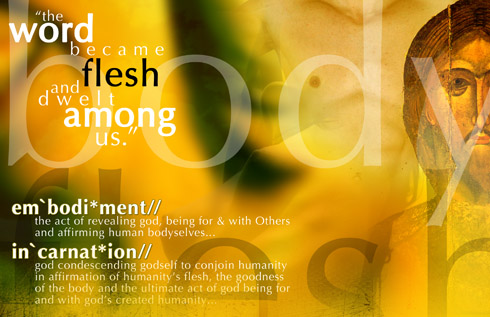
[Full resolution of the graphic can be downloaded here]

I’m sure this paper is a work in progress, but it was interesting to think about the doctrines of revelation and the incarnation, and how James Nelson’s "body theology" played into that, and what all of it might say for sexual ethics. At any rate, it’s done: Sexual Revelation: Body Theology in Conversation with H. Richard Niebuhr and Implications for Sexual Ethics. Download here.

The graphic is a piece of art I’m turning in with the paper. Also, a work in progress. I’d be interested to hear thoughts on either the art or the paper.


14 Responses to “Sexual Revelation”

  1. - kp - said:

    Nelson believes that when we speak of God revealing Godself, that action is not limited solely to Christ. As being God-bearers, just as Christ, humanity has the christic reality within them, and thus, are sharing and revealing God with the Others they encounter throughout their lives. Nelson is not satisfied to simply say that Christ‚Äôs incarnation is the once-for-all unrepeatable event, because that separates that reality too much from humanity….

    …The paradox is that God‚Äôs incarnation in Jesus is sufficient only if it nourishes repetition.

    First of all, to say that “humanity has the christic reality within them” does two things that are bad: 1) it seems not to acknowledge that which the tradition has called sin, and 2) it seems very Gnostic — i.e., that we all have a ’spark’ of the divine that needs to be liberated (though it is clear that Nelson is no Gnostic!).

    Most importantly, if the incarnation is not the unique event in time and space of God’s self-revelation, why pray to Jesus? He was just another dude, albeit a really cool, especially holy, and venerably spiritual dude.

    The Word became flesh. And the Word continues to become flesh.

    Seems to me that Nelson has confused Incarnation with Pentecost. It is the Spirit which proceeds from the Father through the Son that continues to breathe new life into the new community. But that isn’t the same as “repeated incarnation.” It is a result of the incarnation.

  2. - kp - said:

    And you end your paper with an extended quotation of the highly erotic love poetry found in the Song of Songs. By this, I don’t imagine you intend somehow to “leave it at that”, do you?

    It seems highly unlikely that whoever included the Song of Songs in the OT canon meant simply to canonize lusty sex. While it is of course true that the words there found do extol lusty sex, it isn’t lusty sex between two ‘randoms.’ It’s lusty sex between Israel and her Lord, YHWH. The placement of this text in Israel’s scriptures and in the context of the Israelite figure “Solomon” indicate that whoever made it part of the Jewish Bible understood it as erotic poetry about the salvific relationship between YHWH and Israel — or, in salvation-history terms, the exodus. All of that said, to read the Song of Songs as mere sexy poetry is not to read the biblical Song of Songs at all — that is only to read some interesting ancient Near Eastern poetry. But to read the Song of Songs as it appears in the Bible is to read about a story of desire — of desire of the Lord for his people Israel and the desire of those people for Him.

  3. glenn said:

    I like the art. You have a knack for creative expression through PhotoShop.

    I especially like how the definitions are laid out . . . . Cool stuff.

  4. tim said:

    i can’t believe you did it.

  5. Justin Farrell said:

    “While it is of course true that the words there found do extol lusty sex, it isn’t lusty sex between two ‘randoms.’ It’s lusty sex between Israel and her Lord, YHWH.” -KP (post above)

    Kellen, reducing the Song of Songs to be understood as simply an allegory between YHWH and Isreal seemingly ignores the foundation of this text as Hebrew wisdom literature. I would argue that associating this book with the Israelite figure “Solomon” begs this scripture to be read as wisdom literature. Simply placing this text into a category of ‚Äòreligious-salvific‚Äô terms unjustly allegorizes the text into a false dichotemy. Your post above assumes a dichotemy between the secular “lusty sex” and the spiritual “salvific relationship between YHWH and Israel.” We must remember that to be wisdom literatures requires one to value the quest for understanding the human experience without playing upon any type of dualistic dichotomy.

    Song of Songs, then, ultimately begs the reader to recognize love as an inexstinguishable force within the human experience. Human experience is at the core of the wisdom literature, and should not be disregarded because of the attraction (as in many cases) to allegorize this into some story into a “salvific relationship between YHWH and Israel.” It seems that it is ultimately a poem about the love between a man and a woman, in the context of exploring the human experience. I believe that tagging this as allegory removes the erotic value of the human experience that is so rich within this canonized text.

  6. Adam said:

    Justin, thanks. I was waiting for someone else to say what needed to be said. Kellen, I grew up hearing over and over again how the Song of Songs was a nice allegory about the relationship between YHWH and Israel, and thus, also about our own personal relationship with God. I think it’s good to be aware of that, and to recognize that there are some metaphorical parallels to be drawn, but I’m with Justin.

    For too long this has been only about YHWH and Israel - when clearly it is about a human relationship, and exploring the erotic and sexual love found between two people. The fact that this remains in the canonical text says a lot about the place of sexuality and love (I’m not sure where you got the phrase “lusty sex” - I certainly didn’t use that) within the Christian tradition and life.

    To say that it’s solely about YHWH and Israel is to do just what the majority of this paper is arguing against - to continue the Christian ideal that sex is not something in the Bible, is not something to be talked about, etc., etc.

  7. - kp - said:

    Justin,

    Kellen, reducing the Song of Songs to be understood as simply an allegory between YHWH and Isreal seemingly ignores the foundation of this text as Hebrew wisdom literature.

    To the contrary, reading the Song as an allegory between YHWH and Israel does not ignore the foudnation of this text as Hebrew wisdom literature — it assumes it! Please allow me to quote at length the one upon whose shoulders I unabashedly stand.

    ***

    “It is one thing to exegete a narrative text allegorically, and a different thing to make the genre judgment that a text presented for interpretation is itself an allegory; that is, that its plain sense is precisely its solicitation of realities other than those it overtly mentions — and there are of course many such texts. When the ancient rabbis judged that the Song speaks overtly about two human lovers in order to tell the mutual passion of the Lord and Israel, and when the church’s exegetes made the parallel decision, this judgment was not itself allegorical exegesis, in either the current or the more precise use of the term. If the rabbis and the Fathers were right in their judgment about genre, then construing theological allegory for the Song’s overtly secular poems is in fact plain-sense reading, and is an allegorizing reading just in the sense that allegory is the sort of interpretation which the text invites the interpreter to employ. In the church’s traditional exegesis of the Song, more narrowly named allegorical exegesis then occurred as a second step: when the church read the theological story about the Lord and Israel as a story about Christ and the church….

    …Perhaps the poems [that make up the Song] were originally written about the Lord and Israel. Or perhaps they became poems about the Lord and Israel when they were taken into the canon. Or perhaps they came by some now unknowable other route into some precanonical collection and were later made to be poems about the Lord and Israel in order to justify their place in a canon; for exegetical purposes, this possibility anyway collapses into the second. In whichever of these ways, the canonical entity is about the love of Israel and the Lord, and to read it by construing theological allegory is to read what we may call its canonical plain sense.

    ***

    Thus Robert Jenson’s reading of the Song, which I (obviously) affirm. That reading, of course, makes statements like “For too long this has been only about YHWH and Israel….” utter nonsense. These poems are part of the Hebrew canon of Scripture and as such are precisely about Israel and her Lord. That, of course, does not mean that we as Christians or Jews should not talk about our bodies ethically, responsibly, or that for some reason we should disdain erotic sex between lovers. It does mean that we should talk about those things in and only in the context of a certain, particular, and historical relationship between Creator and created, and that is precisely what Jenson does.

    But to argue that the Song of Songs is generically about sex, without regard to the particular history of Israel, is itself a modern allegory.

    And Adam,

    I used the term “lusty sex” because the Song is about lusty sex — eros as opposed to agape. To quote Jenson again, “The poems…are erotic love poetry. If they are about the Lord and his people, it is the erotic love between the Lord and his people that we have to expound, not, for example, the disembodying of the soul in prayer or the proper care of talmudic students — neither of which examples is made up.”

    And just to be clear, none of what I have written means that “sex is not something in the Bible, is not something to be talked about.” That is a myth that should be opposed. And I think you’re right to oppose it.

  8. tim said:

    I came across this quote in a letter from Dietrich Bonhoeffer today. Not that it settles anything, but its interesting…

    “While you’re in Italy I shall write to you about the Song of Songs. I must say I should prefer to read it as an ordinary love song, and that is probably the best ‘Christological’ exposition.”

    Letters and Papers, June 1944

  9. - kp - said:

    I dig.

  10. Justin Farrell said:

    Well put.

  11. Dan said:

    Both are right. A Bible passage can have multiple truths and meanings. That’s what makes it so supernatural.

  12. - kp - said:

    To see more of where I’m coming from, those interested in this thread might wish to read a paper I just wrote on Jenson’s interpretation of the Old Testament, which I think neither does away with Israel nor the fact that sex is “in the Bible.” Click here to read my attempt at a summary and commendation of Jenson’s method.

  13. Katie said:

    Thanks for sharing your paper with all of us, it has definitely made me think more deeply about some questions I already had. I was going to leave a long, thoughtful comment, but I think I’ll save my ramblings from my own blog.

    Perhaps just one thought: Having been taught to place an ultimate value on virginity and “saving myself for marriage” it has proven quite difficult to reorient my values and realize that there are more important things in life than sexual chastity.

  14. Richard said:

    Adam,

    A very helpful and interesting read. As a 45 year old male from a conservative upbringing I find Marie Fortune’s ethical system challenging, yet interesting on a number of levels. My own sons are teenagers living in culture which treats sex as a normal past-time like tennis or stamp collecting only a little more private. But not much. The ethical guidelines of my generation are based on a particular interpretation of Biblical standards and the general authority and of the Bible, even among folks who have no real belief in the good book. I often wonder if there isn’t a better source for making ethical decisions and have looked to reason as the primary alternative to authority. This is of course the only alternative, except that the idea of God revealing himself continually through humans might support the idea of ethics by consensus. One interesting theory you may want to bring into this discussion is Attachment Theory which says there are biological mechanisms related to sexual intercourse that attach a couple for a period of something like three years. The idea is that such attachment provides survival advantage to females by insuring that the male sticks around long enough to see the infant into toddlerhood. If this theory is correct, and there is some evidence behind it, then this three year biological window allows a couple to find other areas of attachment besides sexual attractions. Which is a whole other discussion.

Trackbacks...

Leave a Reply

XHTML: You can use these tags: <a href="" title=""> <abbr title=""> <acronym title=""> <b> <blockquote cite=""> <cite> <code> <del datetime=""> <em> <i> <q cite=""> <strike> <strong>