Communal(?) alt.worship
April 4, 2006
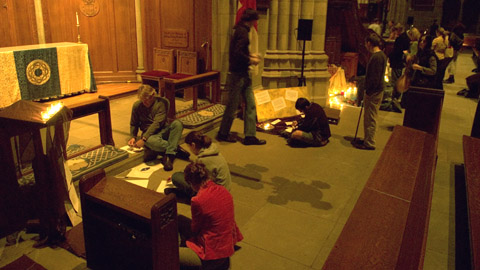
Through my field ed., I had the chance to offer .bE at the Princeton University Chapel last week. If you want to see some photos, check out the alt.worship photo album here. A friend has blogged about it here, and posed some good questions. One of his questions about the worship experience concerned the apparent individualisitic-nature of it. Another good friend of mine who has been involved with .bE since it’s beginning and his thought after this past .bE was that it was very focused on the individual.
It’s interesting - I’ve always thought that .bE was the perfect mix of both communal worship & a time of individual reflection. That’s always been the hope of the prayer stations and giving that space and time for reflection and contemplation. The beginning of the service has always had time of group prayer, worship through song and lectio divina. But when you think about it, the lectio divina is a very personal thing (unless you do it in such a way that you interact and share with a group), the Ignation prayer is very individual and the other times of prayer are very individual. The only thing we really do together is sing communally, but…
So in a sense, the entire service is very individualistic. And that is just what I was trying to fight against in creating this type of worship gathering.
I’m wondering if this is the experience of other people in alt.worship. How can we make alt.worship a truly communal worship experience?
Posted in


Adam Walker Cleaveland:


April 4th, 2006 at 10:49 pm
Adam, looks great. I think worship installations are much needed for personal reflection. It is i ndividual but at the same time everyone is together exeriencing God. It’s a both/and experiential time. We can’t become so focused on corporate worship to the detriment of our individual selves that God created uniquely and different. Just some thoughts.
April 4th, 2006 at 11:34 pm
I have thought about this very things many times. But then I was sitting in a church service once and began realizing that is also is an extremely individualistic expereince as well. You sit in rows not facing each other, but looking at the back of heads and someone up front speaking. You sit there passively and listen. Talking to the person next to you is not really etiquette during a sermon, so you need to remain on your own sitting and listening. When you sing, you are in a corporate experience doing the same thing together - but aren’t you doing that also when people are going through prayer stations? You still aren’t interacting and talking.
Every time i visit a church now, this whole thing pops in my head. How once it “starts” it pretty much is an individualistic experience like watching a movie or a sports game.
Just some thoughts……
April 4th, 2006 at 11:36 pm
I suppose that my question for you is what do you consider “worship” to be, and what is the purpose and goal of worship? This not only affects the nature of what .bE is, but also the sorts of questions or critiques that can be brought to any discussion of it.
Perhaps it is impossible to change the individual nature of .bE, but that isn’t necessarily a problem if it turns out that .bE is something different that a “worship service.”
Fundamental to this discussion is understanding what worship is. With a distinct theology of worship set in place, then we can be better equipped to think about how we create worship spaces and experiences that fully express that theology.
April 5th, 2006 at 7:17 am
I think it is partially about holding in tension the need for individual connection to God versus communal worship. That is where I think corporate liturgy is helpful in that it has a community doing the same act of faith together. What I have also done in one of our services is to structure the “sermon/lectio” as a conversation between folks in the community. Howard Thurman said that church should ultimately be where people come to share their individual expressions of God and test them against one another. I wonder if there doesn’t need to be a time for conversation following the station time where folks share what they have experienced that is understood as worship?
You are asking great questions. Thanks!
April 5th, 2006 at 7:18 am
It’s individualistic and yet everyone is together and engaging in spiritual practices together. So it is very communal. It reminds me of the time Rodger Nishioka offered a simmilar type of thing in a Youth Ministry class using different spiritual practices/stations offered in “God-bearing Life.”
.be is a cool way to create worship space and a nice and important alternative. Not something that could be sustained every week in a congregation neccessarily because you’re extroverts may go crazy :-) but it is good to every once and a while try something different and just be still and know God is God.
On a slightly seperate note, I love how we can experiment and do really cool and different things with worship space and worship in seminary chapel. The challenge, I am finding now, though is how to best incorporate some of those things we do in seminary chapel worship into the traditional worship of a 20-50 year old congregation.
Any thoughts?
April 5th, 2006 at 9:48 am
My thoughts follow along with Melissa, above. I don’t want to deny the multiple aspects (or even goals/purposes) that come together when we come together as fellow believers in Christ: reflection and contemplation, experiencing God, sitting and listening to the Word proclaimed, sharing individual expressions of God and testing them against one another, engaging in spiritual practices together, etc.
The whole topic is amazingly varied, so indeed, it seems good to me that there be amazingly varied modes of worship. Yet, we call it “worship” for a reason. I sense in my own occupation with ordering worship, stressing over worship, speculating about worship, etc. a danger toward pre-occupation with the human side of the equation.
Is it about my experience of God?
Is it about my expression of that experience to my fellow worshipers?
Is it about my uniqueness (or, perhaps Christ’s uniqueness and our lack thereof as creatures and sinners)?
Is the worship service itself the place for talking to someone about what I think regarding the Word proclaimed, or can that wait until later?
I applaud varied proportions between individual and corporate elements in worship, but (whether reflective or expressive) what is the primary aim of any of these elements?
{Aside: At this point I find myself wanting to read a contribution from someone who has thought out the tension between individual expression and corporate worship; how the two interact to the end of praise and worship to God. I’m thinking particularly about liturgical dance (Imani Jones), because that is an expression that I think has gone through challenges in finding a rightful place in more traditional worship circles. I also remember John Bell providing some insight regarding the relationship between the choir (read “worship band”?) and the congregation in worship leadership. But perhaps this tension is old school…}
April 5th, 2006 at 11:39 am
Right, Hoover: The real question *is* how does any of our worship–individual or corporate–function toward the end of glorifying God. Our experience of it–whether in the quiet of our minds or the shared expressions of members of the community–isn’t the only, or even the primary consideration.
Obviously, however, it is important. What occurs to me is that there may some difference in understanding what makes something truly communal. Dan above suggests that “traditional” worship is not really communal because it involves listening, or singing on the same page, rather than interacting and talking. In my view, communion (and this is the word, right?) is much more *about* listening than about talking. I think it is a very Western, very modern idea that our ability to express ourselves to one another is what makes something communal. In fact, could it not be that such an expectation is in fact the most individualistic possible way of thinking about worship?
On a side note, I greatly appreciate the tone and content of the discussion in this thread.
April 5th, 2006 at 8:01 pm
>>”Fundamental to this discussion is understanding what worship is. With a distinct theology of worship set in place, then we can be better equipped to think about how we create worship spaces and experiences that fully express that theology.”
April 5th, 2006 at 8:02 pm
“alwasy” should be “always.” “faith” should be “grace.”
April 6th, 2006 at 4:12 pm
Adam-
Thanks for putting it on. I enjoyed it and it helped to get my own thought wheels turning about what worship is and is not.
April 6th, 2006 at 5:33 pm
Adam,
After leaving the service, Liam and I had the same impression as your friend- that the service was very focused on the individual. Like many others who have posted, I’m not sure that’s not needed today as much as ever, but I think your mentality of making the communal portion and the individual portion both intential could be more pronounced.
For instance, perhaps we could have been closer together on the ground or perhaps praying with icons is better done in the individual prayer stations? I think your commitment to pushing the envelope of worship is so compelling and yet enhances how profound even small logistical challenges or topical choices affect the experience.
Overall, I think the prayer stations were beautifully done with the intention of individual communion with God, and I’d love the first portion of the service to resonate with such intentional community solidarity (with one another and with God).
And as always, I thank you for your progressive, intentional voice in these services and on campus!
April 7th, 2006 at 12:35 am
Adam it looks like it was a kick-a service.
The communal/individual thing is really interesting, and I think it’s experienced differently by everyone - some experience this worship as though they are individual participants in a community (ie Andy), others don’t.
Adam, if you’re interested in resources, check this out (if you haven’t already): http://www.zeta.org.au/~lorien/prodigal/default.html. Mark Pierson is now at Urban Seed in Oz, and he and Marcus Curnow have blogs over at http://www.urbanseed.org where they document some of their worship stuff. It’s well worth a look (they’re mates of mine so I’m biased!)
I’ve found taize to be a very helpful way of facilitating communal meditative spaces, and we’ve also experimented with various forms of drama - that doesn’t have to be loud and raucous (though it often is!) - you can try mime. It’s a bit more confronting for those who aren’t used to it, but by breaking people up into small groups and giving them private spaces to go off into, you’d be surprised by how people come out of their shells!