MLK Day: but what about Malcolm X?

by Adam Walker Cleaveland on January 16, 2006 · 7 comments

in Theology

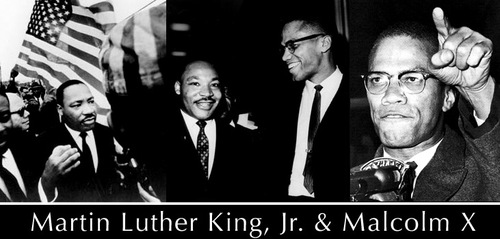
Martinandx

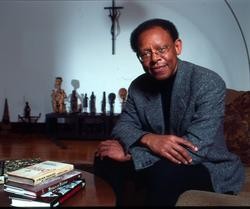
Faculty_cone_1
Today a group of us went to hear Dr. James Cone, systematic theology professor at Union Theological Seminary, preach at Elmwood United Presbyterian Church. Many of us were wondering what Cone was going to preach on, considering that he had just written a book entitled Martin & Malcom & America: A Dream or a Nightmare? But first, the service was absolutely incredible. They had a mass choir of about 4-5 churches who had combined, and it was so powerful. It’s been awhile since I’ve heard good black gospel music, and it was such a great experience to be able to worship with that tradition this morning. It was a welcome, and much-needed change, from my regular Sunday morning experience.

I don’t know if anyone has been able to hear Dr. Cone speak before, but it was also amazing. He spoke for about an hour or so, but it really didn’t feel like it. And he did basically summarize and go through his argument in his book on Martin King and Malcolm X. He began by reading us quotes from both Martin King and Malcolm that sounded very similar and then shared with us all the various ways that Martin King has been honored, commemorated and almost given ’sainthood’ by Christians and the American government as a whole with the National Holiday to celebrate King’s birth. And yet, what has there been done to do the same for Malcolm X? Other than Spike Lee’s movie which help bring knowledge of Malcolm X to the general public…not a whole lot.

Cone’s thesis is that we need to look to both Martin King and Malcolm X
in order to seek a peace that will bring about freedom. He believes that both were working toward the same goal: freedom; it is just that both had different paths which they were following. Holding either one alone is not of a full enough vision of the pursuit of freedom - we need both King & Malcolm X. Both were striving toward freedom, and working for the respect, dignity and humanity of the black person. However, each was sensitive to their geographical area and because of that, had to response differently. Cone believes that while King’s nonviolent approach related well to his Christian faith, it was also one of the only routes possible for King. If blacks had responded with violence in the south, the whites were only too ready for that, and it would have been a bloodbath. However, they were not prepared for, nor did they really understand how to handle King’s nonviolent approach.

What Martin Luther did for the poor black Christians in the south, Malcolm X was doing for the ghetto blacks in the north, by affirming their blackness. Malcolm X arose out of the pits of the violence and drug culture of the black ghettos and was a "Daniel" to them - he spoke with a strong, powerful and courageous rhetoric and inspired the blacks of Harlem to walk with a dignity that they too were created with a humanity and to be willing to fight for that right to humanity. He believed that the worst crime that Americans committed against the blacks in the ghetto was to teach them to hate themselves. So, because of this, Malcolm found his power not in the nonviolent roots of the Christian faith, but rather in Islam and the power of affirming the blackness and African-ness of blacks in the north. King looked to being a good American while Malcolm X attempted to help blacks experience their true blackness and not forgot or try to cut ties to their heritage, history and past with Africa.

What was interesting about Cone’s passionate analysis was that he said for blacks in the ghettos in the north, it may have been even worse than for the blacks in the south. Blacks in the north, instead of having to deal with white bigots, had to deal with white liberals, who although they supported the civil rights movement and hoped for equal rights for blacks, they had essentially created the ghettos which were the problem in the north. So, according to Cone, the hypocritic white liberals in the north were just as bad, if not more so, than the white bigots (especially the white Christians) in the south.

There needs to be, according to Cone, a balance of understanding the issues when it comes to Martin King and Malcolm X. They represent the yin and the yang for the soul of the black person in American today, Cone said. He believes that until whites restore the full dignity of Malcolm X, we will know that we will never have true freedom for all people. Cone wrapped up with a quote from Malcolm X: "While Dr. King was having a dream, the rest of us negroes were having a nightmare."

There certainly is a huge lack of education about Malcolm X in our public schools - I learned a lot today about Malcolm X. Of course, we all hear about Martin Luther King, Jr from day one.

All in all, it was definitely worth the hour-long trip up to East Orange, NJ. Cone was amazing, the music was off-the-chain, and it was just a really great experience.

Does anyone have any thoughts about Martin Luther and Malcolm X? Why DON’T we honor Malcolm X?

Technorati Tags: , , , , ,

{ 7 comments… read them below or add one }

aaron 01.16.06 at 6:54 pm

i had two thoughts on why we don’t honor malcom x. the first being that of the legacy that he left. the people today that are outspoken in their honor of malcom x are not the greatest people to carry on his legacy… we’ve got jesse jackson and louis farrakahn. not the two guys i would want to honor my legacy after i’m dead and gone.

the second is more about our culture. with america being called a “melting pot” of culture, the idea is that you come into our society and you melt in with everyone else. you bring your own culture, etc…and then you lose it and gain other people’s culture. you melt into society. however what malcom x was touting was a pride in blackness. i don’t think that gelled with where we were and are as a society. we expect people to become americanized, not to remain separate but rather to melt into and contribute their heritage/culture to our society.

John 01.16.06 at 7:43 pm

New Orleans Mayor Says God Mad at U.S.

Mayor Ray Nagin suggested Monday that Hurricanes Katrina and Rita and other storms were a sign that “God is mad at America” and at black communities, too, for tearing themselves apart with violence and political infighting.

http://news.yahoo.com/s/ap/20060116/ap_on_re_us/katrina_nagin

You thought Pat Robertson was such an ass for saying it. Now it’s crickets chirping I bet.

Rich 01.16.06 at 9:23 pm

It’s funny you ask why and also tag this ‘nonviolent resistance’. How much have you read about Malcolm X and the Nation of Islam of that time? “By Any Means Neccesary” was their creed and they did carry out many violent acts. That is why we do not honor X in the same way as MLK. That is his legacy in spite of reforming near the end of his life. He fought hate with hate, much like Farakahn does now.

I need to send my wife over to comment. Being black all of her life, she could probably speak to this better than both of us. She aligns with MLK being a Christian and one who abhors violence. Malcolm did not and does not speak for or many blacks today.

I would encourage you to move past what you heard for one hour today and really look into who he was. And no, don’t use the movie for that purpose. :)

myles 01.16.06 at 10:44 pm

rich,

part of adam’s point over the rejection of Malcolm is precisely because of what you bring up: his use of “any means necessary” as his mantra. however, as Cone points out, towards the end of their respective lives, King and X were moving closer together in their approaches. By the end, X had cut ties with the Nation and was advocating a more ‘ecumenical’ approach, in terms of looking towards non-violent solutions to the problem.

meanwhile, towards the end of his life, King was becoming more radical in his rhetoric. Cone’s work, i think, shows that in time, the two may have approached each other more than they did in their lifetimes. So, as to why we don’t honor X and cannonize King? the collection of a man’s life most of the time stands for him, not the direction he was heading.

Aaron, you misunderstand the bastardized legacy of both Jackson and Farrakhan. Jackson was a pretender to the King throne; read Timmerman’s book for the nitty details. While King’s approach was theologically mediated, Jackson’s has been pragmatic, corrupt, and largely rhetorical. Similarly, Farrakhan represents the very life X was leaving behind at the end of his life, and thus, cannot be legitimately called any heir to what X was. Your views on X are largely ignorant of the facts. While no saint, he’s more complicated than simply calling him the forefather of Farrakhan and Jackson.

Rich 01.17.06 at 12:05 am

Myles,

I won’t disagree with anything you said. If we want to ask why, I think the reason I gave pretty much goes hand in hand with yours. We simply said it a bit differently. It may not be fair that he is remembered for the collection of his life, but that is indeed the reason why he is not cannon as MLK now is. I will grant the ‘more radical’ King towards the end of his life, but be careful. It wasn’t a diluted version of Malcolms early radicalism. King never to my knowledge advocated violence. I don’t think you are saying that, but we should be careful in how we state that.

In the early 90’s while I was a student at the University of Tennessee I saw a 2 man play that imagined a meeting of King and X in a hotel room to discuss the direction of the civil rights movement. It was facinating and very thought provoking.

rndaniel 01.17.06 at 6:05 am

It’s a little misleading to say that King and X were moving closer in their approaches to the problem of racism. It is certainly true that King began to become more despondent and cynical about the potential victory of the movement, but this was the result of seeing how nonviolent resistance was futile outside of the South. This became especially apparent after the riots in Detroit and King’s trip to Chicago in the late 1960s. To say that King’s rhetoric was becoming more radical is true, but that doesn’t necessarily mean he was becoming violent. Until the end, King advocated a method of nonviolent resistance. His rhetoric was considered radical because he became more and more vocal about issues that were seemingly outside of the area where he had focused his efforts during the early parts of his leadership (i.e., his anti-Vietnam sermon preached at Riverside Church).

Malcolm X, on the other hand, was not necessarily moving toward a position of nonviolent resistance. After the bombing of his house that could have easily killed his wife or children, he began to question whether or not rhetoric that would inflame violence was the most appropriate way to approach the problem of racism. Nevertheless, he didn’t become nonviolent. He simply acknowledged, as did King, that different places required different approaches.

In any event, the changes that happened in each man’s life were less about them “moving closer together in their approaches” than they were about each of them acknowledging certain inadequacies in their methodologies.

aaron 01.17.06 at 11:38 am

myles,
i may not have been clear… i would never suggest that x was the forefather of jackson and farrakhan. that’s like saying jesus was the forefather of muhammad. i think those two clowns have taken what x started with and twisted it to fit their own personal agendas in whatever ways they possibly could. but they have carried the torch for x whether or not he ever intended for them too and they have largely created a misconception and a poor impression of x because of this.

Leave a Comment

You can use these HTML tags and attributes: <a href="" title=""> <abbr title=""> <acronym title=""> <b> <blockquote cite=""> <cite> <code> <del datetime=""> <em> <i> <q cite=""> <strike> <strong>