
I’ve debated about posting this, because I have not been sure what it is exactly that I want to say, but it’s been something that’s been on my mind, and on the minds of others in our group.
One thing that has continually shocked me is the outright animosity towards Muslims that comes from the Palestinian Christians (Catholic and Greek Orthodox) I have met and spent time with. One of the things that I really wanted to focus on this summer was the idea of interfaith dialogue, and unfortunately, as I am coming to find out, this is apparently not something held up as a very high priority in this area. When I met with the person who has represented the Presbyterian Church (USA) in the Middle East for the past 10 years, and asked him, “So, who is doing interfaith dialogue work in this area, with Christians and Muslims…?†it took him a long time to think about it and then his response was basically, “Well, I guess that’s part of the problem – no one really is.â€
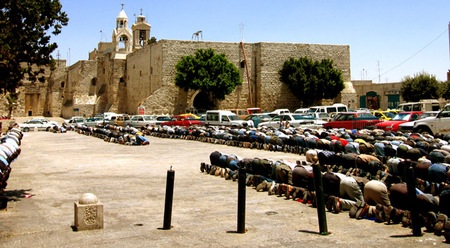
It’s been interesting to live in an area (Jerusalem-Bethlehem) that is so incredibly important to the three largest monotheistic religions in the world. It was an incredibly surreal experience to be walking along the Via Dolorosa, the path that Jesus walked during his passion, being led by a group of Franciscan monks, as we passed by Jewish people, the whole time hearing the Muslim Call to Prayer in the background. What does it mean to live in such a society? The picture above was taken from Manger Square in Bethlehem and you see the square filled with Muslims during the noon Call to Prayer, and the Church of the Nativity is in the background, which is where I went to a Greek Orthodox and a Catholic service last Sunday, before heading to Jerusalem. What does it mean to be Christian, Muslim or Jewish in such a pluralistic geographical area?
I don’t know.
I love the young group of Palestinian Christians who I have been able to hang around with, in Bethlehem and Beit Sahour. However, I don’t know how to handle the continual slurs toward Muslims, references to violence and “If my sister ever tried to marry a Muslim, I’d….â€-kind of statements. This is always done with a very light-hearted attitude, and so there is a chance that I am just not picking up on some socially-acceptable behavior that occurs in the Arab-world. But, I have a hard time believing that most of the people who I hear mention their opinions about Muslims are not being serious when they say these things.
I’ve also found that many of the Palestinian Christians hold very similar viewpoints about Islam that Conservative Evangelical Christians in the United States hold. I’ve heard people make rash generalizations about Muslims (“they don’t want peace, only us Christians want peace…â€), broad statements about the religion of Islam (“it’s not a peaceful religion, it is filled with violent teachings…they are taught to be violent, especially toward Christians…â€) and generally negative attitudes toward Muslims.
I haven’t been able to meet very many Muslims yet, so I don’t know if these attitudes go both ways or not.
Yet at the same time, our group met with a group of young Palestinians (Christians and Muslims) the other night at the Rapprochement Center, and they were asked pretty candidly about this topic, and they admitted that these feelings do exist, but they do have hope for a more unified Palestinian people in the future.
I just don’t know how to deal with all of this. Interfaith dialogue is something I’m interested in, and I don’t know what to do with that here in the Bethlehem area, where it is just non-existent (or it appears that way – does anyone know of anyone doing anything?).
The only last thing I’d like to say about this, is that the young people talked about Israel’s role in the division that exists among Palestinians. One of the techniques that they said Israel uses against Palestine is the “divide and conquer†technique. So, Israel knows that these tensions exist, and many believe that the government uses them to their advantages. On Palestinian ID cards, it says either “Christian†or “Muslim†on them. Many times, guards at checkpoints will let Christians pass and will not let Muslims pass. Obviously, if you are a Muslim and you see a Christian friend of yours be let through a checkpoint regularly, while you may be denied access, that is going to create some hostility. I’ve also heard that it is easier for Christians to go to Jerusalem for the holy holidays than it is for Muslims to travel to the Al-Aqsa Mosque for Ramadan.
So, tensions exist. The Israeli government uses these to its advantage. And I am left asking, “What can I do?â€