Central Jersey Emergent Cohort Recap
March 23, 2005

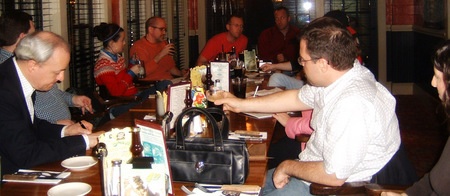
Last night we had the biggest turn-out for our cohort yet. Many of the usual people came out, including a few new faces from PTS. Princeton Theological Seminary President Iain Torrance (picture on the far left in the photo above) spent the evening with us along with some other professors from the seminary, and a visiting scholar from the University of Glasgow Divinity School, Systematic Theology professor Dr. George Newlands. I sat next to George and it was great to hear some of his perspective from the church in Scotland, in addition to the fact that he is just hilarious to listen to and has a very humble spirit.
Last night we focused on the role of the pastor: the pastor as theologian, and how, on a practical level, the pastor deals with doing ministry in an increasingly secular and pluralistic society. Conversations were good (at least at my table). One thing that we touched on for a bit, but didn’t have time to pursue, is the idea of the community/congregation as theologians. We spent a good deal of time talking about the pastor as theologian, one called to lead the people of God - but I wonder how we go about teaching our congregations to be theologians for themselves. Perhaps this is still a personal issue I need to work through, but I do not want to be a "talking head" pastor - I do not want to be viewed by people in my church (if I become a pastor) as "the man with the answers" - I don’t want people to think that Adam is the only one doing theology here. And really, everyone does theology all the time - by their simple act of living in this world as a follower of Christ and their attempting to navigate through the world and see God and learn about God through God’s creation. So I guess, instead of talking about the pastor as theologian, I’d like to hear some dialogue about the congregation as a community of theologians, as a theological community - how do we do that, and what does that look like?
Tags: Emergent, Pastor
Posted in


Adam Walker Cleaveland:


March 23rd, 2005 at 5:01 pm
Sounds like it was a good event - I’ll have to drag myself out to one some day soon…
March 24th, 2005 at 12:35 am
hmm. sometimes it’s simply hard, in the community - it’s hard to get past the word “theology” … we don’t think of ourselves as “theologians” hm. maybe because that sounds so academic/intellectual/stuffy… But what has created the architecture of what we really believe? What DO we believe -does it track with our actions, or choices?… (how about beyond an individual level - on a church level?) Our theology is underpinning architecture of our actions, it’s our REAL beliefs… is it rooted in truth? love? … hm. Well. I just deleted a bunch of things I typed, I am afraid I’ll just begin rambling - not sure where this comment is headed. so anyway, right on… sounds like it was a good night - shalom =)
March 24th, 2005 at 1:25 am
“Congregation as community of theologians”…maybe if the congregation is a bunch of seminarians! Seriously, many lay people wouldn’t ever think of themselves as theologians simply because they haven’t studied theology; however, many of us like to discuss theology! And what does that look like? Well, 1:1 sharing about our lives and particularly about how we live in relationship to God and how we live our lives in relationship to others because of our commitments to Him. How about spiritual direction groups and accountability partners where the intent is to theologize and be expectant about our call to do theology (as Adam says we do in our daily lives).
March 24th, 2005 at 12:11 pm
Maybe lay people could begin to see themselves as theologians if they were taught to read slower and be more patient with “getting the answers.” I’m all for 1:1 conversations, groups, etc., but only in the context of larger educational-liturgical progression. Christians must be taught how to read the Text with great care, without skipping to “the good parts” as we often tend to do. We must encourage faithful disciples to wade through many “fiery brooks” of uncertainty, doubt, anxiety, and patience. Only through such struggling will the sanctification of believers begin to take place.
Otherwise we’ll produce a crop of loosely scattered seeds, without roots, without a chance at surviving when tough times come.
March 24th, 2005 at 12:52 pm
what an important discussion!
I agree with Kellen, we need to teach people how to read Scripture with care, and we need to empower them to do this…too often our sermons or Sunday school classes don’t allow people to explore. perhaps a richer deeper understanding of tradition might help folks read the texts better. We can only do anything in community if we have an identity, and that identity is formed not only by experiences as in spiritual direction groups etc., but also by Scripture, and the Tradition of the Church. We teach folks to think theologically by empowering them with all three.
How do we do that? I have found it helpful in teaching adult ed this year to draw from the particular theological perspective as set out by my denomination (Christian Reformed) as a starting point for talking about theology. we started the semester by going through a five week session about Reformed identity…it was great because it allowed people to voice their theological questions, struggles, and even rejections. it laid a foundation for our approach to studying the Scriptures and now for talking about Christianity and culture…
also, we as seminarians/pastors need to think theologically if we are to ever equip and empower others to do so…hence, it’s a dynamic work in progress led by the power of the Holy Spirit. Here’s my question. Since I’m not a pastor yet, how do I develop the practice of thinking theologically and articulating those thoughts?
susan
March 24th, 2005 at 9:54 pm
as paradoxical as it sounds i think that solid pastors with solid preaching actually encourage the dynamic theology of our congregations. that is to say, i agree that it is the pastor’s role not to be a “talking head,” but it IS the pastor’s role to serve as an authoritative guide who both equips and empowers a congregation to become “everyday theologians.” in fact, as pastors, we should aspire to this. we should never be the only one who does theology in our churches. if we are doing our jobs correctly, then we are fulfilling our calling to be shepherds, not to be dictators or professors, and not to proclaim that we have the only word on theology.
March 24th, 2005 at 11:54 pm
Melissa, when I first read your comment, I thought you wrote: “it is the pastor’s role to serve as THE authoritative guide” — and I was going to have to respectfully disagree. but then I re-read it and see that you wrote “an authoritative” guide…which seems to sound better, but I still get a little antsy when we use the word authoritative about pastors. Whether or not you want it, it’s pretty true that your congregation will view you as THE authoritative source of truth for their lives - and we must fight against that stereotype with all that we can! And I think that part of that means not using the terms “authoritative guide” when referring to pastors…
You did go on to say that they should not be dictators, professors or claim to have the only word on theology…true…and I’m glad you mentioned that. I guess this is just something that I saw in a church I worked at, and I want to make sure I don’t present myself in such a way that people would even BEGIN to think this about me in my church…impossible? Maybe, but worth the try I think.
March 25th, 2005 at 12:51 am
i understand your hesitation about the word “authoritative,” but i still think that it is an important word for describing the role of the pastor. we do not go to seminary to gain secret or special knowledge. but we DO go to seminary in order to best-equip ourselves for theologically sound ministry. we go to seminary in order to prepare ourselves for service in and to the church. as pastors, we shed light on God’s Word and we help people to understand themselves in the greater story of God’s saving work in Christ. but i think that we, as pastors, have committed ourselves to lives that are more than just Christian witness - we have committed ourselves to leadership in and guidance for the church. and with that comes some responsibility to speak with authority about God. by speaking with authority, i don’t mean that we have the final word or the only word. but what i do mean is that pastoral authority, when exercised with integrity and humility, brings a word of grace and truth about our Lord Jesus Christ. pastoral authority is a comfort for those who seek to learn about God from what they would believe to be a “credible” witness. pastoral authority allows people to ask questions. pastoral authority is NOT pastoral authoritarianism. it is merely a term that signifies a vocation of leadership in the church. when that authority is abused, i agree that it is tragic. but i would hope that we, as pastors, could claim a different type of authority! i suppose that i just think that many congregants are LOOKING for pastors to speak authoritatively about God, whether or not we present ourselves that way. and we owe it to them to claim our authority for God’s work (not our own), do we not?
March 26th, 2005 at 2:38 pm
Picking up on Melissa’s post: That distinction between “authority” and “authoritative/authoritarian” seems crucial to me. Claiming authority is a an affirmation of a calling from God–any time anyone steps into a pulpit (or posts on a blog?) they are claiming some authority. “I have a right and responsibility to speak this–and it comes from God.” A pastor who doesn’t claim authority has a problem (and I’ve seen that in pastoral disciplinary cases time and again–in fact, I would say that’s THE problem pastors get into: in one way or another, they lose authority).
But a pastor being authoritarian is another matter–a manifestation of pride, thinking that their authority is purely their own.
On a less heady note: HOW COOL that the President of Princeton Seminary joined you for beers and discussion. (Although I note that in the photo, he has a pen, and not an alcoholic beverage, in his hand.)